
SCRANTON, LACKAWANNA CO. (WOLF) — State officials, educators, and literacy advocates gathered in Scranton Friday to confront what many are calling a literacy crisis across Pennsylvania, while also highlighting one local district as a model for improvement.
The Pennsylvania Literacy Coalition, alongside Teach Plus PA, released a new report showing that despite significant challenges, meaningful literacy gains are possible when schools commit to structured, evidence-based instruction.
The report, Proof Points: Lessons from School Districts Driving Literacy Growth, identifies Scranton as one of four districts statewide achieving stronger-than-expected literacy outcomes.
Across Pennsylvania, low literacy is estimated to cost the state $113 billion each year in lost productivity, reduced earnings, and increased public spending.
And the challenges start early in Lackawanna County, 66% of third graders are not reading proficiently, with that number jumping to 76% among economically disadvantaged students.
Additionally, 33% of third graders scored below basic on the PSSA.
The long-term impacts can be severe. Students who are not reading proficiently by the end of third grade are more likely to face challenges later in life, including higher rates of unemployment, incarceration, and poor health outcomes.
In Lackawanna County, the issue extends beyond K-12 education. Data shows 56% of adults cannot read proficiently, and 17% are considered functionally illiterate.
At the center of Friday’s discussion was the “science of reading.” It focuses on five key components: phonemic awareness, phonics, vocabulary, fluency, and comprehension.
Educators say each piece builds on the next.
“If you don’t have one, oftentimes you can’t move to the next,” said Suzanne Shaffer, Title I reading specialist.” If a child isn’t hearing sounds in words and identifying that words are made up of these little phonemes, they’re going to have a harder time putting them to print and reading them on paper.”
Scranton School District, which serves more than 9,000 students, has worked to implement this approach system-wide. About 80% of students in the district are economically disadvantaged.
District officials outlined several barriers, including the need for more coaching support, gaps in teacher preparation, and limited funding. Staffing shortages have also forced creative solutions, such as holding teacher training sessions after school rather than during the day.
“Funding was a big concern, and we had to reserve that funding so that we can provide that payment for teachers to attend after school,” said Ann Grebeck, supervisor of elementary. “We are short subs and we didn’t want to take teachers out of the classroom during the day. So, afterschool was definitely one of the best options and it came at a cost.”
The district has relied on Title I and Title II funding to support training and scheduling, but leaders say those resources are fragile and not guaranteed long-term.
Student needs are also becoming more complex.
“There are so many factors in a district like ours,” saif Dr. Erin Keating, superintendent. “There’s poverty. There are kids coming in with trauma. There are kids coming out of domestic violence and drug addiction. These are all impacting birth to six-year-old age range. It’s getting those kindergarten readiness skills in place to eventually be able to get quality instruction in k, one, two, and by third grade have kids really reading to learn.”
Educators emphasized that investing in teachers is key to improving outcomes.
“We know that teachers are our biggest asset, so that’s where we wanted to focus on ensuring that our teachers have that knowledge so when the students come to them if they are struggling, they not only have that resources, but they know what to do with them,” said Kimberly Tesluk, reading specialist. “Through the training we really wanted to build that common language around literacy to make sure that we are all aware and the components.”
Leaders also stressed that literacy instruction extends beyond English classrooms.
“It was very important for us to embrace that we’re all teachers of literacy regardless of if you’re math, science or social studies teachers. I think it shed light on education beyond elementary,” said Grebeck.
State Representative Bridget Kosierowski said lawmakers understand both the problem and the solution, but more support is needed at the state level.
“We know what the solutions are. We know the problems, we know solutions. We just need better funding skills so these teachers can do their jobs,” said Kosierowski.
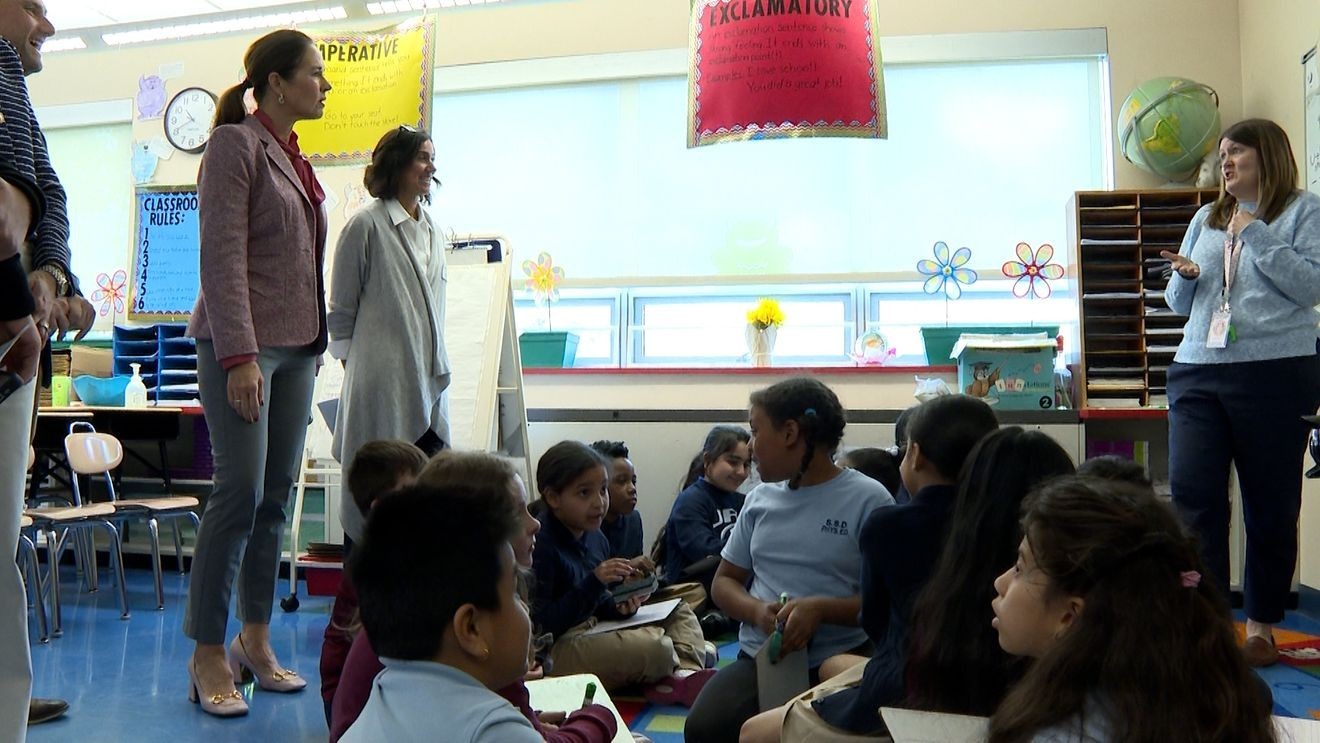
During the visit, leaders observed real classroom instruction and participated in a roundtable discussion on literacy’s impact, not just on students, but on the workforce and regional economy.
Despite the challenges, the report points to districts like Scranton as proof that progress is possible with a coordinated, system-wide approach.
And as one message repeated throughout the day made clear: if students can’t read, they can’t learn.