
Rebecca’s Take
In “Springsteen: Deliver Me From Nowhere,” Emmy winner Jeremy Allen White transforms into iconic rock star Bruce Springsteen. What starts out as a traditional musical biopic becomes an introspective study of Springsteen’s mental state during a trying period in the Boss’ personal life and career.
More subdued than exhilarating, “Springsteen: Deliver Me From Nowhere” doesn’t reach the heights of “A Complete Unknown,” last year’s electrifying musical biopic of folk legend Bob Dylan. Instead, the thought-provoking drama peels back the curtain on Springsteen’s battle with depression, showing the rock star at his most vulnerable.
The limited biopic, based on the book “Deliver Me From Nowhere” by Warren Zanes, follows Springsteen as he’s recording his revelatory 1982 album “Nebraska.” Springsteen is coming off his first hit, “Hungry Heart,” and is on the brink of superstardom. But the rock star finds himself in a period of artistic doubt. While the seeds of “Born in the U.S.A.,” one of the biggest-selling records of all time, are being planted, Springsteen is compelled to tell a different story first.
Feeling the pressure to produce a hit album, Springsteen turns to an acoustic, stripped-down sound, writing and recording dark, confessional songs in his bedroom. Looking inward, the rocker aims to come to terms with his tumultuous relationship with his father, Douglas (Stephen Graham), an abusive alcoholic with mental health struggles.
As Springsteen’s own mental health worsens, the rock star receives support from his loyal manager Jon Landau (Jeremy Strong), guitar tech Mike Batlan (Paul Walter Hauser) and love interest Faye Romano (Odessa Young).
“Springsteen: Deliver Me From Nowhere” is an exploration into melancholy. It seeks to understand its titular artist through the intimate nature of his songs. During its first act, the film follows the conventions of its genre. Springsteen performs the joyful “Born to Run,” receives congratulations on his first hit song and starts dating Faye, a down-to-earth single mother. It feels a bit aimless until the story narrows in on Springsteen’s journey writing “Nebraska.” That’s when the film finds its focus. This isn’t about Springsteen achieving career success: It’s about him experiencing a mental breakdown.
At two hours, the film’s deliberate pacing allows Springsteen’s journey to breathe. Under director/writer Scott Cooper’s grasp, the narrative structure alternates between the present time and flashbacks. The flashbacks, filmed in black and white, center on Springsteen and his father. Though the flashbacks connect to Springsteen’s songwriting, they slow down the plot, dragging down the pace. They can also be too on the nose. However, there is one flashback — which sees the past and present collide — that proves effective.
Known for his work on the highly acclaimed series “The Bear,” White lacks a physical resemblance to Springsteen, which can be disconcerting at first. However, the actor gradually disappears into the role. The dedicated White channels the Boss’ blue-collar vibes and the way the rocker carries himself. The actor does his own singing when he’s performing on camera, having trained for seven months. Capturing Springsteen’s introverted personality, White is cool without trying to be. But as Springsteen’s struggles overwhelm him, the disciplined White lets his emotions trickle out until they become a deluge.
With “Springsteen: Deliver Me From Nowhere” coming out within a year of “A Complete Unknown,” it’s fair to compare the two biopics. “A Complete Unknown” felt like a rousing concert film at times, with stirring performances by the excellent Timothée Chalamet as Dylan and fantastic Monica Barbaro as Joan Baez. “Springsteen: Deliver Me From Nowhere” features several Springsteen songs, but they’re mostly played in a morose vein.
I’m not a Springsteen fan, but I liked several of the songs from the “Born in the U.S.A.” album when I was a kid. I couldn’t help but bop up and down to the title track in my seat when White sings it during the film. However, the songs from “Nebraska” are performed within the film’s melancholic context. “Nebraska” and “Mansion on the Hill” are heavy with sadness. “I’m on Fire,” which made it onto the “Born in the U.S.A.” album, is played during a pensive moment. The film doesn’t want moviegoers to dance to its songs. It wants us to listen and contemplate the lyrics, and realize what Springsteen was going through.
The film’s supporting cast provides a solid support system for Springsteen. Unlike “A Complete Unknown,” where Dylan’s friends and associates questioned his decision to go electric, Springsteen has the full backing of his crew to take his music in a different direction.
The masterful Strong, who received a best supporting actor nomination for “The Apprentice” at this year’s Academy Awards, may get back-to-back nods for his role here. The actor is compassionate and nonjudgmental as Springsteen’s faithful manager Landau. A quiet force of nature in his own right, Landau goes to bat for the rocker, calmly defending the Boss’ radical vision for “Nebraska” and seeing it through. Everyone should have someone steadfast like Jon Landau in their corner.
In addition to Landau, the legendary rocker relies on Mike, his trusted sound engineer. Adding onto his esteemed body of work, the talented Hauser is delightful as his character helps Springsteen find the right sound for “Nebraska.” The grounded Young portrays Faye as genuinely caring about Springsteen the man, not the rocker. She tries to be there for him as he struggles to connect with her. I really liked Harrison Gilbertson as Springsteen’s devoted friend Matt, who provides comfort during a pivotal time.
In exploring the rock legend’s deteriorating mental health, “Springsteen: Deliver Me From Nowhere” excels as a call to action. Throughout the biopic, the music icon — who was involved with the making of the film — is depicted dealing with real-life problems and trauma. Despite his superstar status, Springsteen’s struggles with depression make him relatable. Allowing his story to be told onscreen — and revealing his private pain — may encourage those watching to seek professional help for their own mental health issues.
“Springsteen: Deliver Me From Nowhere” is a good musical biopic, not a great one. Instead of a concert film, it’s a pensive examination of one of the greatest rock stars of all time. The film shines a spotlight on mental health struggles.
After starting out conventionally, the film finds its rhythm when it delves into Springsteen’s embattled psyche. Though the flashbacks don’t fully work, the performances do. Channeling the rock icon, White displays grit and sensitivity. Strong is a standout, delivering an award-worthy turn.
The biopic deconstructs the rock legend through his own music. For Springsteen and for others battling the darkness of depression, the film shows there is a light at the end of the tunnel.
3.5 out of 5 stars
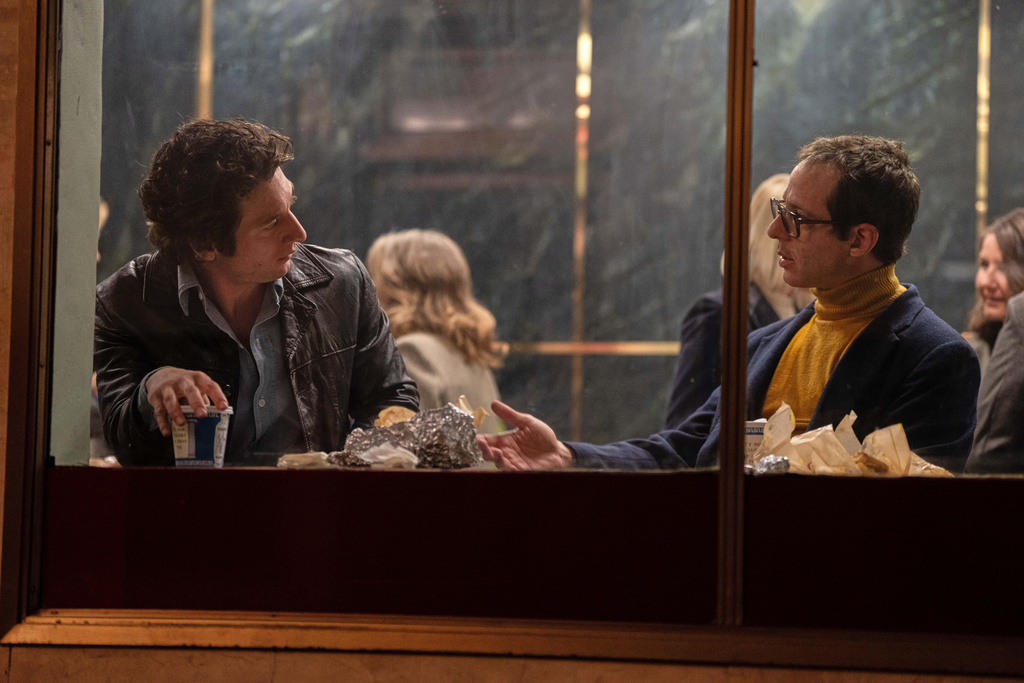
 This image released by 20th Century Studios shows Jeremy Allen White as Bruce Springsteen in a scene from “Springsteen: Deliver Me From Nowhere.” (Macall Polay/20th Century Studios via AP)
Joe’s Take
I tend to enjoy music biopics, although most of them are flawed to varying degrees. Last year’s “A Complete Unknown” was excellent with a number of top-notch performances. “Bohemian Rhapsody” is certainly entertaining, although an overrated film. “Straight Outta Compton” proved stellar. I even enjoyed “Whitney Houston: I Wanna Dance with Somebody.” All these films had one thing in common. They had energy, no matter the quality. “Springsteen: Deliver Me From Nowhere” trades in the energy for a deep dive into Bruce Springsteen’s depression. Except the dive wasn’t that deep, leaving the audience with a surface-level and lifeless film that holds back the great performances.
Although he doesn’t look like him, Jeremy Allen White is excellent as the rock legend. As a fan of White, especially from “The Bear,” the only thing that threw me off was his contact lenses to turn his eyes brown. He has very pronounced blue eyes, so to see that change looked strange. Other than that, White disappears into the role. He always does such a nice job acting with his face and body language, not having to say anything. He also does an excellent job singing, and proves a believable musician and rock star. When he sings songs from “Nebraska,” it was really touching. He’s also relatable, as he struggles with fame, his past and potential relationships.
Jeremy Strong transforms into Springsteen’s friend and manager. Everything about his performance, from the way he talked, walked, smiled, truly impressed me. He has a history of getting very into his roles, and here it totally pays off. He stays even-keeled for most of the film, so when he shows that emotion it has weight. There’s a part in this film where his stoic face eases into a teary smile, and it’s just an incredibly powerful sequence. He has a great chemistry with White. I wish the film explored their relationship more.
Odessa Young (Faye Romano) also shares a natural chemistry with White. They make me care about their onscreen relationship quickly. Paul Walter Hauser (Mike Batlan) is always fun to see, and provides small moments of desperately needed humor. Gaby Hoffman (Adele Springsteen) is excellent as Bruce’s mother. She’s loving and fearless. Stephen Graham (Douglas Springsteen) is a great character actor, and he’s solid again as Bruce’s father. Matthew Anthony Pellicano Jr. does a great job as young Bruce. He also does a lot with his nonverbal acting.
If this film wanted to focus on Springsteen’s battle with depression as he made this “Nebraska” album, that’s fine. I’m all for it. I love a film with a focus. However, everything in the film is still surface level. It shows us numerous flashbacks that all tell the same story — Springsteen’s father was a bad guy who hit his kid, his wife and was a drunk as he battled his own demons. Show don’t tell is obviously what we’re always looking for, but there wasn’t any sequence that was unique. It was all the same idea. We didn’t see what the father struggled with, we didn’t see a lot of interaction. There’s one flashback scene that takes it up a level, when young Bruce hits his father with a bat, but overall the flashbacks were repetitive and didn’t have a major impact on the movie. They just slowed the film down.
The movie doesn’t delve enough into why this “Nebraska” album is so important. It also spreads Springsteen’s relationships so thin that it doesn’t focus on any one in particular. There’s the relationship with his mother, the relationship with his father, the relationship with his girlfriend, the relationship with his manager, the relationship with Hauser’s character. Again, the relationship I wanted to see more of was the one between Springsteen and his manager. Every time White and Strong were on screen together, the movie clicked.
It’s weird because the setup all seemed right. The film focuses on a moment of his career. The casting is fantastic. It’s showing us scenes instead of telling us. However, it tries to touch on too many things that happened within that time period. The film builds up to an ending resolution that is abrupt because it seemed like the studio didn’t want the movie to go a minute over two hours.
Because of the decision to try to explore Springsteen’s depression, the film is devoid of fun or humor. There’s one concert sequence to start the film, where White sings “Born to Run.” There are a handful of funny moments, if that. And that’s it. Writer/director Scott Cooper does not make movies that are knee-slappers, but a movie about Springsteen should probably have some more energy. Or, it needed to commit to really diving deep into Springsteen’s depression and the importance of “Nebraska,” and we just didn’t get enough of it.
“Springsteen: Deliver Me From Nowhere” proved a disappointment. There were excellent performances, and the setup was solid. However, the film was surface level and dull. It had a vision of the time period it wanted to focus on, but didn’t have a good enough focus within that time period to give a proper deep dive into anything.
2.5 out of 5 stars