

PHILADELPHIA — At times this season, the San Francisco Giants have defied explanation.
Not in an awe-inspiring sense. More like a break-your-brain sense.
Now take your mental mainframe and input a putrid pair of come-from-ahead losses in Thursday night’s doubleheader against the Philadelphia Phillies at Citizens Bank Park. Fire up all your synapses. You’re going to need them to process the franchise’s first double helping of walk-off losses in one day in nearly 70 years.
Not to determine which odd bullpen matchups, bizarre pitch selections, questionable coaching decisions and general moments of inattentiveness you’d define as egregious. More like how to order them by level of egregiousness.
First, the bare facts: The Giants took a one-run lead into the ninth inning of Game 1. They lost 3-2. The Giants took a one-run lead into the ninth inning of Game 2. They lost 6-5 in the 10th.
The results would’ve been excruciating regardless of how the Giants arrived at them. They hadn’t been walked off in both ends of a doubleheader since July 15, 1956, at Cincinnati’s Crosley Field, according to the Associated Press’ Josh Dubow. The dispiriting and disturbing part is that this wasn’t merely a case of two bullpen hiccups. It wasn’t merely a tip-your-cap exercise to Kyle Schwarber, a bearded thumbscrew who reached base in eight of nine plate appearances Thursday.
The Giants’ mistakes and mis-evaluations went so much deeper than that. They did so much of the damage to themselves. And most of it defied logic.
How do you explain right-hander Ryan Walker throwing nine consecutive two-seam fastballs to Bryson Stott in the ninth inning of Game 1, the last of which resulted in a blown save and a tying triple? How do you explain the same nightmare repeating in the ninth inning of Game 2 when right-hander Keaton Winn threw seven consecutive splitters to Schwarber, the last of which resulted in a blown save and a tying double?
How do you explain why Winn was facing Schwarber at all when left-hander Matt Gage was warmed up in the bullpen? Or why, at the most critical moment in Game 1, Walker completely neglected Adolis García, who had taken off from first base on a 3-2 foul ball? The entire ballpark knew he’d be running with the next pitch that Stott stroked down the right-field line. How do you explain why nobody — not Patrick Bailey behind the plate nor the coaches in the Giants dugout — called for Walker to pick over?
How do you explain Giants third-base coach Hector Borg’s decision in the 10th inning of Game 2, when he stopped Drew Gilbert from scoring what appeared to be a sure run after Heliot Ramos’s single glanced off Stott’s glove and into center field? How do you explain Giants manager Tony Vitello’s somewhat defensible yet eminently questionable decision in the bottom of the 10th to have Gage face Alec Bohm — a struggling hitter but an unfavorable matchup — with one out and the winning run at third base?
“We’re trying to get him to chase out of the zone and then move on to the next guy,” Vitello said of Bohm, who hit the game-winning sacrifice fly to center. “Did a good job of lifting the ball to the outfield.”
At least there was some justification for that one.
But how do you explain the decision to fly in Trevor McDonald, in the middle of a minor-league road series, on a redeye from Salt Lake City and instead start Adrian Houser in Game 2, thus kicking the can into next week’s home series against the San Diego Padres when the Giants won’t have a rested starter and also won’t have the gift of a 27th player?
While it didn’t really impact anything, how do you explain Jerar Encarnacion — who triggered a pitch-clock violation on the last road trip when he was late starting an inning in right field — forgetting how many outs there were when he caught the third out of an inning?
How do you explain the Giants walking into Citizens Bank Park on the day the 9-19 Phillies fired their manager, and walking out two days later looking like the more dysfunctional team?
“Obviously, not a good day,” Vitello said. “A lot of things you’d like to replay, redo, but you can’t do that. So it’s a bitter pill to swallow. Get on a plane and see what you can make of the rest of the road trip.”
The Giants boarded a flight to Florida to face the Tampa Bay Rays. Consternation was surely on the in-flight menu.
“We lost two games and I’m supposed to be in charge of this group,” Vitello said. “There’s a lot of things we could’ve done better. Can’t go back and undo anything. Decisions go well, look smart. Player looks good. If not, you’d like to reverse it. There’s difficult decisions when Schwarber’s up to bat and we didn’t make any, or I didn’t make any of the right decisions. You can call it that way.”
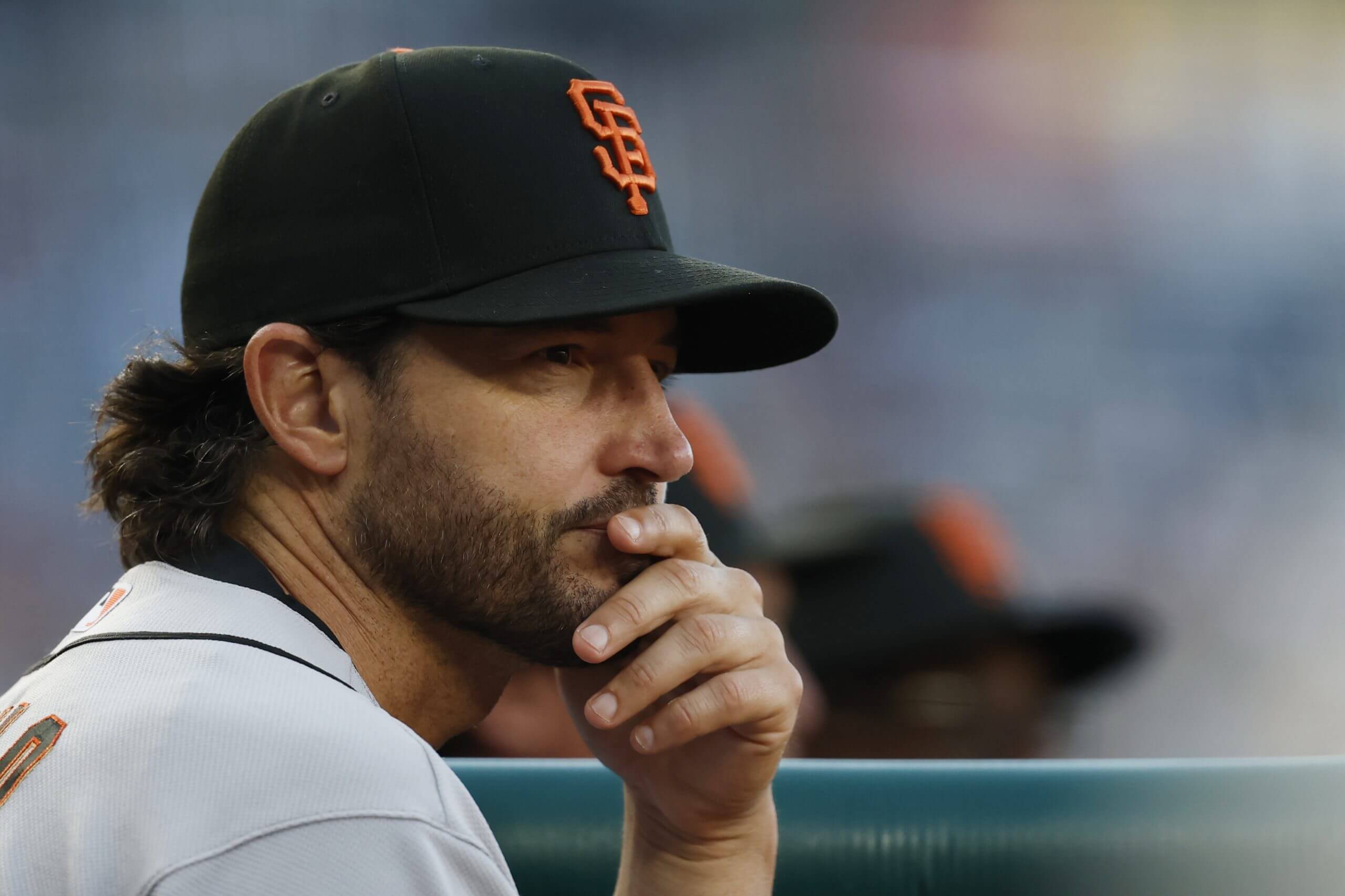
Tony Vitello’s first season as an MLB manager has gotten off to a bumpy start. (Geoff Burke / Imagn Images).
The first internal issue that the Giants have to sort out would appear to be between Bailey, the pitching coaches and the staff, concerning Walker in particular. Vitello provided some cover for Bailey when asked about Winn’s seven splitters to Schwarber, saying it wasn’t by design, but “Mess (pitching coach Justin Meccage) is kind of calling from the dugout, trying to get Schwarber to chase up, but it’s also been a pretty effective pitch for him. Not easy decisions when that guy’s up to bat.”
Walker was more direct about his inning, acknowledging it was a mistake to throw just one slider out of 21 pitches and to keep repeating his sinker to Stott until he left one over the heart of the plate.
“It’s just something we need to figure out,” Walker said. “Obviously (a slider) would’ve been beneficial. Two-seam’s been working a lot. I think we overused it, potentially, today. It’s in the back of my mind. If we utilize a slider in that situation, it’s a different story.”
Why didn’t Walker shake to a different pitch?
“I have a tough time shaking,” Walker said. “I’m not a big shaker. I put a lot of trust in my catchers. I still have a lot of trust in Bailey, whatever he calls, especially as a two-pitch guy. I have the confidence in both pitches in any situation. But obviously, nine two-seams to Stott is not ideal. And I will be making some changes in terms of situational pitching.”
Vitello said he met with Walker in his office between games and the right-hander expressed “nothing but regret from him. Came in here and visited a little bit about things in general. I wouldn’t even call it a pattern. It was a one-dimensional thing. That wasn’t any set pregame plan or anything like that. It’s just one consistent pitch that he went with. Opportunity to shake there, he didn’t want to do it. He’s usually in a pretty good rhythm with the catcher, so …”
So? How about an explanation from the catcher?
“Good pitches,” said Bailey, when asked why the Giants kept going to the same well against Stott and Schwarber. “Trying to get them out. … I trust my guys and their pitches.”
The explanation was just as flimsy when Vitello was asked about the decision to start Houser in Game 2.
“Just because we know he can give us a quality start and we’ll worry about that day when it comes,” Vitello said. “That’s what he did.”
Fact check: Houser gave up two home runs before he threw a sixth pitch, and while he settled down after that, he was pulled with two outs in the fifth — well short of the definition of a quality start.
Moving on. Borg’s explanation for holding Gilbert?
“I feel pretty good holding him right there with Chappy (Matt Chapman) coming up and (Luis) Arraez,” Borg said. “The second baseman kind of killed the ball more than I thought. But I feel pretty good in that situation with those guys coming up. Honestly, I feel pretty good. … That’s the main focus for me as a third-base coach. I want to be fair to those guys in that situation.”
The Giants did a few things well. They drew three walks against Cristopher Sanchez in Game 1 — just the second time all season they’ve drawn three walks against a pitcher (the other was Miami Marlins reliever Tyler Phillips last Saturday) and the first time against an opposing starter. Ramos continues to heat up at the plate and should become the regular leadoff presence against left-handers again.
Chapman made a nice play at third base to cut down a run at the plate. Backup catcher Eric Haase turned some smart baserunning into a run. Caleb Kilian, who has allowed one run and five hits in 14 innings, retired six of seven Phillies batters in Game 2 and continued his emergence as a dominant relief presence. Logan Webb pitched well in Game 1 while limiting the Phillies to a run in seven innings, which theoretically set up their pitching for the rest of a difficult day.
But the Giants continue to get very little out of Rafael Devers and Willy Adames, who squandered so many chances to collect put-away hits in the series. And you don’t get credit for a handful of big league plays when you make so many avoidable mistakes.
Sometimes the simplest explanation is the right one. Maybe the Giants just aren’t a very good team. At the end of April, anyway, with a 13-18 record that feels like something of an overachievement given all the holes in their game, they cannot claim to be anything different.
They have five months to redefine themselves. And unlike what the Phillies and Boston Red Sox did in recent days, there is no reset button to push.
The Giants are one month into Vitello’s three-year contract and they’re earmarking $10.5 million to the manager position this season between his salary, the buyout on his contract with the University of Tennessee and the money they owe to fired former manager Bob Melvin. The Giants are in the nascent stages of Adames’ seven-year, $182 million contract and the more than $250 million they are scheduled to pay Devers by the time his contract expires in 2033.
The team you see, by and large, is the team you’re going to see.
Just about the only thing the Giants could explain with any success Thursday night was how they felt at the end of it.
“Painful,” Vitello said. “And certainly not mistake-free, starting in here. Not much you can do at this point. Not an easy flight, whether it’s the time you get in or the mood of the travel. Certainly no easy opponent we’re about to (face). I don’t know. Gotta find a way to make the most of what we’ve got left on this road trip.”