
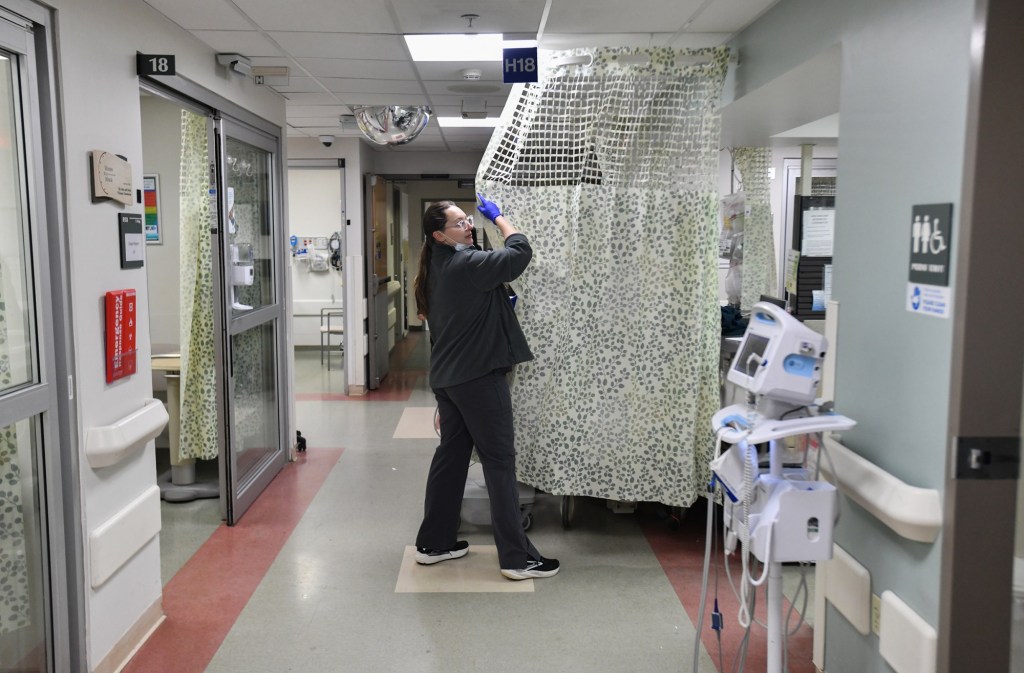
Geisinger officials say they’ve taken many steps to attract and retain nurses amid a nationwide shortage:
• Partnering with high schools through cooperative programs to spur interest and build the pipeline.
• Offering an externship program where college students receive exposure to the profession.
• Providing scholarships for current employees to return to school.
• Offering residency and fellowship programs.
Still, it’s a problem not likely to go away soon.
The U.S. Bureau of Labor Statistics projects that demand for most advanced practice registered nurses will grow 35% by 2034 and estimates that about 189,100 openings for registered nurses will be projected each year, on average, over the decade, according to a statement from the American Nurses Association.
The ANA — which advocates for policies that expand access to nursing education and supports nurses practicing to the fullest extent of their education and clinical training — opposes a proposed U.S. Department of Education rule that would remove nursing from its current classification of a professional degree, ANA officials said in the statement.
“With faculty shortages and the cost of advanced education already constraining Bachelor of Science and graduate program capacity, limiting access to federal post-baccalaureate loans would create new barriers at the exact moment our healthcare system depends on more nurses pursuing advanced education,” ANA officials added.
Janet Tomcavage, chief nursing executive for Geisinger, noted nursing schools struggle to recruit enough faculty and therefore must limit the number of enrollments
According to the American Association of Colleges of Nursing report on 2023-2024 Enrollment and Graduations in Baccalaureate and Graduate Programs in Nursing, U.S. nursing schools turned away 65,766 qualified applications from baccalaureate and graduate nursing programs in 2023 due to insufficient number of faculty, clinical sites, classroom space and clinical preceptors, as well as budget constraints.
With Geisinger being a rural healthcare system, Tomcavage also stressed many students, even those from the local area, choose to pursue a career in larger metro areas like Philadelphia, Pittsburgh and Atlanta after graduation.
She added an aging population across the region also impacts the workforce.
“Our only growing demographic here in Northeastern Pennsylvania is really over 65,” Tomcavage said. “If the younger population is not here, I don’t have a workforce. The second thing is it increases the demand we have for healthcare services, which increases demand for nursing. Our hospitals are more full than they’ve ever been. We are having to expand — we have a tower going up in Danville, we have an extra tower in Wilkes-Barre, and we’ve added rooms in Scranton because we’re being pushed over capacity. We have a couple challenges we’re faced with that I don’t think are going to go away anytime soon.”
In recent years, Geisinger expanded its outreach to a younger group of prospective future employees.
“We have a very strong cooperative program with about 72 or 73 high schools,” Tomcavage said. “We have to get 10th and 11th graders interested in the health sciences. They work during their school year for high school credits and get exposure to nursing and other healthcare areas. It’s been very helpful because those students often stay, work in the summer as an unlicensed worker, and then get interested and go into nursing in the fall.”
An externship program for college students between their junior and senior years has also proved fruitful for Geisinger, Tomcavage said.
“We hire those students in their summer break to come work with us,” she said. “They get paid, assigned to a nurse and they work that nurse’s shift — weekends, nights — just so they really get exposed to nursing. It has a phenomenal way of enhancing their skills and has really served us well.”
Recently, Geisinger officials recruited about 80% of the externs from the 2025 group at the Danville location to start working at the hospital this summer, Tomcavage said. Additionally, hospitals in the northeast region recruited about 75% of their externs.
Current employees also have access to certain perks, Tomcavage said.
“We also offer a pretty robust scholarship program for our own employees who want to go back to nursing school,” she said. “We offer $40,000, so depending on the program that covers pretty much two years of education in our community colleges and state schools.”
Since 2021, the Nursing and Health Sciences Scholars Program has supported more than 550 employees in advancing into nursing and health science careers, including roughly 500 registered nurses, Geisinger officials said.
“If you retain, you don’t need to recruit. So we’ve put a lot of emphasis on retention,” Tomcavage said. “During COVID, we had turnover in the mid-teens but our turnover is back down to about 9%, which we’re pretty happy about, but we still have a vacancy rate of about 18%. Because of the growth of the organization, adding beds and the growing needs for healthcare, we still have a pretty significant vacancy.”
Specifically, Geisinger implemented a yearlong residency program for new graduates, launched two or three different leadership development programs, and invested in technology as both a recruitment and retention tool, Tomcavage said.
Virtual nurses, working remotely, help the bedside nurses with admission assessments, discharge assessments and patient education, she added.
In 2022, in an effort to train additional caring and skilled nurses, Jersey College and Commonwealth Health established a School of Nursing on Moses Taylor Hospital’s campus, serving the Scranton region.
Jersey College’s Scranton Campus has about 140 currently enrolled students and has graduated more than 80 nursing students, said Jessi Tillett, the college’s manager of marketing services.
The Jersey College campus at Moses Taylor complements a number of other local nursing education programs, including those offered by Lackawanna College, Marywood University, Luzerne County Community College, King’s College, Misericordia University, Wilkes University, the University of Scranton, Penn State Scranton and other institutions.
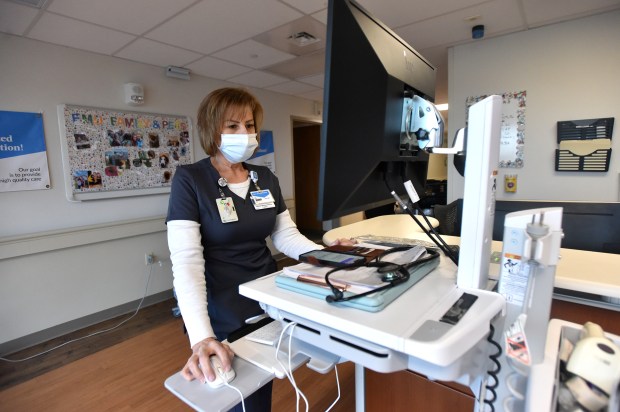 Registered nurse Jodi Spotts works in a recently renovated unit that expands inpatient capacity at the Geisinger Community Medical Center in Scranton Tuesday, March 4, 2025. (SEAN MCKEAG / STAFF PHOTOGRAPHER)
Raelene Brooks, Ph.D., dean of the College of Nursing at the University of Phoenix, listed the aging nursing workforce and a drop in enrollment as the two biggest factors driving the nationwide nursing shortage.
“There is less interest in the profession and nursing is expensive,” she said. “It costs a lot for a university or a higher education system to support a nursing program.”
Brooks added that the rigors of a nursing career — specifically for those working in high-stress, rapid-action environments like emergency rooms — take a toll on the individuals.
“There are a lot of mental health issues in nursing that are unspoken,” she said. “Burnout is just the tip of the iceberg.”
After working the night shift as a nurse in a Level 1 trauma unit in downtown San Diego for more than 17 years, Brooks still deals with the aftermath of the experience.
“I have PTSD from taking care of gunshot wound victims and their families,” she said. “If it’s gang related, the perpetrator is still wanting to finish up the job, so I’m taking care of a patient and in fear for my life. It’s like going into a war zone every single day and it’s not uncommon for nurses to feel that way.”
Brooks feels that inconsistencies regarding requirements for transferring credits between institutions create a barrier for many students.
“In the Philippines, there’s a wonderful pipeline where all schools have the same expectation if you choose a profession,” she said. “You can complete your degree in about three years after high school because you’ve already been prepped and groomed. I think, given the freedom we have to be creative and innovative in curriculum, it can be a barrier for potential students because some universities may have higher admission criteria and different prerequisite courses. I don’t think we do a very good job creating a streamlined approach and pipeline to make it more seamless for students to progress. We’re seeing a lot of nurses who are graduating with a bachelor’s degree, and the mean age is 25. If I had a magic wand and could fix the nursing world, I would say streamline the pipeline process.”
Brooks believes a passionate national campaign geared around the personal, empathetic aspect of nursing would help boost interest in the profession.
“Johnson & Johnson did a great campaign on caring and compassion, and helping others, about 20 years ago, and I think that speaks to this generation,” she said. “I really feel strongly about the way nurses are portrayed. If we could focus on the caring and compassion, and the patient-centered advocacy, I think that speaks to the human heart, which is what you need in nursing. You need the skill and the intelligence, but you have to be in it for the right reason.”