
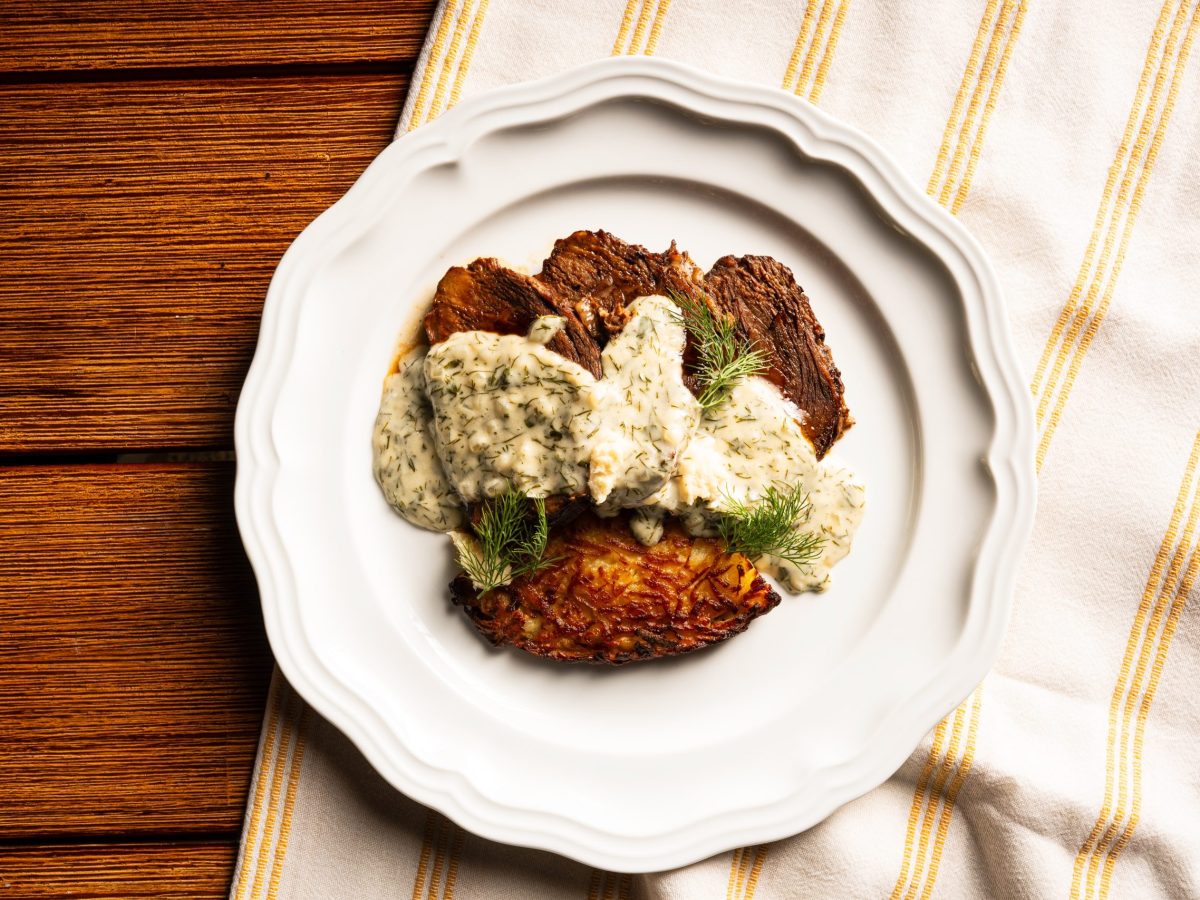
At tables inside the Food and Energy Hub in Millvale, a family-style dinner began with a small square of cornbread soaked in orange and clove syrup studded with crumbles of fried prosciutto.
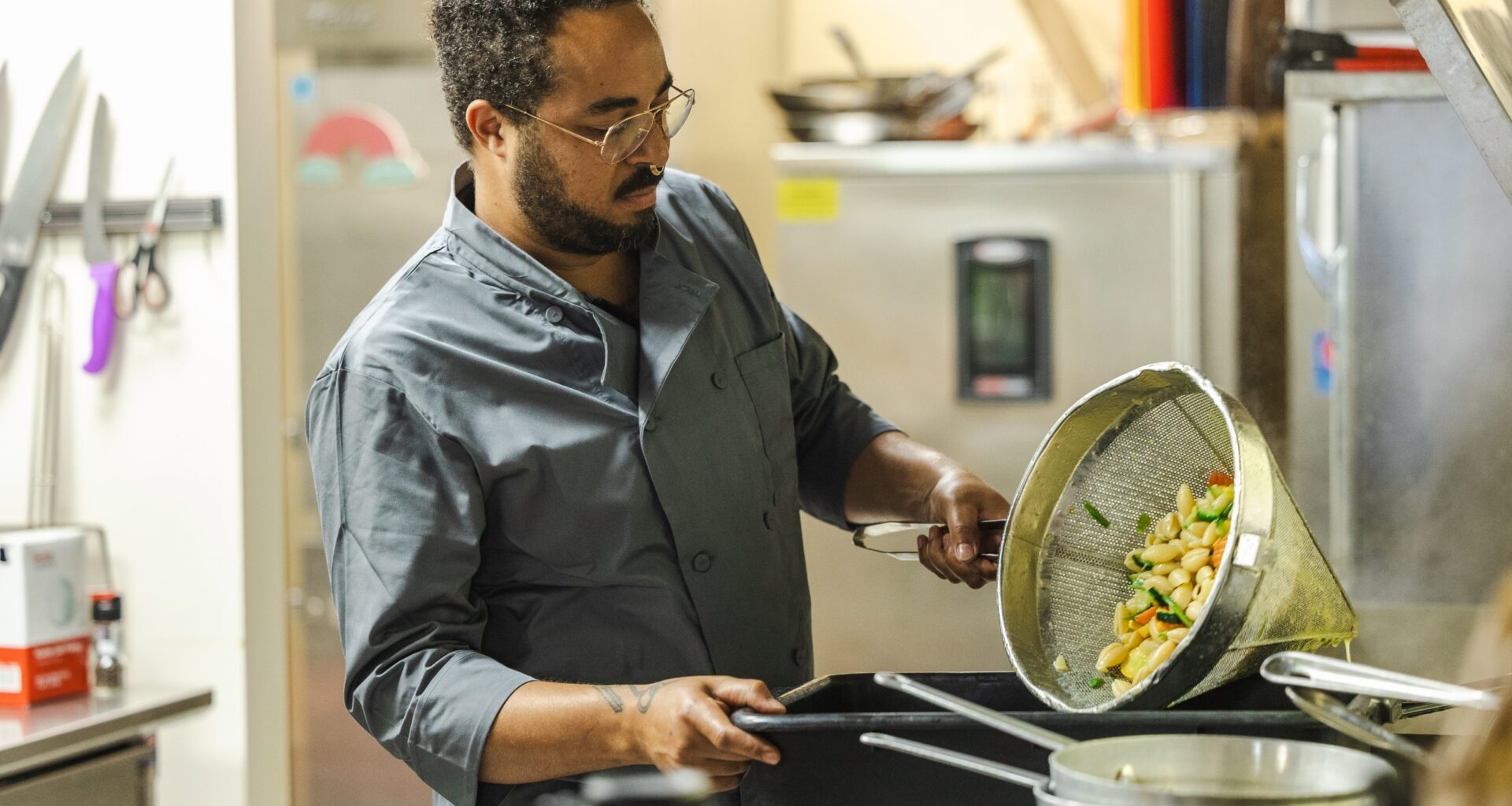
The coursed meal moved on to a crisp cucumber and celery salad dressed in yogurt and dill, then a perfectly al-dente, primavera-esque pasta tossed with spring vegetables. A cabbage and chicken soup, ladled out warm, followed. Luscious rice pudding was packed up to go for attendees at the end.
Libations included spirit-free cocktails and craft nonalcoholic beer donated by locally opened Virtue Signal Brewing Co. (The company has not yet launched, but we’ll keep our eyes peeled for this one).
Every delicious dish had been created from “rescued” food from the NFL Draft.
The dinner, called “Fourth & Feast: From the Field to the Table,” took place the day after the NFL Draft inside 412 Food Rescue’s zero-waste kitchen, The Good Food Project. At the kitchen, bulk surplus food is sorted, repackaged and transformed into meals that can be redistributed across the city. The kitchen operates as part of a larger system inside the Food and Energy Hub, a shared nonprofit space that includes community programming, sustainability infrastructure and a commercial kitchen designed to handle large-scale donations.
The evening included a “fireside chat” moderated by Natalie Bencivenga, a Pittsburgh-based journalist and media personality, and featured Alyssa Cholodofsky, CEO of 412 Food Rescue, alongside chefs and Lilith co-owners Jamilka Borges and Dianne DeStefano.
DeStefano said the zero-waste thinking aligns naturally with their kitchen philosophy at Lilith.
Lobster shells from their famous lobster rolls are boiled down into stock, layered with ginger, lemongrass and citrus, and turned into an aromatic sauce. That stock becomes part of a rotating system, sometimes forming the base of a kumquat-laced sauce served with whole snapper and seasonal vegetables. Elsewhere, by-products are also repurposed. Borges has used carrot pulp left behind from juicing in a wildly popular pierogi filling, a dish that traveled with her to events across the country, including her work at Spoon.
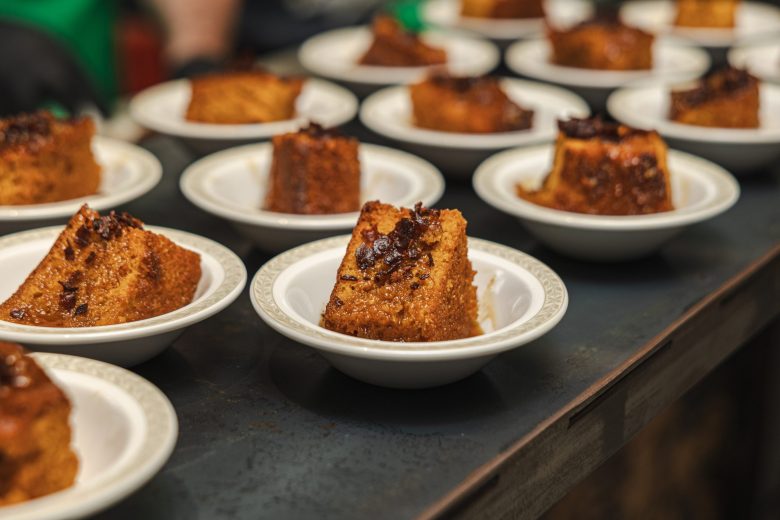 Cornbread soaked in orange and clove syrup topped with crumbles of fried prosciutto. Photo by Tyler Newpol.
412 Food Rescue operates on a similar premise at city scale, intercepting surplus food and redistributing it in real time through a network of more than 26,000 volunteers.
It was all hands on deck during the NFL draft. Pittsburgh hosted hundreds of thousands of visitors; vendors, hotels, stadium operators and temporary food sellers produced food at a scale designed to ensure no one went hungry.
To reduce wastage, 412 Food Rescue coordinated directly with event organizers to collect excess food and transport it to nonprofits serving communities across the city.
As of midweek, 26,085 pounds of food had already been rescued from Draft-related events, with an estimated 60,000 pounds expected by the time all recoveries are complete. Twelve total rescues had been conducted from four donor partners, serving five nonprofit organizations, with eight volunteers assisting alongside a fleet van and a box truck.
Volunteers and staff spread out across Downtown and the North Shore, canvassing restaurants, hotels and temporary vendors as they cleared out. They moved through loading zones and service corridors, identifying food that could be safely recovered before it crossed into waste. That could be chicken drumsticks or thighs that they turn into soup. It could be the cabbage, fresh or cooked, that becomes part of another recipe. The easiest to recover are things like peanut butter, canned sodas or other packaged goods like candy.
Some donations came palletized, requiring forklifts and coordinated transport. Others were smaller and more time-sensitive, claimed in real time through Food Rescue Hero, the proprietary app developed by 412 Food Rescue in 2016 that guides volunteers through pickups and deliveries.
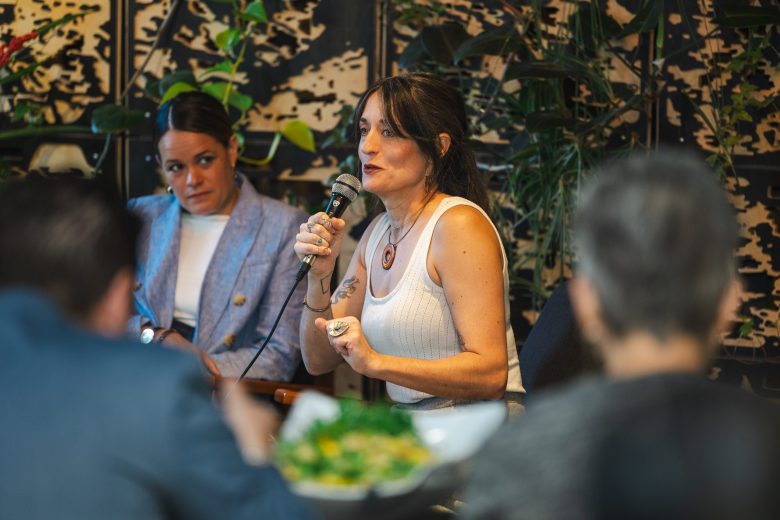 Dianne DeStefano speaks at 412 Food Rescue’s Fourth & Feast event with Lilith co-owner Jamilka Borges to her left. Photo by Tyler Newpol.
The platform now supports a network of more than 63,000 volunteer drivers across North America and has been licensed to 22 organizations in cities including Philadelphia, Erie, Cleveland and Cincinnati. Since its launch, that network has diverted more than 280 million pounds of food that would have gone to landfills. If an event organizer wanted to donate unused food, Food Rescue Hero would be the place to do so.
“The generosity and thoughtfulness of our partners and individuals on the ground never cease to amaze us,” said Josh Weiland, vice president of operations for 412 Food Rescue. “From forklift operators willing to do extra work to save food, to nonprofits willing to lend a hand to ensure we get that food to people who could use it.”
Much of what was recovered was delivered swiftly across the city, including to sites like Center Avenue Housing in the Hill District and organizations including the Women’s Shelter of Greater Pittsburgh and the Salvation Army Adult Rehabilitation Center.
“Food rescue is a challenge, and we’re up for it,” Weiland said. “We work closely with partners across the city to properly identify what types and amounts of food are truly meaningful to them. These relationships help us ensure the food we’re sending is useful to them. It’s a complex problem, but also one we have the resources to meet with care.”
Food that had already been placed on hot buffets cannot be recovered once served, due to food safety constraints. “This is a small loss,” Weiland said, noting that the organization continues to work with vendors to store food in ways that allow it to be safely rescued and distributed.
Timing, access and communication all shape what can and cannot be rescued, said Weiland.
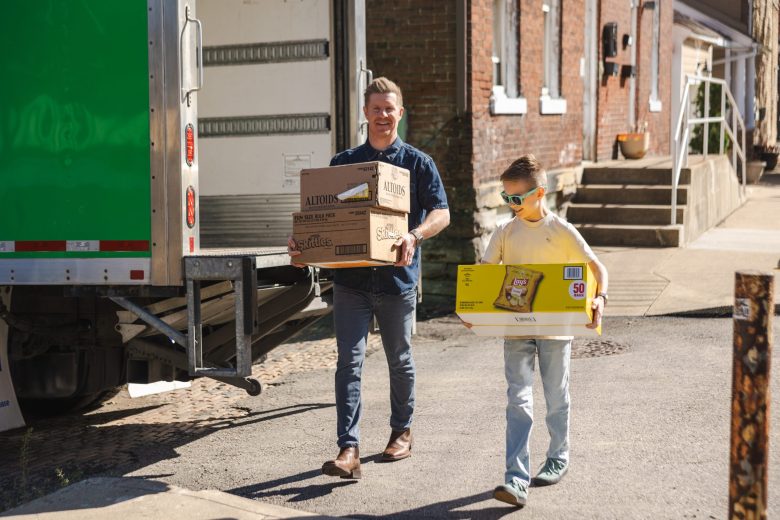 Volunteers help move rescued food from a truck after the NFL Draft. Photo by Tyler Newpol.
“Communication is always a moving target,” Weiland said. “As the landscape changes so do the opportunities, and being in step with those adjustments always necessitates flexibility and curiosity.”
That flexibility has been built over time. The organization scaled rapidly during the pandemic and adapted again when SNAP cuts increased demand last year.
DeStefano points to an alarming statistic: Nearly half of food insecure residents in Allegheny County do not qualify for SNAP benefits. They do not meet federal eligibility thresholds, but still cannot consistently afford to meet their nutritional needs. They rely instead on food banks, shelters and systems like 412 Food Rescue. Experts call this the SNAP gap.
“We’re actively working to understand this,” Weiland said. “As grocery prices remain high and hunger relief efforts lose funding, we’re working diligently to determine where and how to increase food access through food rescue.”
412 Food Rescue has diverted more than 39 million pounds of food in Western Pennsylvania since its founding in 2015, the equivalent of more than 33 million meals, while mitigating over 83 million pounds of carbon emissions.
The Draft, he said, offers a clear reminder of both the potential and the limits of that work.
“The Draft is a moment, and people will still be hungry,” Weiland said. “Food rescue helps in the battle against hunger, but we work with donations and the goodwill of our donor community.”
Weiland said the work is ongoing.
“Hunger and environmental issues are wicked problems,” he added. “We’re providing an elegant solution. These things won’t be solved by one organization, but through a tight fabric of support with one another.”
Back in Millvale, the last of the rice pudding is packed up to go. The meal ends, but the work does not.
April 27, 2026April 30, 2026
April 23, 2026April 23, 2026
April 16, 2026April 21, 2026