
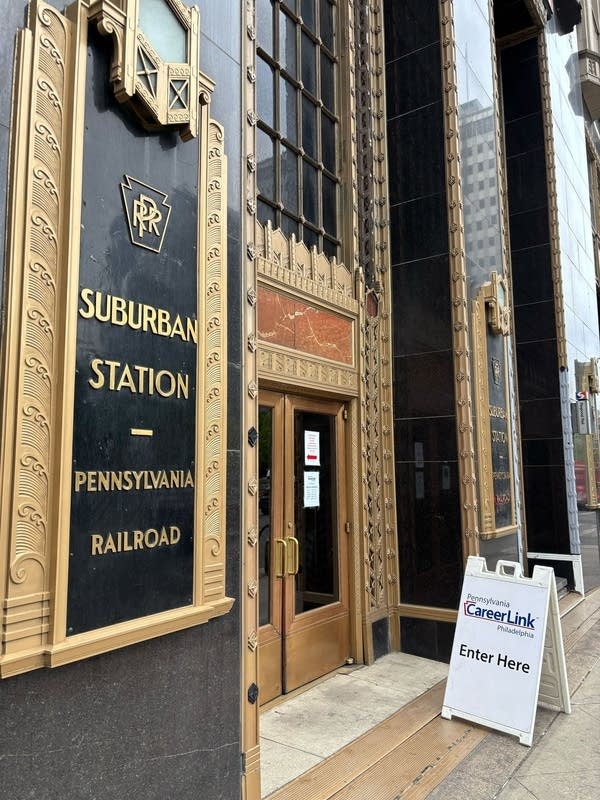
The entrance to PA CareerLink’s Suburban Station location in Center City, Philadelphia.
Samantha Fields/Marketplace
In the last year, more than 17,000 people have walked into an old Art Deco office building in the center of Philadelphia, just down the street from City Hall, looking for help finding work. Inside on the second floor is one of four publicly-funded job centers in the city. In the mornings, there’s often a line at the check-in desk.
Dawn Thomas-Hayward, the communications director at Philadelphia Works, the city’s nonprofit workforce development board, said people come here for all sorts of reasons, “to see their workforce advisor, to go use the computer resource center, do job search, get resume help, get into trainings.”
This is one of four such centers around the city. All are open from 8 a.m. to 4:30 p.m. five days a week for anyone to walk in.
James Anderson first walked in five or six years ago, soon after he got out of prison in his mid-50s.
“I was incarcerated, tired of that circle, in and out,” he said. “And I thought, ‘Maybe I’ll just start looking into some of the resources that’s available and see where it can lead me.’”
He told his advisor at the time that he was interested in vocational training, and they got him into a program to get his commercial driver’s license. “They funded everything, like really helped me get that opportunity to get into a new future,” he said.
But without much on-the-job experience, Anderson has found it hard to land steady, full-time work at a good company. Right now, he’s only working one day a week, and not as a driver. That’s why he’s back at CareerLink, hoping they can help him find something again.
“It’s been challenging trying to get a job where you could say, ‘Whew, thank you, God,’ you know what I mean. ‘I’m good now, ain’t got to stress,’” he said. “That kind of work, it’s been challenging for me.”
It’s challenging for a lot of people to find work right now. Elizabeth Giddings sees that every day in her job as a CareerLink workforce advisor, where she works one-on-one with people to help them find a job or get into an apprenticeship or training program.
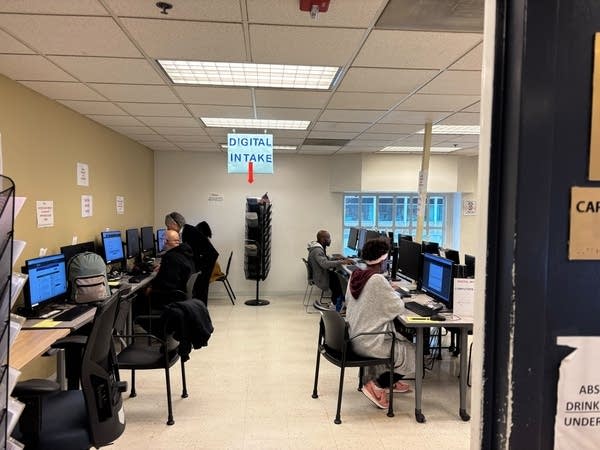
People come to CareerLink to “go use the computer resource center, do job search, get resume help,” and more, said Dawn Thomas-Hayward, the communications director of Philadelphia Works, the city’s nonprofit workforce development board.
Samantha Fields/Marketplace
“When I do an orientation for the individuals to get a workforce advisor, the room is packed,” Giddings said. “So I know the economy is pretty bad.”
And those one-on-one appointments people can make with her or another advisor are booked until June.
“A lot of people are just becoming laid off,” Giddings said. “And I see individuals that come in that have been laid off since last year, the early part of the spring, and they still have not obtained employment.”
Philadelphia’s unemployment rate has risen, from 4.5% in December to 5.3% in January, the most recent month for which city data is available. That is a whole percentage point higher than the state and national average. By contrast, the unemployment rate in Pittsburgh — Pennsylvania’s second largest city — is lower than both the state and national average, at 4.1%.
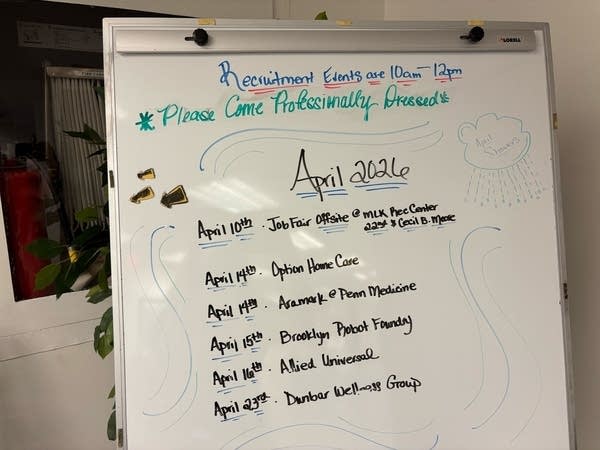
A recruitment calendar on a whiteboard.
Samantha Fields/Marketplace
“One of the challenges we face as a city is our adult literacy rate,” said Patrick Clancy, president and CEO of Philadelphia Works. “We are severely challenged, with some of our adults unable to pass a sixth- or eighth-grade reading and math test.”
More than two-thirds of adults in Philadelphia are reading at or below an eighth-grade level, according to Achieve Now, a local literacy nonprofit. Almost 40% struggle to fill out a job application.
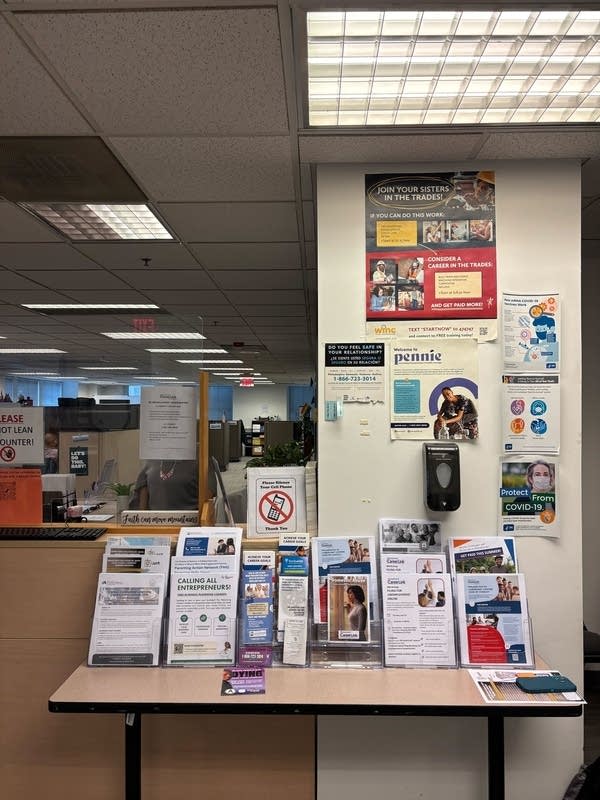
About 70% of those who come into Philadelphia’s CareerLink centers find a job.
Samantha Fields/Marketplace
The city is also the second-poorest in the country, after Houston, and poverty creates a lot of barriers to employment.
“Without stable housing, going to work is really a challenge,” Clancy said. The same is true if you can’t afford transportation, food, or childcare.
On top of that, the labor market in the city is stagnant right now, much like it is nationwide. All of the uncertainty and higher costs around tariffs have made many employers hesitant to hire for a while, according to Clancy, and now the war in Iran and higher oil prices are adding to that.
“The sooner we can have more confidence in the economy, then I think employers will feel that way too,” he said. “But at this point, I think we’re still in that sort of hesitant mode.”
There’s more uncertainty ahead for Philadelphia’s economy, with Medicaid cuts looming next year; healthcare is one of the city’s biggest industries.
But for all the challenges, people are getting jobs. About 70% of those who come into Philadelphia’s CareerLink centers find something.
Every time Elizabeth Giddings learns that someone she’s been working with has been offered a job, she’s thrilled.
“I get up and go to my supervisor, and I say, ‘I got another placement!’” she said. “And I’ll just be excited for them. I let them know that, ‘Hey, you got a job! We’re going to assist you. We’re going to help you with transportation til you get your first paycheck. We’re going to help you with the career wardrobe to get you three new outfits so you can go on that new job looking really nice.’”
For some people, that moment might come in a few months. For others, it can take a year or more.
Related Topics