
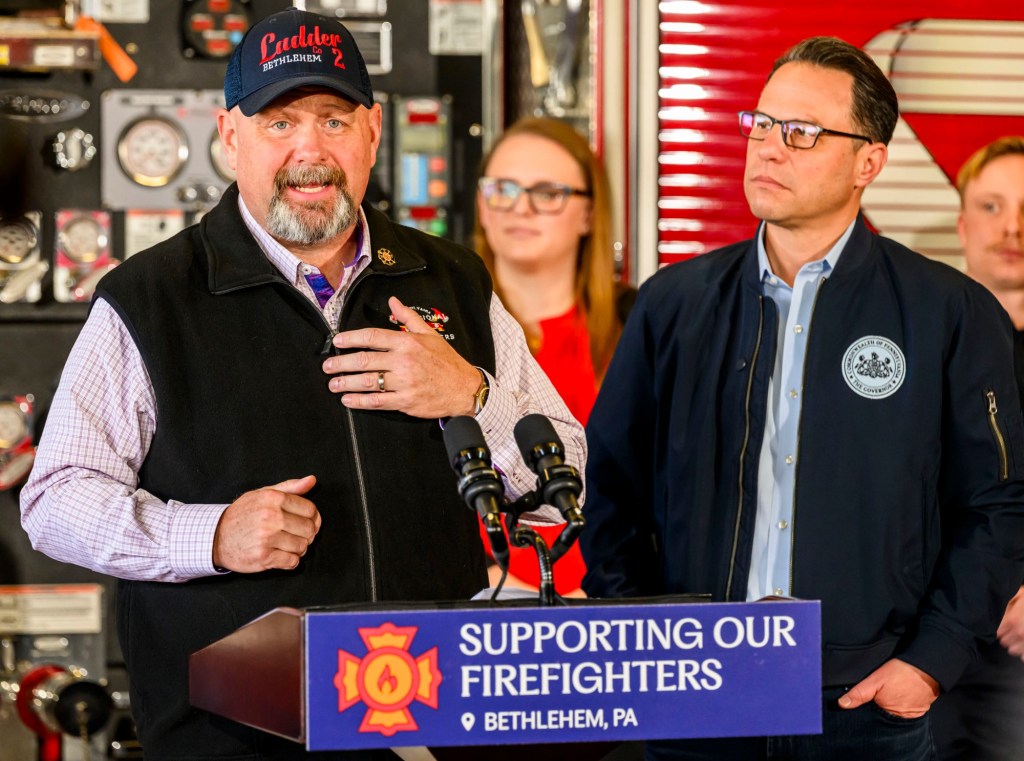
In a crowded Democratic primary in the Lehigh Valley where the four candidates are largely in lockstep on key issues, one candidate is emerging as a clear favorite among the most prominent national and local Democrats to take on Republican U.S. Rep. Ryan Mackenzie in November.
The support for Bob Brooks, a former Bethlehem firefighter and current president of the statewide firefighters union, is unmatched by his opponents, who each have drawn varying levels of local support but nowhere close to what Brooks has received from prominent political figures, interest groups and fundraising machinery that are backing his campaign.
Those include figures across the Democratic spectrum, from moderate Democratic Gov. Josh Shapiro to progressive Sen. Bernie Sanders to the official campaign arm of the Democratic Party.
The Lehigh Valley-based 7th Congressional District includes all of Lehigh, Northampton and Carbon counties and a portion of western Monroe County. It is one of the most competitive districts in the country in an election that could determine which party takes control of the House of Representatives in November.
With the stakes that high, it is no surprise that prominent Democrats are getting involved in the race and well-funded groups are pouring in hundreds of thousands of dollars. The race has been the most expensive among Pennsylvania districts for the last two election cycles.
But for these prominent figures and wealthy interests to do so before the primary election in a crowded field is unusual, and is causing some discontent among Brooks’ opponents and other local Democrats.
“I absolutely do not think it is appropriate for the DCCC or any outside organization to weigh in on this race before it has been determined by the voters. That’s what the primary is for for the people to vote their choice to represent the Democratic party,” said Lori McFarland, chair of Lehigh County Democratic Committee. The county party does not endorse candidates in competitive primaries where there is no incumbent, McFarland said.
Brooks’ support from wealthy donors and political action committees also appears to be at odds with his purported stance against unlimited money in politics, though he has defended this support as necessary to gain an advantage in the election.
As his campaign has continued to consolidate support, he faces increasing attacks from opponents on both sides of the aisle on issues from his past social media posts, his support from alleged “dark money” groups and a statement he made to Lehigh University students this past week regarding the 2024 state treasurer race.
Here’s how Brooks amassed so much support, how his Democratic opponents are trying to undercut his advantage, and what it can tell us about this key race.
The Brooks campaign
Brooks was one of the later candidates to jump into the race, in August 2025. The day of his launch, he already had Sanders, U.S. Rep. Chris Deluzio, and Lt. Gov. Austin Davis backing his campaign. A few months later, Shapiro announced his endorsement.
Brooks had previously backed his opponent Lamont G. McClure’s campaign, after the former Northampton County executive declared his run in February 2025. But Brooks decided to jump into the race himself after being asked to do so by Shapiro and Deluzio, he has said.
In statements and throughout the campaign trail, Brooks has touted his working class roots and past brushes with poverty as evidence that he is the candidate that best understands the district’s residents, and therefore can serve them best.
Brooks does not have a college degree and has spoken publicly about facing foreclosure, relying on food stamps, and choosing whether to pay for medical expenses or housing expenses.
“I’ve spent my life serving my community and living the challenges of regular people, whether it was behind the bar pouring beers or behind the wheel of the fire truck putting out fires in Bethlehem, and I know personally what it’s like to live in fear of foreclosure or see your paycheck eaten away by higher prices,” Brooks said in a statement.
Brooks’ working class background, everyman persona and laser-focus on economic issues — which according to polling is the most important issue to voters — are why Democratic analysts believe he has the best chance. The Bench, a new political action committee founded in the wake of Democrats’ underperformance in 2024, is backing Brooks and other candidates with “real-world experience” like teachers, nurses, veterans, farmers and first responders, according to its website.
As voters’ perceptions of the Democratic party continue to sink — the party as a whole has only a 35% approval rating, according to polling averages compiled by Real Clear Politics — groups like The Bench and others that are backing Brooks believe that candidates like him can win back voters disillusioned with the party.
“I think it’s his working class persona and of the four candidates he most fits that bill and in a swing district like this district he might be able to pull over some Trump voters, enough Trump voters to carry the election for the Democrats,” said John Kincaid, politics professor at Lafayette College in Easton. “Given he is president of the PFFA as a first responder and he supports pretty liberal Democratic policies, I think that’s why Governor Shapiro and others have lined up behind him.”
Brooks’ opponents, however, are quick to point out his personal wealth. According to Brooks’ public financial disclosure, he and his wife, Jennifer, have a net worth anywhere between $148,000 and $3.2 million, according to an analysis by NOTUS, a nonpartisan news organization (candidates are only required to disclose their assets in broad ranges, not exact amounts).
Jenna Kaufman, Brooks’ campaign manager, told NOTUS that Brooks is “not a millionaire,” although she declined to provide more specific details about his financial status.
Other prominent Brooks backers include more than a dozen local and national union organizations, more than 30 Democratic state legislators including Lehigh Valley Reps. Mike Schlossberg, Peter Schweyer and Nick Miller, and three Democratic members of Congress from Pennsylvania: Deluzio, Madeleine Dean, and Chrissy Houlahan.
An April poll of likely Democratic voters in the district commissioned by the Congressional Progressive Caucus PAC and conducted by pollster GBAO showed Brooks had a seven-point lead over his three opponents. Still, more than 35% of those polled remain undecided about their vote.
Brooks’ platform and the money supporting it
Brooks released a detailed policy platform that his campaign dubbed his “Putting out the Fire Agenda,” which includes breaking up corporate monopolies, raising taxes on the “ultra rich,” and supporting the “PRO” Act, which would make organizing and joining a union easier.
He has positioned himself firmly as a progressive candidate, pushing for policies that just a few years ago were to the left of the Democratic Party platform, including “Medicare for All,” for which Brooks is a staunch advocate. It is those stances that have helped him earn the support of progressive groups including the Working Families Party and Make the Road.
Another arm of Brooks’ policy agenda is opposing Citizens United, a 2010 Supreme Court decision that paved the way for unprecedented amounts of money to be raised and spent in order to influence campaign outcomes.
Brooks has called for a constitutional amendment which would overturn Citizens United and restore stricter limits on campaign fundraising and spending.
But support for his own campaign appears to be at odds with this position.
Brooks’ candidacy has already been propped up by $500,000 in spending from outside groups, which can spend unlimited amounts on candidates’ behalf and are not allowed to directly coordinate with his own campaign, which is subject to spending and raising limits.
One of those groups spending on Brooks’ behalf is “Stronger Together PA,” a political action committee that appears solely focused on supporting Brooks’ campaign. Its website prominently features Brooks and his campaign platform and no other candidates are mentioned. The group is currently running pro-Brooks digital ads touting both Shapiro’s and Sanders’ endorsements.
According to campaign finance records, Stronger Together PA received $250,000 from The Bench, which launched earlier this year and aims to usher in the “next generation” of Democratic leaders in Congress. Other Bench-supported candidates include Texas Senate candidate James Talarico and Alaska congressional candidate Mary Peltola.
The Bench exploits Citizens United loopholes which makes it easier for wealthy interests to dominate campaign races, according to reporting from Lever News. Donors to the group include billionaire Democratic megadonors Mark Heising, Tench and Simone Coxe and James Murdoch, son of Rupert Murdoch. The latter three donors have also donated directly to Brooks’ campaign, according to reports.
The Bench operates several interconnected organizations that all funnel money toward their preferred candidates, some of which have no fundraising and spending limits, and others which are not required to disclose their donors.
The group has created a network of organizations that each have varying levels of restrictions on their fundraising, spending and financial disclosures, allowing millions of dollars to flow toward candidates these donors prefer.
Some of Brooks’ own supporters, including Sanders and Sen. Elizabeth Warren, have urged Democratic leaders to withhold endorsements to candidates backed by billionaire-funded Super PACs.
Brooks, in public statements, has addressed the wealthy interests funding his campaign, which seem to be at odds with his stance on money in politics. At an April 7 debate, Brooks was pressed by moderator Ryan Gaylor about the fact that he has accepted more in PAC contributions than any of the other Democratic candidates.
In response, Brooks said, “Don’t hate the player, hate the game.”
“I would like to get all money out of this game, I would like to get all money out of politics, but you need to be able to work and dig and be able to fund a campaign and you can’t fund a campaign on 20 bucks, Brooks said at that debate. “You can’t do it, you have to raise money.”
He specified that his campaign has not accepted any direct corporate PAC donations.
Democratic infighting
Brooks’ well-funded support speaks to his place as a candidate frontrunner. But three Democratic opponents remain in his way — McClure, former federal prosecutor Ryan Crosswell, and former PPL engineer Carol Obando-Derstine.
These candidates — as well as Mackenzie, whom the primary winner will face in November — have increasingly attacked Brooks on issues including the PAC money, perceived offensive old Facebook posts, and comments he made about the 2024 election which reflected poorly on his ally, Shapiro.
At an April debate hosted in Carbon County, McClure pressed Brooks to explain several Facebook posts he made in 2019, including one that criticized former NFL quarterback Colin Kaepernick for his participation in pro-racial justice protests, and another that blamed school shootings on a lack of prayer in schools.
Brooks had issued an apology for his posts a few days before the April 21 debate took place.
“I’m proud of my record of service as a first responder and union leader,” Brooks said in a statement released by his campaign. “Politics is nasty — a bunch of D.C. insiders who don’t want more working people in office are selectively digging up years-old Facebook posts. I’ve shared a few stupid things over the years, and for that I am sorry. I believe who I’ve fought for and my values have always been clear.”
He also made recent headlines for remarks he made to Lehigh University students —which were recorded on audio — in which he said that Shapiro pushed the firefighters union to back Republican Stacy Garrity in the 2024 state treasurer’s race, after the Democratic nominee, Erin McClelland, criticized Shapiro. The story was first reported by Axios.
“Josh Shapiro had requested [the endorsement] because Erin McClelland came out hard about something on Josh Shapiro, and really the Democratic Party as a whole turned on Erin McClelland. And he said, you guys need to endorse Stacy Garrity. So we went with Stacy Garrity,” Brooks said.
In a statement to Axios, Pennsylvania Professional Fire Fighters Association secretary Pat Martin said McClelland did not apply for the union’s endorsement in 2024. Shapiro and Brooks also denied that Shapiro ever requested the union to make any specific endorsements in the race, and Brooks has said he “misspoke” at the event.
The recent unflattering headlines have fueled his opponents’ attacks on him. Some have also criticized the DCCC for tipping the scales before the primary election takes place.
“This election is not the DCCC’s or the DC insiders’ decision,” Crosswell wrote in a Facebook post. “This is yours. It’s your kids in our schools. It’s your parents in our nursing homes. It’s you and your neighbors who have been out at No Kings events standing up for our country. But if you let them decide the election, they will. And nothing will ever change.”
“Instead of letting local voters decide, D.C. insiders and the political establishment are trying to handpick our next Representative and buy this seat,” Obando-Derstine said in a statement sent to The Morning Call. “The establishment is pushing Bob Brooks — a candidate who has repeatedly endorsed election deniers, downplayed the deadliest attack on the Latino community in modern U.S. history, and shown he’s willing to lie to voters.”
McClure did not criticize the Democratic organization directly but said he is “looking forward to working with the DCCC when I’m the nominee.”
Even Mackenzie’s campaign has begun to single out Brooks in its attack messaging, despite the fact that Brooks is not yet his official opponent. In a press email, Mackenzie’s campaign manager Arnaud Armstrong criticized Brooks’ campaign financials, including his support from super PACs.
The Democratic primary election is May 19. Only registered members of the Democratic party may vote in Pennsylvania primary elections.
Reporter Lindsay Weber can be reached at Liweber@mcall.com.