
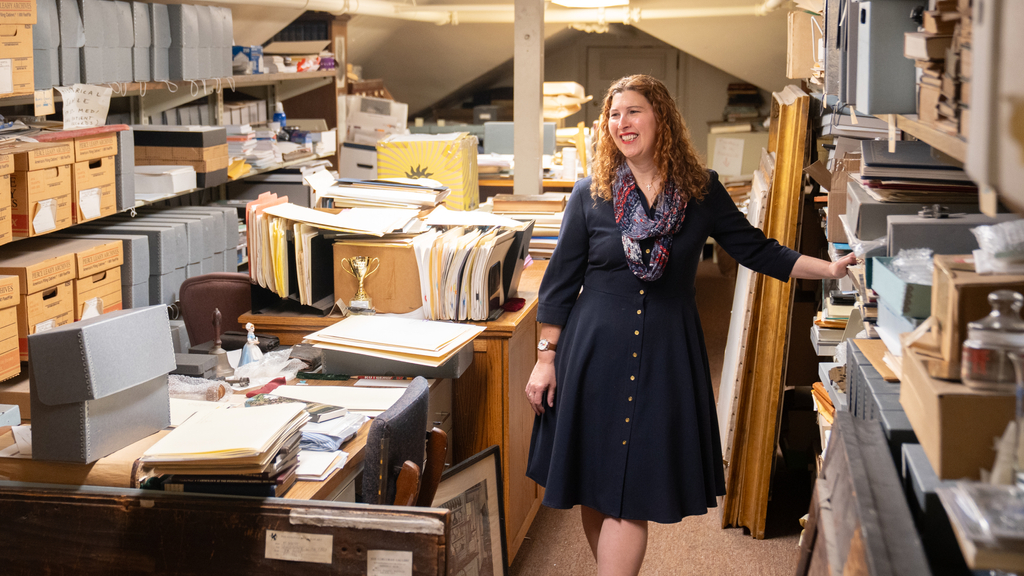
Peeples has joined forces with other Philadelphia organizations—the Mütter Museum, the American Philosophical Society Museum, the Museum of the American Revolution—to help build on each other’s records. “Anyone working in an institution with ties to Benjamin Franklin eventually works together,” she said. A recent collaboration with the Fireman’s Hall Museum assessed how the hospital reacted to the city’s historic fires and provided care for injured firefighters.
“It’s rewarding to discover something new,” she said. “Even if we don’t have all the answers, there are people actively looking into some of this to try to fill in these gaps and complete the story.”
Finding the extraordinary in ordinary life
Peeples finds the extraordinary in ordinary things, like letters, diary entries, and personal items from physicians and nurses that give a glimpse into daily life from decades and centuries past.
“There’s a play called ‘Our Town’ with the message that the ordinary days are the most meaningful,” Peeples said. “I would love to time travel to a random day at the hospital and see exactly that—just a regular day.”
Nurses’ uniforms—thick, wool capes adorned with gold buttons that depict the hospital seal of the “Good Samaritan”—are some of Peeples’ favorite pieces in the collection. Many were donated by former nurses or their families.
Peeples is not only documenting the past. Especially as more modern notes become digital, she is intentional as she stewards contemporary records to continually build the collection. This ensures that future researchers have access to “ordinary life” items from more recent times, like documentation from the COVID-19 pandemic. These have built upon the archives’ materials from past infectious outbreaks, which include administrative notes from the 1918 influenza epidemic.
“Most of the archives are paper based. So much exists in computers now. People don’t keep the same notes or journal like they once did,” said Peeples. “But seeing what people wrote down, what they took the time to write about, sets you in a time and place.”
In 2021, Peeples encouraged the hospital’s frontline staff to share the human experience of the pandemic for a time capsule to be opened in 100 years. Staff submitted personal items like the ribbon used for the opening of a vaccine clinic, a framed photo of a Christmas tree decorated with face masks, and handwritten letters.