
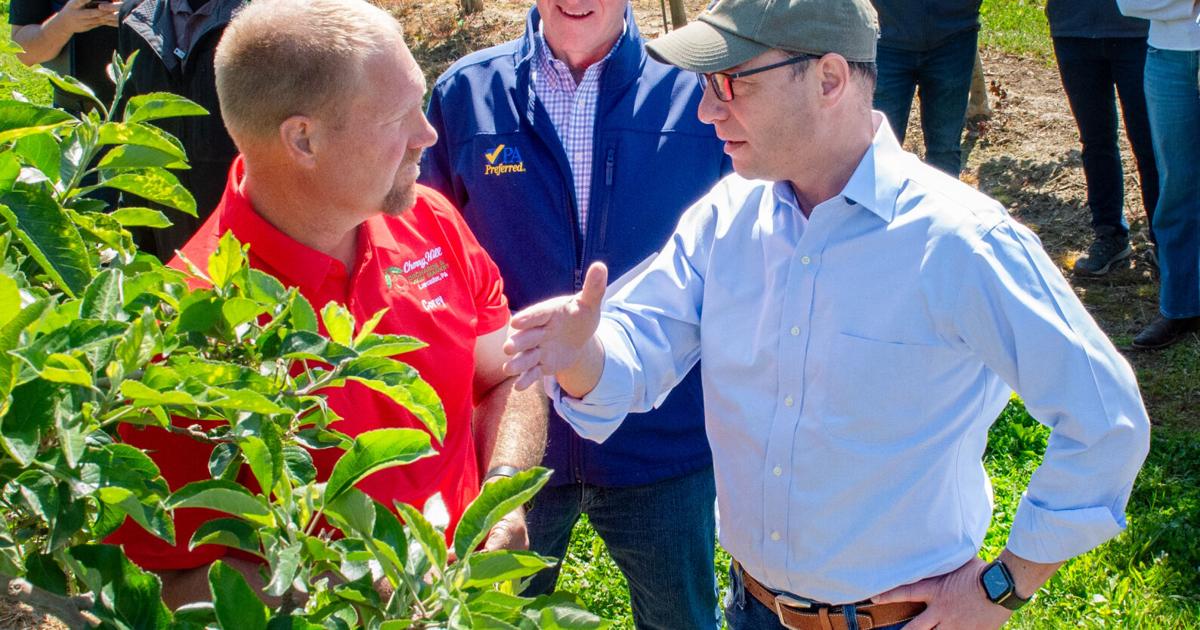
Pennsylvania specialty crop farmers will likely see losses of $150 million to $200 million after an early spring cold snap damaged crops across the state April 21, Gov. Josh Shapiro said Friday morning during a visit to Cherry Hill Orchards in Pequea Township.
The trip came weeks after Lancaster County growers of apples, apricots, peaches, cherries, strawberries and other crops saw devastating damage caused by a late frost.
Corey McCleaf, owner of Cherry Hill Orchards, said Friday he has virtually no apples or peaches to sell now and won’t see revenue from those fruit trees until fall 2027, even though he has to continue paying for pruning, labor and dealing with pesky bugs to make sure his plants survive for next year.
Close
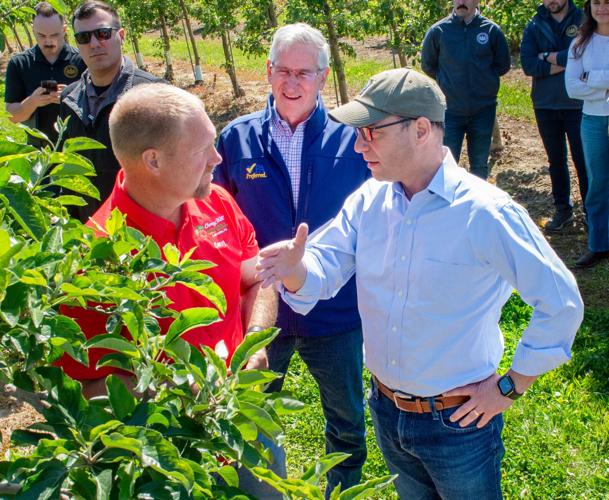
Corey McCleaf, owner of Cherry Hill Orchards, in Pequea Township, left, talks with Pennsylvania Gov. Josh Shapiro, right, and Secretary of Agriculture Russell Redding in an apple orchard at Cherry Hill Orchards on Friday, May 8, 2026.
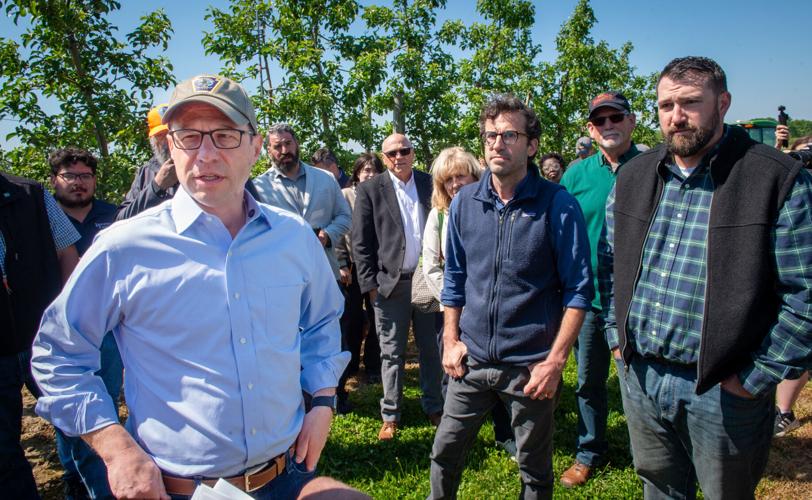
Pennsylvania Gov. Josh Shapiro, left, talks with farmers at Cherry Hill Orchards, in Pequea Township on Friday, May 8, 2026.
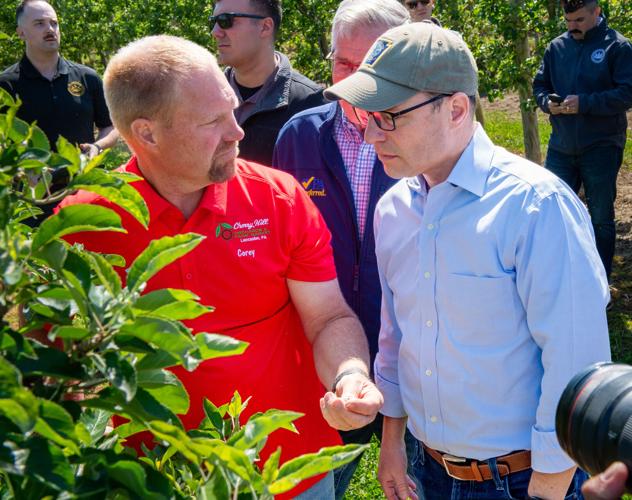
Corey McCleaf, owner of Cherry Hill Orchards, in Pequea Township, left, talks with Pennsylvania Gov. Josh Shapiro, right, and Secretary of Agriculture Russell Redding in an apple orchard at Cherry Hill Orchards on Friday, May 8, 2026.
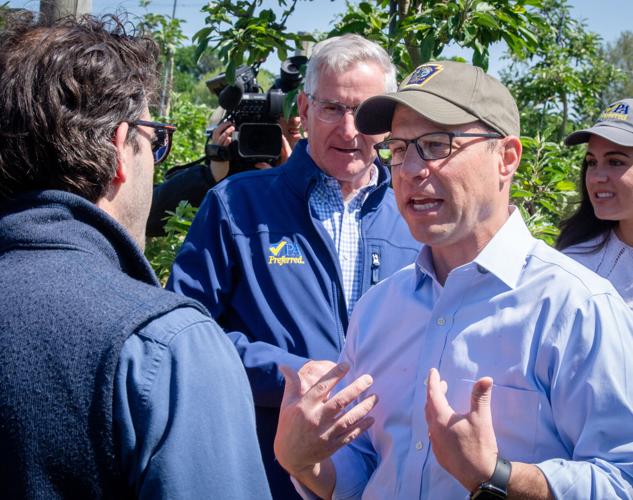
Pennsylvania Governor Josh Shapiro, right, talks with a farmer about losses due to the freeze in April while touring Cherry Hill Orchards in Pequea Township on Friday, May 8, 2026. Pennsylvania Secretary of Agriculture Russell Redding is in the background, center.
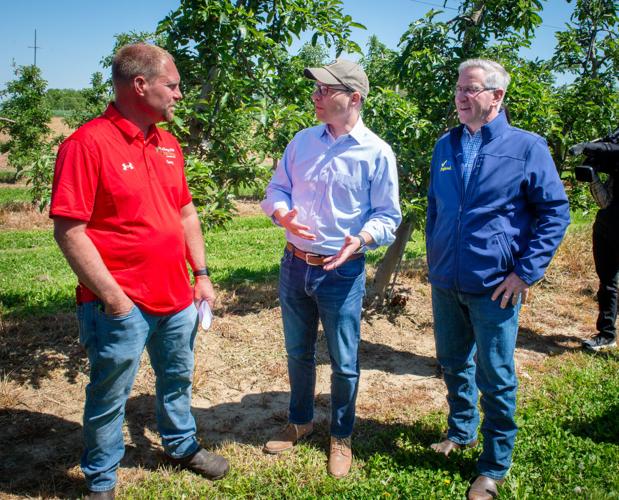
Corey McCleaf, owner of Cherry Hill Orchards in Pequea Township, left, talks with Pennsylvania Gov. Josh Shapiro, center, and Secretary of Agriculture Russell Redding in an apple orchard at Cherry Hill on Friday, May 8, 2026.
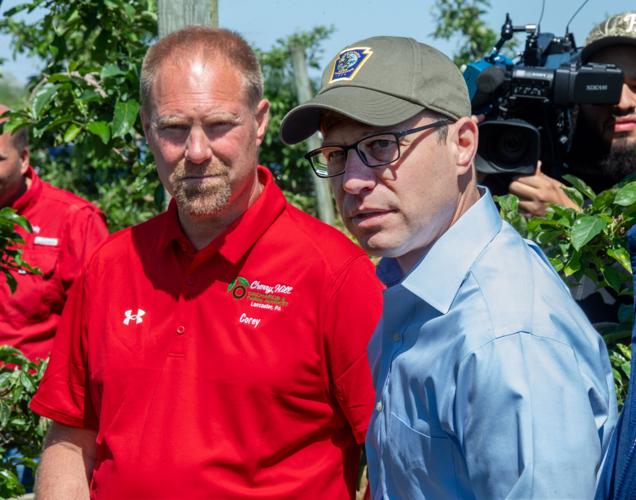
Corey McCleaf, owner of Cherry Hill Orchards, in Pequea Township, left, stands with Pennsylvania Gov. Josh Shapiro, as Shapiro talks with farmers at Cherry Hill Orchards on Friday, May 8, 2026.
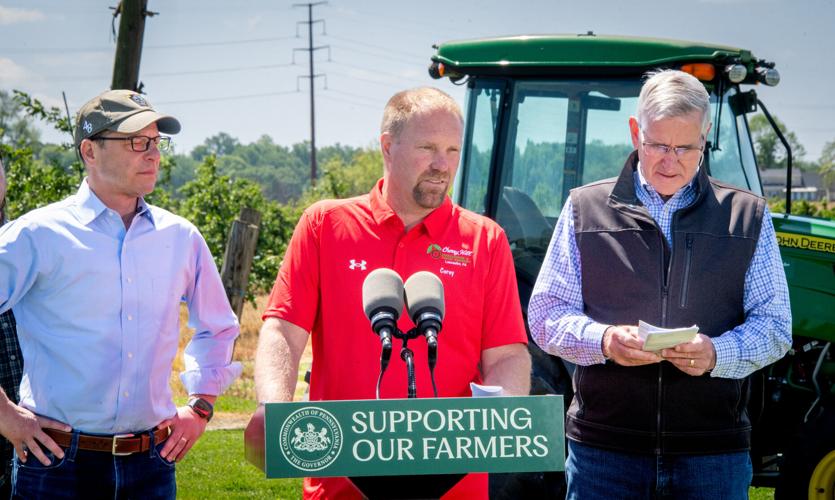
Corey McCleaf, owner of Cherry Hill Orchards, in Pequea Township, center, talks stands beside Pennsylvania Gov. Josh Shapiro, left, and Secretary of Agriculture Russell Redding during a news conference at at Cherry Hill Orchards on Friday, May 8, 2026.
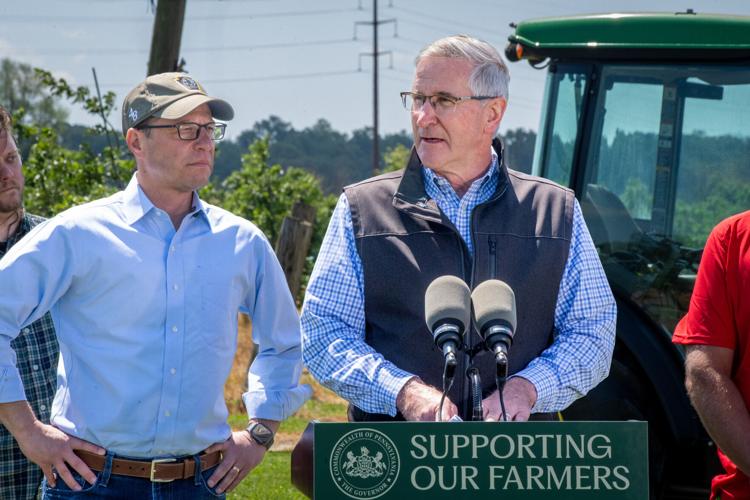
Pennsylvania Gov, Josh Shapiro, left, stands with Secretary of Agriculture Russell Redding as Redding speaks at Cherry Hill Orchards, in Pequea Township, on Friday, May 8, 2026.
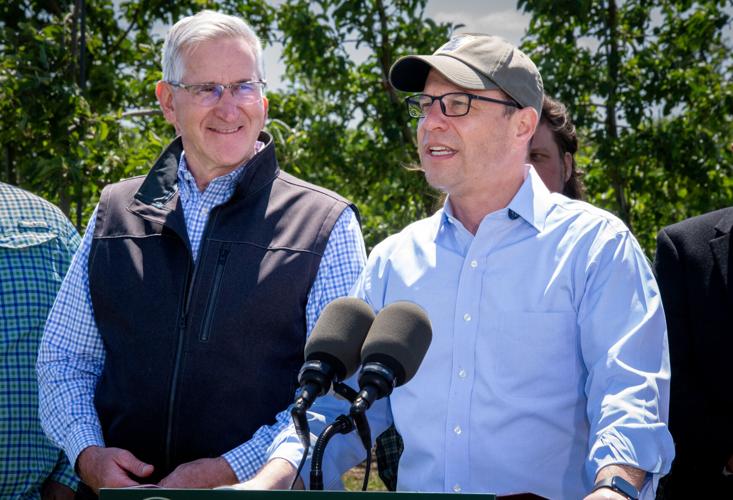
Pennsylvania Secretary of Agriculture Russell Redding, left, stands with Gov. Josh Shapiro as Shapiro speaks at Cherry Hill Orchards, in Pequea Township on Friday, May 8, 2026.
Corey McCleaf, owner of Cherry Hill Orchards, in Pequea Township, left, talks with Pennsylvania Gov. Josh Shapiro, right, and Secretary of Agriculture Russell Redding in an apple orchard at Cherry Hill Orchards on Friday, May 8, 2026.
Pennsylvania Gov. Josh Shapiro, left, talks with farmers at Cherry Hill Orchards, in Pequea Township on Friday, May 8, 2026.
Corey McCleaf, owner of Cherry Hill Orchards, in Pequea Township, left, talks with Pennsylvania Gov. Josh Shapiro, right, and Secretary of Agriculture Russell Redding in an apple orchard at Cherry Hill Orchards on Friday, May 8, 2026.
Pennsylvania Governor Josh Shapiro, right, talks with a farmer about losses due to the freeze in April while touring Cherry Hill Orchards in Pequea Township on Friday, May 8, 2026. Pennsylvania Secretary of Agriculture Russell Redding is in the background, center.
Corey McCleaf, owner of Cherry Hill Orchards in Pequea Township, left, talks with Pennsylvania Gov. Josh Shapiro, center, and Secretary of Agriculture Russell Redding in an apple orchard at Cherry Hill on Friday, May 8, 2026.
Corey McCleaf, owner of Cherry Hill Orchards, in Pequea Township, left, stands with Pennsylvania Gov. Josh Shapiro, as Shapiro talks with farmers at Cherry Hill Orchards on Friday, May 8, 2026.
Corey McCleaf, owner of Cherry Hill Orchards, in Pequea Township, center, talks stands beside Pennsylvania Gov. Josh Shapiro, left, and Secretary of Agriculture Russell Redding during a news conference at at Cherry Hill Orchards on Friday, May 8, 2026.
Pennsylvania Gov, Josh Shapiro, left, stands with Secretary of Agriculture Russell Redding as Redding speaks at Cherry Hill Orchards, in Pequea Township, on Friday, May 8, 2026.
Pennsylvania Secretary of Agriculture Russell Redding, left, stands with Gov. Josh Shapiro as Shapiro speaks at Cherry Hill Orchards, in Pequea Township on Friday, May 8, 2026.
He is not alone in that problem, according to state Secretary of Agriculture Russell Redding. Growers across the Mid-Atlantic are suffering.
“This is not limited to Pennsylvania. This is from the Shenandoah to the Hudson valleys,” Redding said.
Lancaster County ranks fourth in Pennsylvania — behind Adams, Erie and Franklin counties — for fruit and berry production, according to the 2022 agricultural census. Its fruit industry generates more than $13 million in annual sales. The census is conducted every five years by the U.S. Department of Agriculture.
Shapiro said he has already submitted a letter asking Brooke Rollins, the U.S. Secretary of Agriculture, to approve emergency funding to support Pennsylvania farmers through a USDA disaster declaration. If a loss assessment shows Pennsylvania has suffered at least a 30% loss of at least one crop, the USDA may make growers eligible for low-interest emergency loans.
Redding could not provide a timeline for when farmers would receive those loans, or how much the loans would cover. But he said he was confident Pennsylvania growers in the disaster area would be eligible.
“Everything that we’ve seen and have heard shows a 70 to 80 to 90 to 100% loss,” Redding said.
Next steps
Aside from asking for federal emergency dollars, Shapiro said he also plans to work with the USDA Risk Management Agency to negotiate better crop insurance options for affected farmers and ask for support from the Pennsylvania Legislature.
Redding and Shapiro said members of his administration would meet with the RMA next week in an attempt to get flexibility on crop insurance that would incentivize farmers to harvest the crops they have while getting them through a year without a paycheck.
As for state-level support, Shapiro said he planned to submit language to the Legislature on Friday afternoon to allow dollars from the $75 million Highly Pathogenic Avian Influenza Recovery Fund to also assist farmers hurt by the April freeze.
The state Senate and House of Representatives would have to agree to make those dollars, originally allocated to support poultry farmers impacted by bird flu, flexible.
“I’m confident we’ll be able to get bipartisan consensus on that,” Shapiro said.
Pennsylvania Sen. James Malone and Pennsylvania Sen. Judy Schwank, both Democratic members of the state Senate Agriculture & Rural Affairs Committee, voiced support for the action Friday.
Either way, Shapiro urged farmers to seek insurance dollars from their respective agriculture insurance agencies, since it will be difficult to fully compensate Pennsylvania farmers considering the scale of losses.
“There will not be one fund that covers 100% of the cost, but hopefully we can cobble these different resources together to help. I think it’s safe to say we will not be able to make up dollar-for-dollar losses, but we will do everything in our power to help sustain these farmers,” Shapiro said.
McCleaf, who has crop insurance, said he knows his insurance won’t be a full fix.
“It’s a Band-Aid. It’s all right if you still have some fruit, but man, if you don’t have any fruit …,” McCleaf said.
Beyond Lancaster County
The ripple effects of a freeze that kills large swaths of crops extend beyond the grower. Farmers, packers and elected officials Friday said farm labor forces and the packing and processing industries across the state also will be affected.
Some farmers had time to cancel their H-2A contracts — which allow U.S. employers who meet certain requirements to bring foreign nationals to the United States to fill temporary agricultural jobs — after the freeze. But representatives with Cherry Hill Orchards said they already spent $6,000 to $7,000 on a contract for laborers who won’t be able to do their jobs as originally planned.
Ben Rice, president of Rice Fruit Co. in Adams County, said his packing business doesn’t have crop insurance, which leads to a gap in coverage when his revenue is directly tied to the volume of now-damaged crops that comes in.
Plus, he said he worries about states unaffected by the freeze swooping in to take up spots at markets and grocery stores.
“That shelf space, it would be very hard to get back,” Rice said.
Mark Boyer, owner of Ridgetop Orchards in Bedford County, said financial support from the USDA can take between a year to two years to actually get to growers. In the meantime, he said he’s coping with the uncertainty by hanging out with his three sons and coaching baseball. In the April freeze, Boyer’s orchard suffered a 95% loss, losing all his cherries and peaches, as it was hit by some of the coldest temperatures recorded in the state.
“We’ve had to cut a lot of employment. We’re running just a really tight ship,” Boyer said.
Ben Wenk of Three Springs Fruit Farm in Adams County, which also makes an alcoholic cider brand that sells to some Lancaster County vendors and restaurants, said despite his diversified revenue stream, this is still uncharted territory. He said he won’t be able to capitalize on his seasonal peaches, which drives his supply to regional markets.
Ed Weaver, owner of Weaver’s Orchard in Berks County, is now looking for new opportunities after significant losses, such as planting more strawberries, planting more flowers for a cut flower operation, preparing to grow more pumpkins and planning more experiential events.
“It’s all to keep our business on the radar,” Weaver said
Success! An email has been sent to with a link to confirm list signup.
Error! There was an error processing your request.