
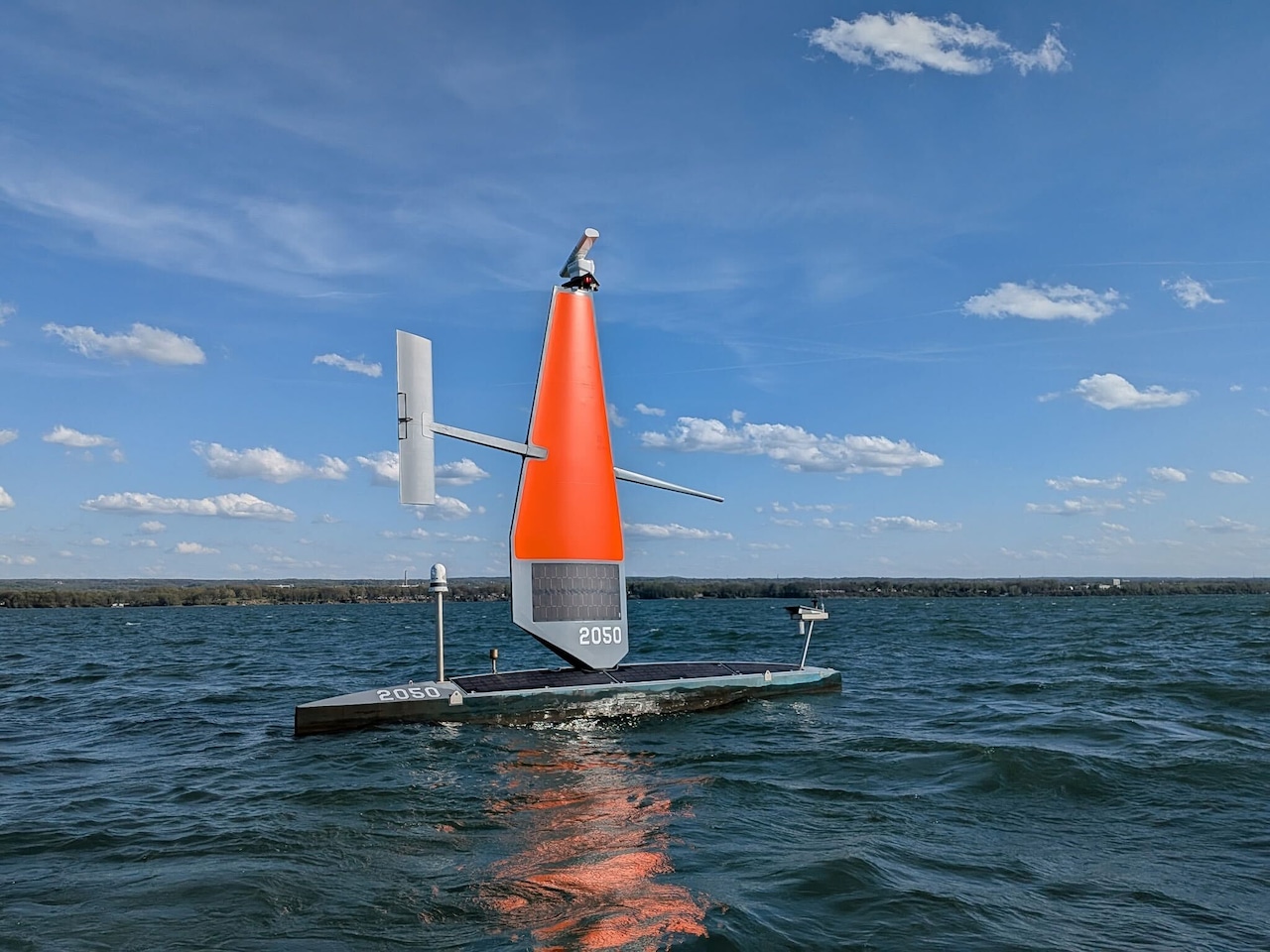
The U.S. Coast Guard now has boats that can stay on the water for months at a time without refueling or returning to docks for provisions.
They’re autonomous sailboats, powered almost entirely by the wind and sun, that Today in Ohio podcast hosts described as something out of the future.
Host Lisa Garvin said the sleek 33-foot boats are primarily for search and rescue and fishing regulation enforcement. They have 19-foot masts and vertical wing sails and are built by a California company called Saildrone.
Traditional Coast Guard vessels need to be refueled roughly every three days, but these boats can patrol for months. Two are operating in Lake Erie, two in Lake Superior, with plans to deploy one each in Lake Huron and Lake Ontario. Lake Michigan, notably, won’t receive one — it doesn’t share a border with Canada, so there’s no cross-border enforcement mission there.
“This story tickled me,” said host Chris Quinn. “Just because it’s so seemingly high tech. There was a movie a few years back called Interstellar where there were drones in the sky that just flew nonstop because they were powered by the sun. And it seems so futuristic, but to have sailboats just racing around Lake Erie for months at a time blows my mind.”
Garbin noted that these drones are not buzzing surveillance machines hovering overhead. They’re vessels — quiet, wind-driven, and capable of covering enormous stretches of open water without burning a drop of fossil fuel. The electric motor onboard is there for precision maneuvering when needed, but the primary propulsion is entirely renewable.
Garvin said the mission scope is broader than just fishing enforcement. The Coast Guard also will use them to search for undocumented people attempting to use Lake Erie to gain entry into the United States. The sailboat drones add a persistent, low-cost surveillance layer that traditional vessels simply can’t match.
And Saildrone isn’t just playing in the Great Lakes. According to the company’s president, John Mustin, Saildrone has 70 drones currently on missions around the world — including in the Middle East, the Pacific, and the Arabian Gulf. The company is also actively working with the U.S. Navy on an armed version of the technology, though the current Great Lakes deployment is entirely unarmed.
Quinn noted his hope that there will be more reporting on how these drones perform over the coming months as their use ramps up.
Listen to the conversation here.
Listen to full “Today in Ohio” episodes where Chris Quinn hosts our daily half-hour news podcast, with Editorial Board member Lisa Garvin, Impact Editor Leila Atassi and Content Director Laura Johnston.