

TOLEDO, Ohio — The National Oceanic Atmospheric Administration’s National Centers for Coastal Ocean Science released early season projection for western Lake Erie’s harmful algal blooms, which are forecasted to be moderate, but the level could change.
What You Need To Know
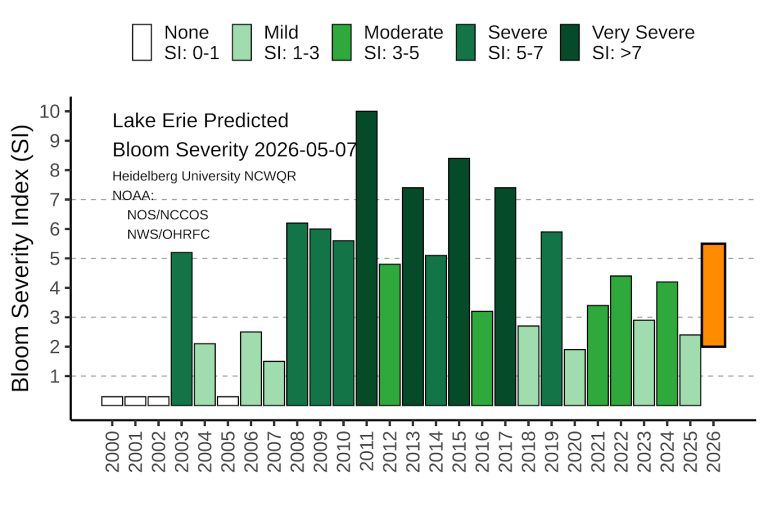
Currently, models predict a bloom severity between 2 and 5.5
The severity index is based on the bloom’s amount of algae, according to Ohio State University, during the peak 30 days of the bloom
NOAA said it will issue weekly projections of the bloom’s severity through mid-June
It will also issue the official Lake Erie HAB Seasonal Forecast on June 25

NOAA said the severity of the cyanobacterial harmful algal bloom (cyanoHAB) depends on the total bioavailable phosphorus (TAP) from the Maumee River during loading season, which starts in March and ends in July.
Currently, models predict a bloom severity between 2 and 5.5.
The severity index is based on the bloom’s amount of algae, according to Ohio State University, during the peak 30 days of the bloom. Anything between a 3 to 5 is considered a moderate bloom, whereas an index above 5 indicates more severe algal blooms.
(NOAA)
HABs have a blue-green algae called cyanobacteria, which is capable of producing a toxin called microcystin. It’s a liver toxin that can cause harm to human and wildlife health, according to OSU. While it impacts health, it also impacts local governments and economies. Cities tend to add more treatment to drinking water, as well as close beaches and other areas, which can prevent people from fishing, swimming, boating and just visiting.
OSU said HABs have an annual economic impact estimated at over $70 million for the Lake Erie region.
OSU said while HABs may differ in size, the mass doesn’t indicate how toxic it is. Each algal bloom can be unique.
“Throughout the spring, conditions have been relatively wet with a particularly high precipitation and associated river TBP input event in early April,” NOAA said. “The uncertainty for the forecast should continue to narrow as additional river discharge and phosphorus loads are measured over the next two months.”
NOAA said it will issue weekly projections of the bloom’s severity through mid-June. It will also issue the official Lake Erie HAB Seasonal Forecast on June 25.
To learn more information on algal blooms, click here.