
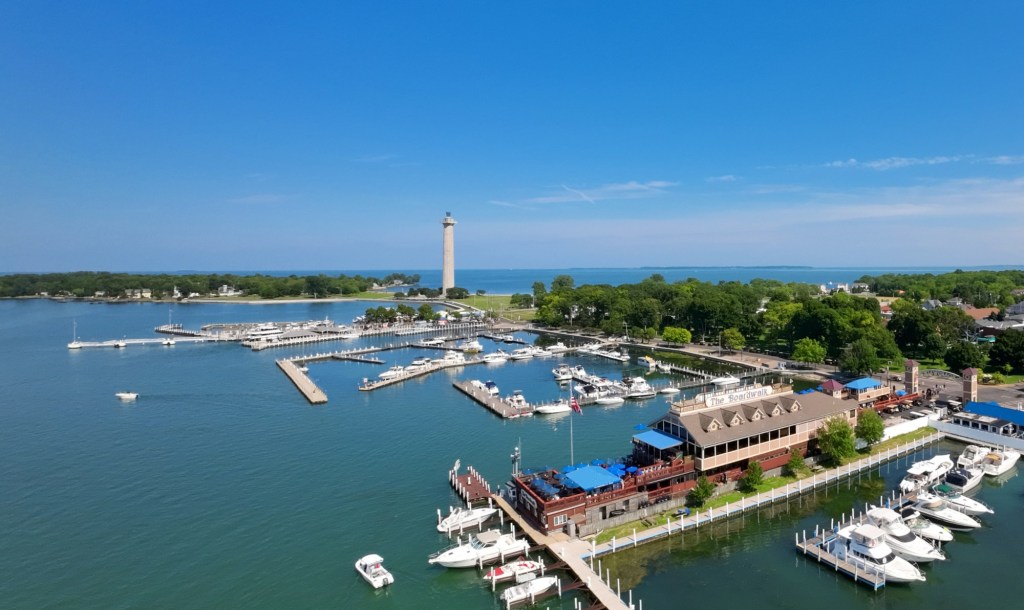
Many of us agree that Lake Erie is the best of the Great Lakes.
Warmer and shallower than the other four, it has long, sandy beaches, spectacular sunsets and scores of activities along its coasts.
Its history comes into focus on the Lake Erie Islands, left behind when ancient glaciers retreated tens of thousands of years ago to create a sprawl of more than a dozen landmasses on the Ohio side alone. Only six of them are inhabited, with South Bass and Kelleys islands most easily reached by ferry.
Back on the mainland, Marblehead, with the oldest continuously operating lighthouse on the Great Lakes, has a private toll causeway ($2) connecting it with Johnson Island, where Confederate Civil War dead are spending eternity. The 200-plus graves in the Confederate Stockade Cemetery were officers who died in captivity while imprisoned on the island between 1862 and 1865.
A 20-minute ferry ride away is South Bass Island, where the village of Put-in-Bay is known as the Key West of the North, with a lively party scene fueled by its many bars. Its year-round population of under 200 swells to a half-million during its April-to-October summer season. Its public school, which also serves students from other islands, is one of the smallest in the state, with a graduating class of just 14 in 2025.
The island’s guest rooms range from the Victorian-era 1870 Park Hotel right downtown, with its dorm-style bathrooms down the hall, to modern condominiums and vacation homes.
South Bass Island’s most prominent feature is the 352-foot-tall Perry’s Victory and International Peace Memorial, now closed as it undergoes a $20 million renovation. Its pink granite column, visible from the mainland, is said to be the third-tallest national memorial in the United States, after the Gateway Arch in St. Louis and the Washington Monument. But its visitor center remains open; there, the National Park Service staffers will explain the significance of the September 1813 Battle of Lake Erie, which established the northern border of the United States with Canada. That 5,525-mile line remains the longest undefended border in the world.
When it reopens in spring 2028, views all the way to Canada’s mainland again will be the reward from its observation deck.
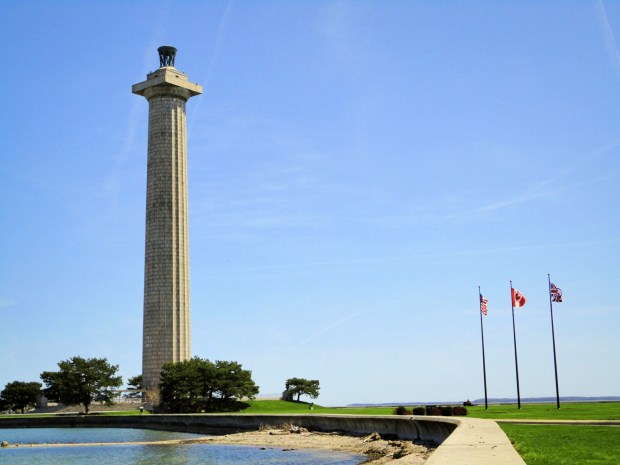 The 352-foot-tall Perry’s Victory and International Peace Memorial, now closed for a $20 million renovation, dominates the Lake Erie Islands. But National Park Service staff in its visitor center explain how it pays tribute to Oliver Hazard Perry’s victory over the British in the War of 1812, resulting in the 5,525-mile U.S. border with Canada, the longest undefended border in the world. (Courtesy of National Park Service)
Islanders would likely all be Canadian if it weren’t for the epic naval battle against the British led by Commodore Oliver Hazard Perry off South Bass Island in the War of 1812, which won all of the Great Lakes for the United States. Perry captured or destroyed all six British ships in the Battle of Lake Erie, then messaging Gen. William Henry Harrison that, “We have met the enemy, and they are ours.”
Before that battle, Perry surveyed the watery battleground from Gibraltar Island, in the bay of what would later become the town of Put-in-Bay, and gathered water for his troops from the caves on South Bass Island.
No one settled South Bass Island until the 1840s, but by the turn of the 20th century, steamships delivered passengers to the tiny island of Gibraltar and the Victory Hotel, touted as the world’s first fully electrified and largest wood-frame hotel. Constructed on the area’s highest elevation, it burned to the ground in 1919 in a spectacular fire, visible in Detroit, some 60 miles away.
Today’s 6.5-acre Gibraltar Island is home to Stone Laboratory, established in 1895 and now the oldest freshwater biological field station in the United States. It‘s managed by The Ohio State University, which gives 90-minute walking tours of the site.
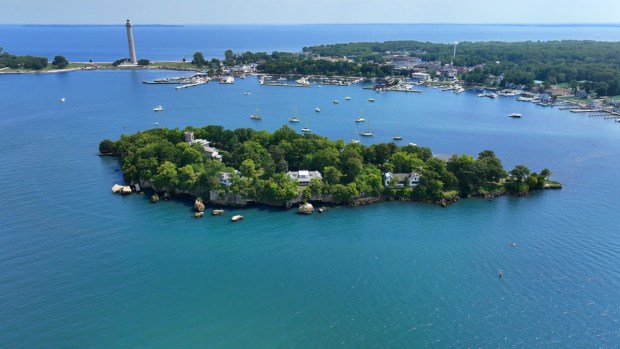 The 6.5-acre Gibraltar Island, in the bay of Put-in-Bay, can be visited on Thursday walking tours hosted by The Ohio State University staff from Stone Laboratory, who operate the country’s oldest freshwater biological field station there. (Courtesy of Shores & Islands Ohio)
Consider a South Bass Island visit to coincide with Lake Erie Awareness Day on Aug. 6, when a half-dozen education stations may be visited to discover the magic of Lake Erie’s culture while learning about island history, native plants and animals.
Explore by foot, bicycle or golf cart, meandering around Put-in-Bay among the stations. They include Perry’s Victory and International Peace Memorial, 93 Delaware Ave.; Lake Erie Islands Nature and Wildlife Center, 255 Meechen Road; South Bass Island State Park, 1523 Catawba Ave.; Aquatic Visitor Center, 360 W. Shore Blvd.; Duff Woods Preserve, 913-999 Mitchell Road; and the South Bass Island Lighthouse, 2368 Langram Road.
Better yet, take the Put-in-Bay Tour Train, which is adding stops to include each station. Board it downtown at the Train Depot, 154 Delaware Ave., and step off at each stop. The hop-on-hop-off tour itself is just under an hour but can be stretched to the better part of a day to give visitors a good look at the island. The $15 ticket is good for one trip around the entire circuit.
One stop is at Crystal Cave, beneath the four-generation Heineman Winery and said to be the largest celestite geode in the world. Tours of Crystal Cave, created eons ago from pale blue strontium sulfate crystals called celestine, can be arranged with the winery. Those tours, along with tastes of grape juice from its vineyards, helped the Heineman Winery survive during Prohibition. The strontium sulfate, today used in electronics, was mined and sold by the Heineman family for making fireworks. When ignited, it produces a bright red color.
Just across the street is Perry’s Cave, another good place to cool off on steamy summer days.
Kelleys Island, the largest of the American islands in Lake Erie, is a peaceful contrast to the party scene of Put-in-Bay on South Bass Island. Its year-round population of about 300 people includes many living in lovely homes with wide wraparound porches and impeccable landscaping. Some are rented out to vacationers.
The 677-acre Kelleys Island State Park covers the north side of the island. In addition to its campsites, it rents furnished yurts, which sleep six, and basic four-person cabins. (Visit ReserveOhio.com or call 866-644-6727.)
The 396-foot-long, 30-foot-wide glacial grooves, for which Kelleys Island is widely known, also are part of the state park. The grooves in the rock — created when glaciers retreated — illustrate the raw power of the geological forces of the ice age.
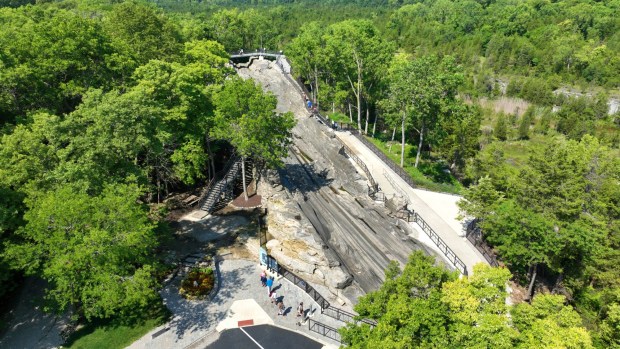 The 30-foot-wide and 396-foot-long glacial grooves on Kelleys Island can be examined from all sides thanks to a boardwalk around them. Formed when glaciers retreated in the ice age, they illustrate the power of the past. (Courtesy of Shores & Islands Ohio)
After learning about the many fossils in the glacial grooves, you may wish to hunt for them yourself on Kelleys Island. That’s not possible at the grooves themselves, but fossils may be found in other locations on the island. Ask at the state park. Land that was covered by the glaciers once was at the bottom of a vast tropical sea, as evidenced by the many fossilized corals, trilobites and cephalopods that can be found along the shore and East Quarry Trail in the state park.
On the other side of the island is Inscription Rock, a 32-by-21-foot limestone boulder covered with pictographs of animals and people carved by the Erie Indians, aka the Cat Nation, who spent summers here in the 1600s.
Travelers’ checks
The Lake Erie Islands are about 70 miles east of Cleveland on Route 2. Your best resource for information, ferry schedules and lodging is Shores & Islands Ohio at shoresandislands.com or info@shoresandislands.com. It operates welcome centers in both Sandusky (800-255-3743) and Port Clinton (800-441-1271).
If you wish to bring your car to Kelleys Island, you’ll need to take the Kelleys Island Ferry (800-876-1907) from Marblehead.
Miller Ferry (800-500-2421) runs to South Bass and Middle Bass islands from Port Clinton and also can accommodate vehicles.
The Jet Express (800-245-1538) takes pedestrians to both islands from Port Clinton and Sandusky.
The Goodtime 1 (419-625-9692) offers an all-day boat tour that includes time ashore for exploring both Kelleys and South Bass islands.
Do some research to learn what it will cost to park your car for the time you’ll be on one of the islands. Parking is nearly impossible to find in downtown Put-in-Bay, and the fee is $5 an hour, even for rental golf carts. Before accepting your car, ferry boat operators may ask to see proof of accommodations in Put-in-Bay because parking is at such a premium.
It’s easy to take your bicycle on the ferry, and golf carts can be rented near ferry terminals on both islands.
Ninety-minute walking tours of Gibraltar Island and Stone Lab take place on Thursdays from mid-June to mid-August and cost $12 for adults. Transportation by water taxi is an additional $8 from the Boardwalk Marina in Put-in-Bay.