
Inside William Penn’s recovery strategy
William Penn serves approximately 5,000 students from the boroughs of Aldan, Colwyn, Darby, East Lansdowne, Lansdowne and Yeadon. A majority of the district’s students in Delaware County come from economically disadvantaged households.
The district was among six that successfully sued Pennsylvania in 2014, arguing that the state’s funding model was discriminatory and unconstitutional. A landmark ruling in 2023 sided with the districts, but it did not immediately resolve the district’s persistent money problems.
Becoats’ introduction to the district coincided with the COVID-19 pandemic. Although the decline in the nation’s reading test scores predates the quarantine, the period of subsequent shutdowns and social-distance learning saw the cratering of academic measures of success across the board.
“The pandemic basically highlighted the fact that there were districts in Pennsylvania that did not have some basic resources, I would say, that were needed for our 21st-century education,” Becoats said.
He said William Penn did not let the pandemic upend the implementation of its strategic plan.
In fact, he said, the district leveraged the influx of federal relief dollars to purchase more educational tools, provide professional development for teachers and improve the infrastructure of the buildings.
“In addition to that, we also implemented an instructional model that focused on supports being in schools,” Becoats said. “So every school had an instructional facilitator. Every school had two academic interventionists.”
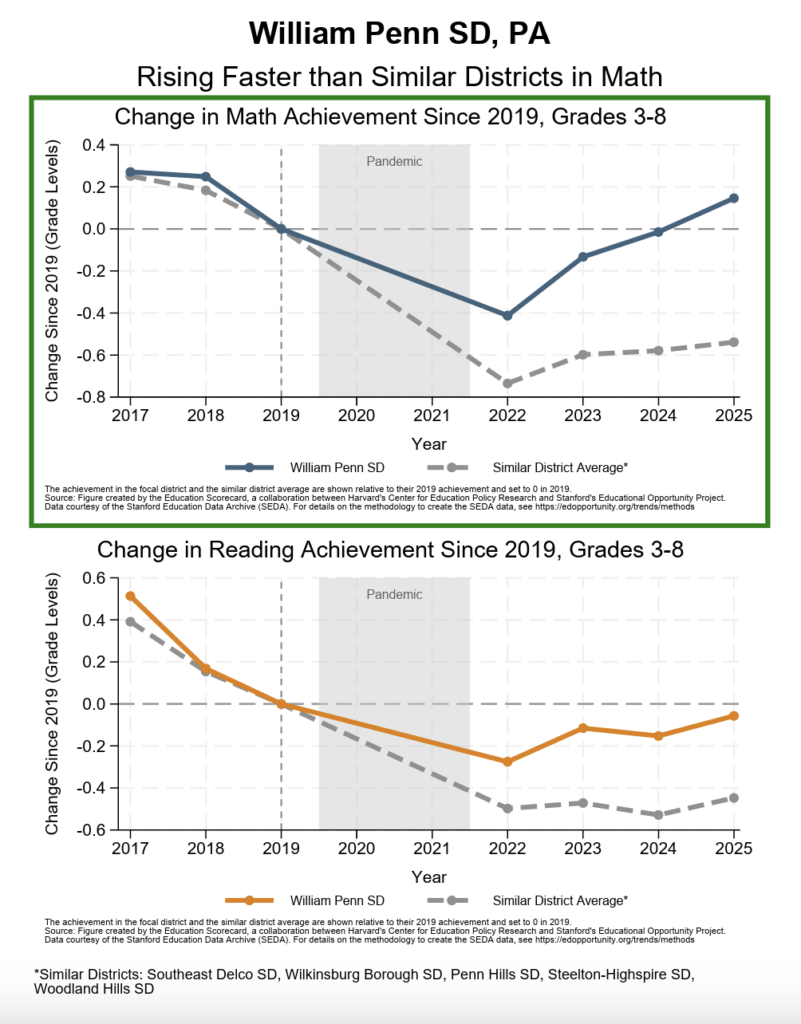
The researchers behind the Education Scorecard also highlighted William Penn’s use of frequent assessments to track student progress, along with quarterly review sessions and the hiring of a research supervisor.
“Are we perfect? No,” Becoats said. “[In] no way, form or fashion are we perfect, but we have a model that I think works and we have a model that I believe will continue to move the district forward.”
The role of money in academic recovery from the pandemic
Becoats cautioned that any future breaks or gaps in funding could slow the trajectory of recovery.
“We now need to make sure that we continue to push the state and others to continue the level of funding that they provided for our district,” Becoats said.
His belief in the role of money in pandemic recovery is supported by the data.
Education Scorecard researchers pointed out that much of the recovery has been “U-shaped,” meaning that more affluent districts and the poorest districts — buoyed by federal relief funds — have seen the largest improvements. School districts in the middle of the wealth spectrum have largely not seen such progress.
“The median federal relief grant for the highest-poverty districts was $6,000 per student,” Kane said. “That was about three times as high as the median grant for districts that were 40–50% poor.”
Without the federal grant money, researchers estimated, there would have been no recovery in math in the highest-poverty districts and even larger loss in reading in the highest-poverty districts.
The Education Scorecard report highlights four priorities for education and policy leaders to adopt: Direct more resources to districts with lingering learning losses; lower chronic absenteeism; spend more money on research into student performance; and pair “districts on the rise with similar underperforming peers.”