
PLAINS TWP. — Pennsylvania faces a teacher shortage crisis that needs immediate solutions.
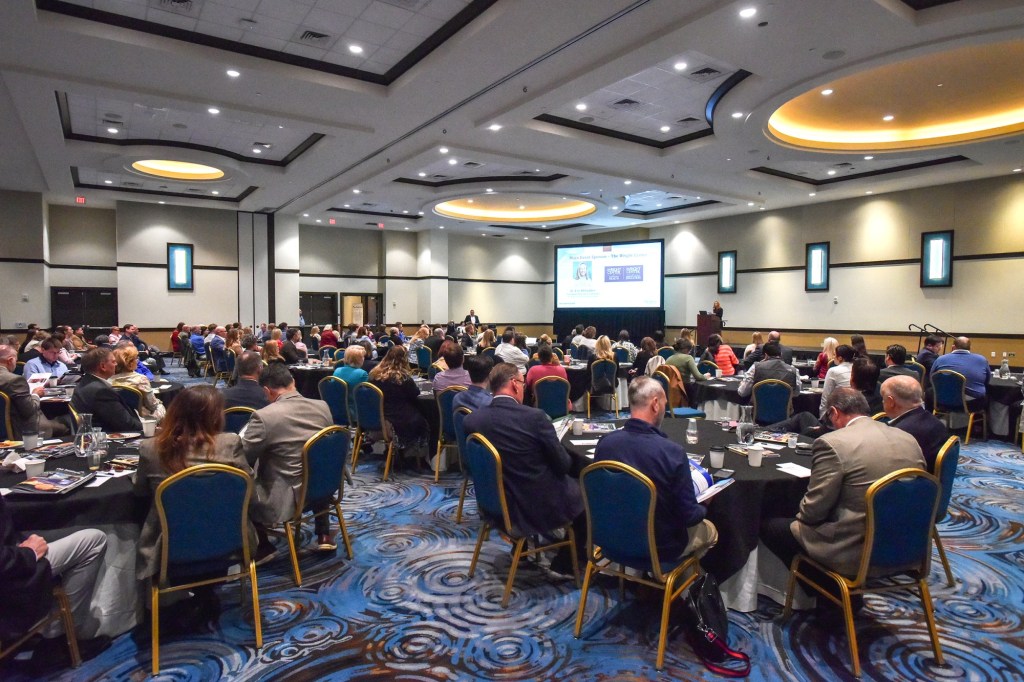
That was one of the messages at the 21st annual Indicators forum hosted by The Institute on Tuesday morning at Mohegan Pennsylvania.
The president and CEO of a two-year technical college with campuses in Scranton and Hazleton discussed ways to mitigate the ongoing teacher shortage — including expanding recruitment pipelines and alternative certification pathways.
During the program, which also addressed healthcare, housing, transportation, and energy, Katie Pittelli, Ed.D., advisory board chair for The Institute, a data analysis, research, and consulting organization, described teacher shortages as one of the most pressing challenges facing education systems across the United States.
“This issue not only affects schools’ ability to operate effectively, but it also threatens long-term student outcomes, workforce development, and community stability,” Pittelli said. “Education is the core of who we are as a region and has a ripple effect for years to come. If we don’t start by finding good teachers in our classrooms, educating our students, then we’ve sort of failed our youth.”
Pittelli noted educators are leaving the field at increasing rates while fewer individuals are entering teacher preparation programs.
“As a result, vacancies go unfilled and schools, especially those in low-income and high-minority communities, struggle disproportionally,” she said.
The exodus of teachers from classrooms began several years ago and the problem will likely grow in the coming years, Pittelli said.
“By the 2022-2023 school year, the state experienced a 36.4% increase in teacher exits from the previous year — the largest single year increase in a decade,” she said.
Several factors contribute to the shortage, including insufficient compensation and reduced long-term benefits; limited administrative support and challenges related to student behavior, which accelerate burnout and turnover; barriers to entry including costly licensure exams; and an aging workforce, Pittelli added.
“Approximately 40% of the region’s education workforce is between 45 and 64 years old, signaling a looming wave of retirements without sufficient new educations in the pipelines,” she said
Despite the challenges, Pittelli expressed some optimism about the future.
“We’re making significant progress,” she said. “We’ve seen an increase in our college educated and skilled workforce, which is critical for economic growth and innovation.”
Ethan Van Gorden, a research analyst for the Institute, said artificial intelligence can help fill in some gaps for educators.
“AI can help teachers develop and customize lesson plans, streamline administrative tasks, and better address individual student needs,” he said. “These advantages are particularly valuable in the region where the higher-than-average student-to-teacher ratios may otherwise limit instructional capacity and personalized learning opportunities.”
Another research analyst, Timothy Ooms, stressed regions with stronger educational pipelines tend to have greater economic stability and labor force participation.
“There’s no secret we’re operating in a tight labor market that is projected to continue for decades,” he said. “In that context, education becomes not a social priority, but an economic necessity. While our K-12 and higher education systems are relatively strong, disparities between districts and rapid shifts in required skills remain major challenges. Similar to other industries, the education sector grapples with a significant shortage of professionals due to both replacement demand and few teachers entering the profession. Across the region, student-to-teacher ratios vary notably, and research consistently shows a correlation between lower ratios and improved student outcomes, particularly in early grades. Education is a driving force between health and well being, employment, and earning potential, as well as overall quality of life.”
As class sizes grow in the lower grades and some instruction may slip through the cracks, Pittelli sees the repercussions at the college level.
“Sometimes, with the teacher shortage, they come in underprepared in the important stuff like math and science, and things that will go on to shape their career,” she said. “It’s really critical that we work together to have teachers to get them off to a good start so that when we see them, they’re prepared.”
Reached following the program, Erin Keating, Ed.D., superintendent of the Scranton School District, said Scranton faces continued challenges hiring instructors.
“We cannot find certificated educators in hard-to-fill subjects like computer science, STEM-based subjects, math, special education, and world languages,” she said. “And you’re in competition with your colleagues, locally, especially when you have one of those very challenging positions to fill. What’s most frightening is that when my generation leaves, within the next three to five years, you’re going to see 30 to 40% of the Scranton School District (educators), like the high schools, evacuate for retirement and there are not going to be certificated people to fill them.”
A very high percentage of the current vacancies for the next school year are in special education, said Tim Wolff, chief of human resources and labor relations for the Scranton School District.
“We’re struggling in the area,” he said. “We have about 60 special ed. positions open, and right now we only have 29 submitted applications. We know there are probably going to be 30-plus emergency certified people. There is definitely still a shortage.”
Wolff credits partnerships with higher education institutions for helping alleviate the problem to some extent.
“We’re working on two grant programs with King’s College and Keystone College that are clearing some pathways for our teachers,” he said “And we started a Grow Your Own program two years ago with Marywood University and East Stroudsburg University, but that’s four or five years away. We’re consistently making other outreach efforts to connect with other local colleges and universities. They’re eager to help us and work together so we have a collaborative relationship trying to fill these positions for our students. “

Chair of The Institute Charlie Kasko speaks in a banquet room at Mohegan Pennsylvania Casino during Indicators 2026 Tuesday, May 12, 2026. (SEAN MCKEAG / STAFF PHOTOGRAPHER)

Director of Financial Planning and Analysis Daniel Haddle speaks in a banquet room at Mohegan Pennsylvania Casino during Indicators 2026 Tuesday, May 12, 2026. (SEAN MCKEAG / STAFF PHOTOGRAPHER)
Show Caption
1 of 2
Chair of The Institute Charlie Kasko speaks in a banquet room at Mohegan Pennsylvania Casino during Indicators 2026 Tuesday, May 12, 2026. (SEAN MCKEAG / STAFF PHOTOGRAPHER)