
YATESVILLE — The Pittston Area Board of Education introduced an approximately $67 million budget Tuesday that keeps taxes level for the sixth straight year.
Speaking after the school board meeting Tuesday, Pittston Area Superintendent Kevin Booth said the budget demonstrated the continued financial stability of the school district as well as its dedication to the community.
“It’s another no tax increase for the taxpayers of Pittston Area School District,” Booth said.
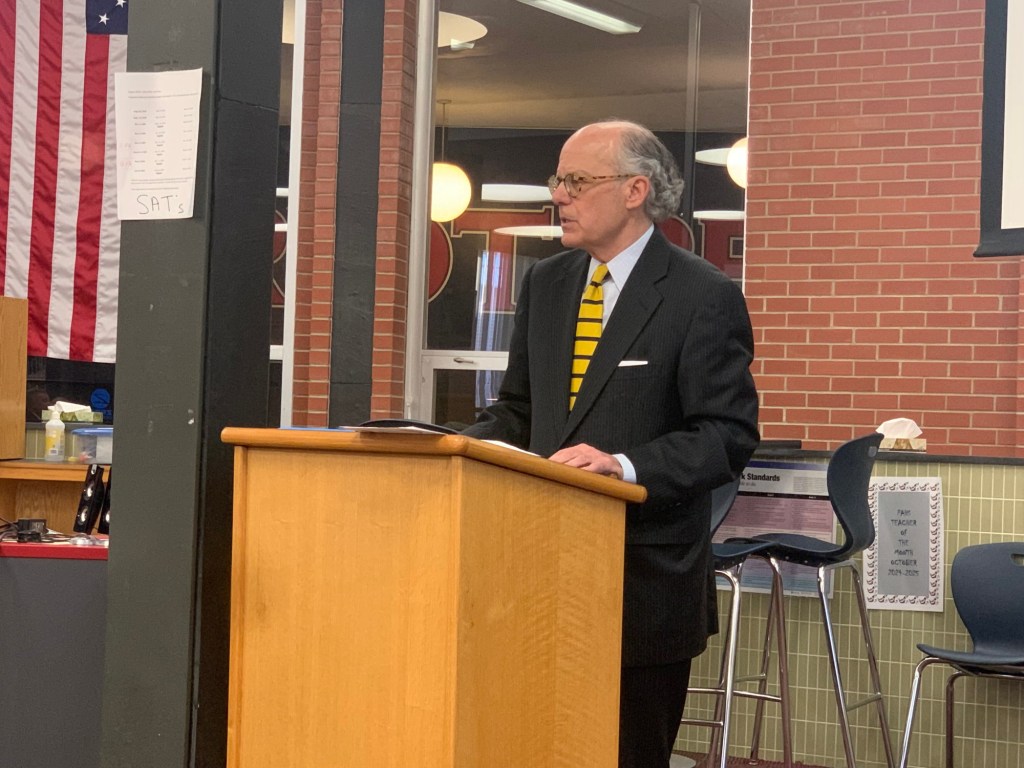
Tom Melone, whose firm performs business-manager duties for Pittston Area, delivered a presentation about the budget before the board’s vote in which he complimented the district on its financial position.
“That’s something the district should be very proud of,” Melone said.
The proposed budget includes a 3.91% annual increase in revenue to $67.57 million and a 4.07% annual increase in expenses to $67.48 million, yielding a surplus for the year of $92,514. Pittston Area is budgeted to collect $35.85 million of that total revenue figure, or 53.05%, from local sources.
Most of that local revenue would be generated from the property tax, which would be set at a rate $16.5413 per $1,000 of assessed value — remaining at the millage it has been set at since the 2021-22 school year. Under this rate, the average homeowner, whose property has an assessed value of $146,622, would pay $2,425.32 in taxes to the school district. If the per-household homestead exclusion, a property-tax break on owner-occupied properties largely funded by the state gambling tax, remains unchanged from last year for Pittston Area, it would reduce this tax bill $215.25 to $2,210.07.
The total local revenue the district will generate is projected to increase despite the lack of tax increase due to what Melone said was the continued growth of the school district’s ratable tax base, which is currently assessed at a value of $1.97 billion.
“Once again, it’s the strong real estate tax base within the district,” Melone said. “Our assessed valuation continues to grow within the district and were certainly the beneficiaries of additional property tax revenue without increasing the millage.”
The proposed budget does not include the annual increases in state education funding Gov. Josh Shapiro has requested from the General Assembly. Instead, the district budget assumes Pittston Area will receive the same amount of state funding granted to it in the state budget the General Assembly adopted for the 2025-26 school year — $29.94 million, or 44.31% of the district’s projected 2026-27 school-year revenue. If the General Assembly ultimately accedes to Shapiro’s full request for more education funds, Melone projects that Pittston Area would receive an additional $1.48 million. Of those potential added support from Harrisburg, $1.24 million would come from state adequacy funding — money the commonwealth distributes to school districts designated in-need pursuant to the seminal 2023 ruling from the Commonwealth Court on fair school funding.
If the General Assembly does adopt a budget before Pittston Area’s next meeting, the finalized state-funding figure will be incorporated into the final budget the school board adopts.
“We’re very hopeful that (a state budget) is adopted by June 30,” Melone said. “If it is not, we’ll adopt without it and then adjust throughout the year.”
These revenues will help Pittston Area fund a set of increasing expenses. Melone projected that salaries will increase 4.2% to $26.54 million; benefits will increase 3.51% to $19.22 million; and certain purchased services will increase 6% to $11.19 million. Melone said factors driving costs higher include the expense of healthcare, transportation, special education placements, and charter-school tuition — factors affecting schools throughout the Wyoming Valley and across the commonwealth.
Melone recommended that the school board be cognizant of the fact that certain costs, such as those related to healthcare, were occasionally volatile and that Pittston Area could utilize tax increases to offset costs in the future. (The tax collection rate of Pittston Area being 90% on a tax base of $1.97 billion, an increase of 1 mill, i.e. $1 per $1,000 of assessed value, would increase revenue $1.77 million if the school board were to decide to hike taxes.)
“I just think it’s important that the board realize that these (costs) are areas that fluctuate in a year,” Melone said. “Although we’re not recommending any of the increases in property taxes, I think it’s important for the board to recognize that there certainly is an alternative and in our property tax base, there is significant revenue to be raised…perhaps down the line.”
The $92,514 surplus Pittston Area is set to achieve in spite of these costs bolsters the district’s growing general-fund balance. Over the last nine years, the Pittston Area fund balance has increased from $5.64 million at the end of the 2016-17 school year to $8.86 million at the end of the 2025-26 school year.
“That’s an indication of a very healthy district with some strong financial trends coming through,” Melone said.
Melone also stressed how the district has capitalized its strong financial situation to direct more funds to finance capital projects, transferring to them a total of $19.65 million from the 2018-19 school year to the 2024-25 school year. Melone said this self-financing has helped Pittston Area avoid borrowing costs that most school districts incur when pursuing capital projects.
Pittston Area Board of Education President Frank Serino praised the budget plan. He said the school district was able to avoid program cuts while continuing investments in capital projects that will enable the district to expand “even further academically.”
“If you look at the success we’ve had…we didn’t do it by cutting, we didn’t do it by eliminating jobs, we did just the opposite,” Serino said. “This board spends a lot of time trying to get to the details, to the bottom of issues, trying to make the right financial decisions in the best interest of the educational process of our kids.”
With its budget introduced, the Pittston Area school board must now adopt a final budget before June 30.