
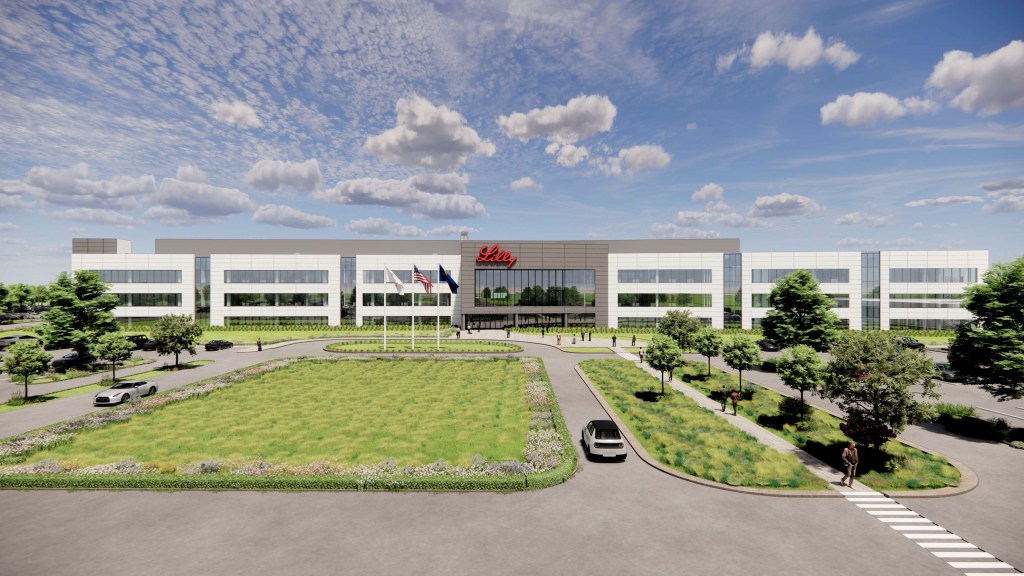
The Parkland School Board tabled a vote Tuesday on a tax break for Eli Lilly, after unveiling new terms to increase the amount of taxes the district would receive in the earlier years of the deal.
The tabled resolution differs from previously discussed proposals in that it eliminates the sliding scale at which the tax break would go into effect over the 10-year deal. Lilly would still get the same overall amount of tax forgiveness, but would end up paying the same percentage of taxes owed each year rather than a gradually increasing amount.
The issue at hand is the Local Economic Revitalization Tax Assistance program known as LERTA, a state program designed to spur investment in “deteriorated areas” that permits township, county and school district officials to authorize tax breaks that allow land owners to delay full payment on the value of construction.
As Eli Lilly progresses with its plans for a proposed $3.5 billion plant in Upper Macungie, debate at the school board level has centered on whether or not the district is being unfairly asked to shoulder the burden of a tax abatement.
Parkland School Board members concerned a tax break for Eli Lilly would shortchange district
Last month the school board reviewed a presentation from the Lehigh Valley Economic Development Corp. that emphasized how much work economic development officials have put in to secure Lilly’s historic investment.
Although school board members are united behind the idea that Lilly’s new plant will bring economic benefits to the region, the LVEDC’s positive spin on the project met a much colder reception when the topic turned to the proposed tax abatement.
Nothing in the state law that created the LERTA program requires the school board to go along with the township and the county in approving the tax abatement. The LVEDC has presented the tax abatement as the local portion of the incentives that drew Lilly to the Lehigh Valley and argued that passing it would be a sign that local officials support those efforts.
Parkland school board member Jon Macklin and board vice president Chris Pirrotta, the loudest opposition voices in previous discussions of the proposed tax abatement, have argued that the $100 million in state incentives tied to the project are more than enough to make the investment worth it for the pharmaceutical giant, and expressed deep skepticism at the idea that the school district should also provide tax incentives when it is facing a budget crunch.
Tabling tax discussions
There was little public discussion Tuesday as to why the revised LERTA resolution had been tabled.
Superintendent Mark Madson, who put forth the resolution to table the vote, said that there was an opportunity to review the terms and that he supported delaying the vote to give the board time for those discussions.
Board president David Hein said the issue would be moved to a future meeting.
During the night’s closing round table, in which each board member is given a chance to comment on the meeting’s proceedings, Pirrotta was the only director who referenced the tabled LERTA resolution, saying, “I’m interested in our tabling of a particular item today.”
Macklin told The Morning Call that the changes to the proposed LERTA are not sufficient to address his concerns that the district would be shortchanging its constituents by foregoing tax revenue.
The change in how the proposed LERTA is structured would mean that for each of the 10 years the tax abatement is in place, Lilly would receive a 50% break in its taxes due to the school district. The previous proposal was a more traditional LERTA structure in which the property owner receives a 100% tax break in year 1, decreasing by 10% each year.
The change would allow the district to receive more tax revenue upfront, but Macklin said the overall amount of money the district would lose over the 10 years the LERTA would be in place would not change, leaving him still concerned that the district would be sacrificing too much.
Throughout the implementation of a LERTA, the property owner continues to pay taxes on the assessed value of the land. The value of that Upper Macungie Township land is set to rise significantly as Lilly builds its new plant, and a LERTA is designed to give the property owner a break on the increased taxes that would result if the property owner immediately paid the full amount of tax owed on an improved property.
Budget crunch vs business incentives
Madson presented a detailed proposal to the board last month, in which he emphasized the LVEDC’s argument that as the overall value of the land on which the Lilly plan it scheduled to sit rises, the district will benefit from both increased tax revenue and the spillover effects of the regional economic development the new plant is expected to spur.
While Macklin and others who have expressed skepticism of the LERTA say they are happy that Lilly is coming to the Lehigh Valley, last month’s board discussion included many comments from directors worried about the district’s long-term financial future and its current budget deficit.
In that meeting, board member Carol Facchiano said continued enrollment growth could mean the district will need another elementary school or might struggle to adequately staff its buildings as enrollment increases.
Parkland’s proposed 2026-27 budget, approved by the board Tuesday and now up for public review before it is finalized next month, is a $246 million budget that relies on a 3.5% increase in the district’s property tax millage rate that is calculated to generate an additional $5.8 million in revenue.
Following that tax increase, the district is projecting it still will have a nearly $9.8 million shortfall. It plans to draw on its general fund balance to achieve a balanced budget. All Pennsylvania school districts are required to approve balanced budgets by June.
School districts are waiting to see if Harrisburg lawmakers will deliver on their promises to avoid the months-long impasse that delayed last year’s budget, and directors at districts across the Lehigh Valley have called on lawmakers to remember that delays in fund disbursements forced districts to take drastic steps to continue their operations while state funds were frozen.
Parkland was among the districts that voted last cycle to withhold state-mandated charter school tuition payments during the budget impasse. Its current budget proposal emphasizes the cost of ongoing capital investments, especially the $68 million high school renovation and expansion that broke ground in March.
District documents released with Tuesday’s board meeting agenda say, “The district is not in a crisis. Current fund balance reserves provide a bridge for the near term. However, to protect long-term financial health and avoid depleting reserves, the district is implementing a structured 5-Year Fiscal Transition Plan with the goal of returning to a structurally balanced budget by 2031-2032.”
Madson said Tuesday that Parkland remains a “district of choice” and said it is one of the few in the state that is “growing and growing.”
In light of that growth and the budget crunch, board members like Macklin remain concerned about any proposals that would see the district forego tax revenue.
The only public comment offered on the subject of the LERTA was positive. Mike Bodnar, who lives on the border between Whitehall and South Whitehall townships, said he believes that economic development in the region is the primary factor that is keeping school district property tax rates low in comparison to other local districts.
When asked whether the change in how the proposed LERTA is structured would change his opinion of the tax abatement, Bodnar reiterated to The Morning Call that he supports the tax break.
“I just like the idea of it,” Bodnar said.
Upper Macungie Township resident Laura Warmkessel, whose public comments Tuesday centered around the school district and community reaction to the proposed Project Atlas data center that would be located across the street from Parkland High School, told The Morning Call that she agrees with Bodnar’s assessment that economic development in the area is what is keeping the school district’s millage rate low in relation to neighboring districts.
As to Madson, his closing public remarks regarding future board discussions about the proposed LERTA were simply: “We’ll learn more.”