
This story is one in a series created in collaboration with Future-Driven Schools to celebrate the work of groundbreaking school districts in the Pittsburgh region. Kidsburgh will feature these stories on our homepage throughout the 2026-27 school year.
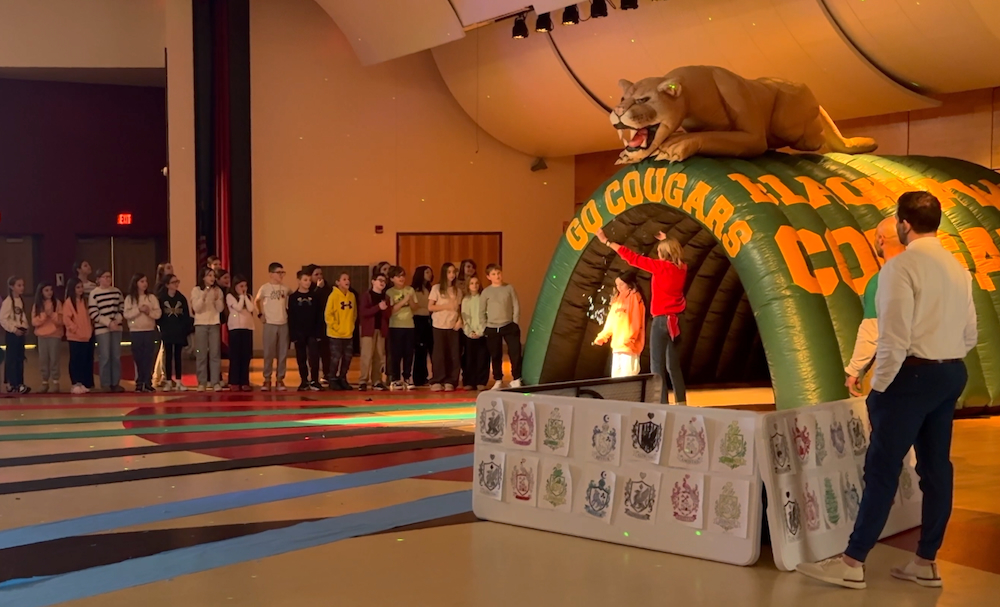
It was the happiest kind of chaos: One by one, kids emerged from a green inflatable tunnel. Suddenly, a balloon would pop — boom! — over each child’s head, scattering confetti while raucous eighth-graders cheered them on.
As sunshine streamed into the gymnasium at Blackhawk Middle School, the exuberant initiation welcomed kids to “houses” designed to help them build a sense of community and responsibility.
These new middle-schoolers hadn’t known which house they were joining until they saw the color of the confetti.
“It was this crazy ceremony,” says Johannah Vanatta, Blackhawk’s superintendent. It was also the launchpad for what district leaders hope will be years of belonging that spark personal growth, self-esteem, and a foundation for academic success.
Across Western Pennsylvania, a growing number of school districts are adopting “house systems” to infuse a stronger sense of community among students across grade levels — with a little inspiration from Harry Potter. These districts include Blackhawk, Shaler Area, and Chartiers Valley.
The idea was born in 2004, when educator Ron Clark created a nonprofit middle school with many of the trappings of Hogwarts, including a system where students are sorted into “houses” in an official ceremony. Each house is assigned a core trait — such as altruism, friendship, or courage — that house members strive to embody.
House systems can be especially powerful at the middle school level, which is often a time when adolescents begin to feel isolated. But Shaler Area and Chartiers Valley are finding success with house systems as early as the primary grades. By building structure around the development of character, these schools are enriching children’s experience while pre-empting some of the problems that can get in the way of learning.
Chartiers Valley, Blackhawk, and Shaler Area are each putting their own spin on the house system approach. But together with districts across the Pittsburgh area, they’re encouraging one another and sharing ideas as part of Future-Driven Schools, a regional alliance of school districts working to prepare every learner for tomorrow. Together, they help teachers, administrators, and board members do what they do best: innovate and collaborate in ways that benefit students.
Shaler Area: A feeling of safety and support
The Shaler Area School District, which runs from the banks of the Allegheny River into the North Hills, already uses the Positive Behavior Interventions and Supports (PBIS) framework.
Now, at the district’s Scott Primary School and Shaler Area Elementary School, it has added a house system to create “a strong sense of belonging,” says Superintendent Bryan O’Black. The process has been especially valuable at Scott Primary, which merged with the now-closed Jeffery Primary School.
Part of the calculus is making sure that students from different grades are involved, creating a cross-pollination that fosters unity. Ideally, it also prevents the exclusion that can stem from social cliques.
At Shaler Area, the house system fits into its wider, pre-existing PBIS initiative. Together, says O’Black, they create “a consistent culture and shared expectations.”
That consistency is key to building cohesion among a diverse group of students who are developing in different ways and at different speeds, and who come from four different communities. “The house system is a way to connect students and adults across classes, grades, and professions to interact with others they may not normally have a chance to encounter,” says Ian Miller, principal at Shaler Area Elementary. “It allows us to create a family atmosphere and a culture of friendship in our school.”
That, in turn, sets the stage for meaningful learning.
In the house community, what helps one person helps others, too. Students earn points and recognition for modeling behaviors and values, which uplifts their entire house. As students support each other, they are recognized by teachers, administrators, and even the parent-teacher organization with celebrations and praise. “This approach not only encourages positive behavior, but also strengthens connections between students and staff across the building,” says O’Black.
Kids get excited when their house earns points. But in the end, it’s about something bigger: making students feel seen, valued, and connected. That, says O’Black, reinforces the district’s “commitment to creating welcoming learning environments where students are empowered to support one another and take pride in their school community.”
 Students celebrate one another during the House sorting ceremony at Blackhawk.
Blackhawk: Celebrating membership in a supportive group
The sense of belonging that house systems offer is a powerful foundation for academic success. If you feel safe among your peers and in your community, you can concentrate on learning.
“If a student doesn’t feel safe, then a student may act out in various ways,” says Vanatta. “There may be areas outside of a school’s control, but we can offer emotional safety and academic safety.”
Good things happen — and learning can take place more easily — when schools create an environment where students can realize that “it’s OK if I’m wrong,” she says. To that end, the team at Blackhawk thinks often about the challenge of teaching and supporting middle-schoolers. Why are some kids struggling? Why is it hard to get traction with a particular student? Why might some students misbehave?
The house system, as Vanatta and her team see it, serves as a sort of idea lab for solving these challenges. It can help grownups understand what makes adolescent kids tick and what it takes to create an environment where they can thrive. It also helps preteens start to understand themselves better.
This holds particularly true for middle-schoolers, who are at a challenging developmental stage.
It’s vital, Vanatta says, to “truly understand the importance of that social aspect of the middle school child. Understanding it only makes our jobs as educators easier. You’re not fighting against that. You’re learning to develop those children as they grow.”
Chartiers Valley: Connecting to critical values
At Chartiers Valley Primary School, “we talk about things like integrity, independence, and responsibility,” says Principal Deidra Stepko. And at the heart of those conversations is the house system.
Like Shaler Area, Chartiers Valley connects the house values to their existing PBIS system and its character themes. These ideas are introduced during the K-2 years, then reinforced as students progress toward middle school. This gives students continuity and a shared vocabulary, while teachers work together to plan how each house will move from one level to another with new challenges, but common themes.
An additional layer comes through communication with parents about house activities. Families get a “Monday Memo” that updates them and explores the monthly themes. “For example, if it’s integrity, we teach the kids that integrity is doing the right thing even if no one’s looking,” says Stepko. “So we include that for the families to hear.”
This helps build consistent communication that’s reinforced at home and at school, and helps kids understand: “These are the values of this community,” Stepko says.
Together, the house system and the PBIS framework support students so they can thrive academically. Michael Sable, the district’s assistant superintendent for curriculum and assessment, says the interplay between a child’s internal habits and academic successes is a cornerstone of the philosophy.
Through the house system, he explains, “not only are they getting the social-emotional piece, but it’s also helping them with the academic pieces.”
In other words, the district isn’t just announcing to students that concepts like integrity matter. Students themselves discuss these values within their houses while teachers bring them up in classrooms.
Just one example: The success of the district’s VEX Robotics team relies on a combination of the social-emotional skills being modeled by the houses and the STEM skills kids learn in their classrooms. Without one, it’s hard to make the best use of the other.
The work is still evolving at these school districts. But already, kids of all ages are beginning to talk about — and aspire to — admirable qualities like integrity, altruism, and courage.
“We’ve found a way to break it down,” Sable says.