
The terms vary—cemetery, graveyard, churchyard—but the purpose is the same: to serve as a final resting place.
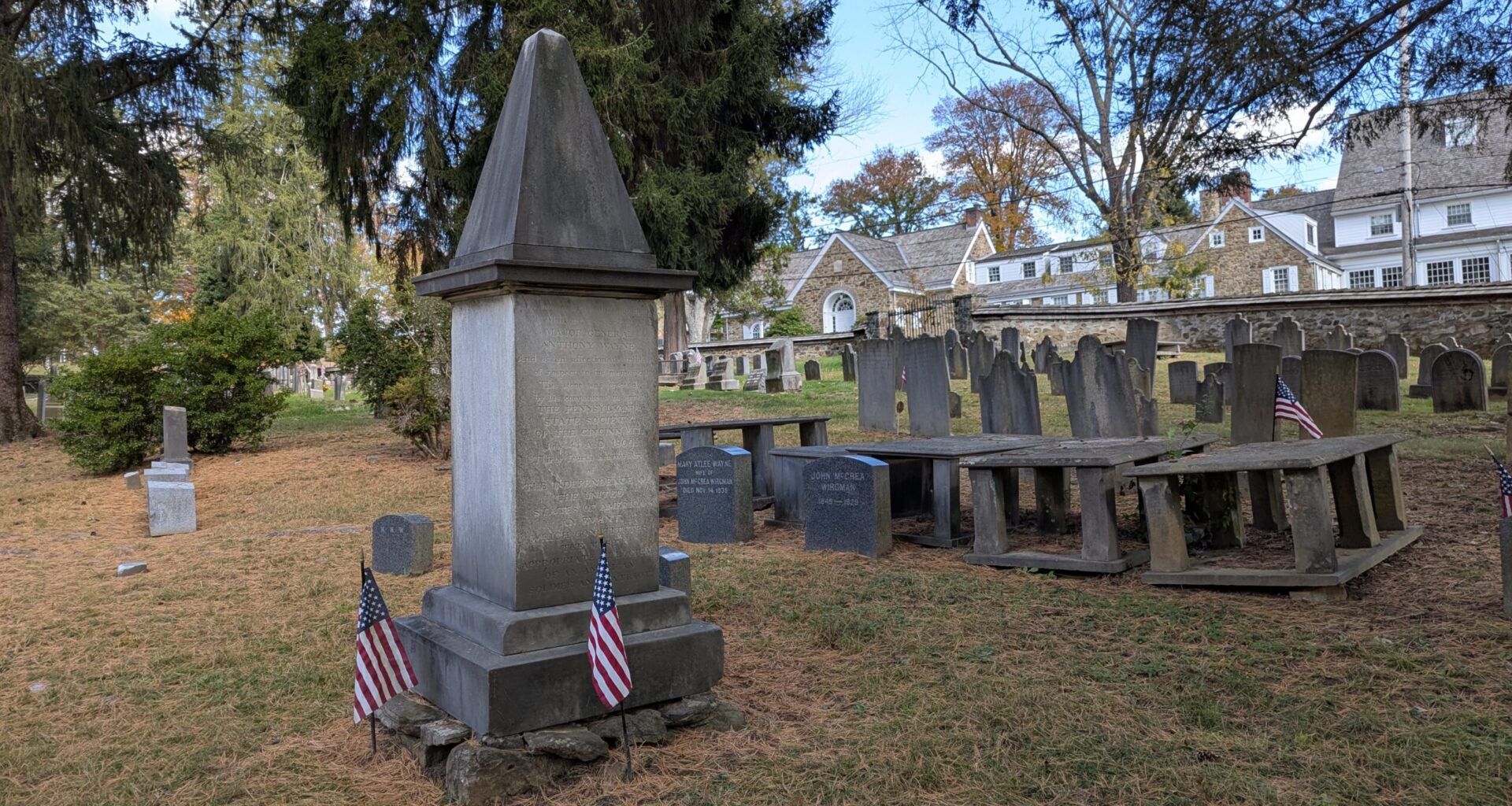
In the Diocese of Pennsylvania, connected to a parish whose property sits on the borders of three townships and two counties, is a churchyard where 11 Revolutionary War soldiers were laid to rest. Established more than 300 years ago in 1715, after Welsh settlers built a stone church in honor of David, the patron saint of Wales, St. David’s Church lists Wayne, Pennsylvania, as its mailing address.
But its 39-acre compound—which includes the churchyard, a small creek, fairgrounds, and arboretum—extends across Delaware and Chester counties. The parish’s history also intersects with the birth of the United States and the Episcopal Church.
At the dawn of the American Revolution, “a rapidly swelling wave of resentment against the Church of England arose among the patriots of the congregation,” St. David’s website notes. One of those patriots was Anthony Wayne, who was named after his grandfather, who emigrated to Pennsylvania in 1723. Like his grandfather, Wayne served on the vestry. Before the war, he was a member of the Pennsylvania legislature.
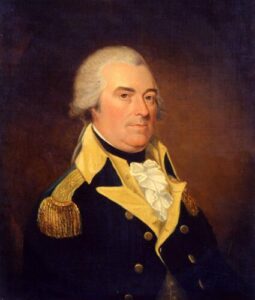 A portrait of Major Gen. Anthony Wayne by Edward Savage | Wikimedia Commons
In 1779, Wayne led George Washington’s Continental Army in the Battle of Stony Point, a key British outpost. Determined to capture the position or die trying, according to one account, Wayne and his 1,200 men succeeded in what is regarded as one of the major general’s greatest victories. Washington later appointed him commander of the U.S. Army in 1792.
Wayne died four years later, in 1796, while on an inspection tour of army outposts near Fort Presque Isle in Erie, Pennsylvania. Although he was originally buried elsewhere at his request, his remains were later reinterred in St. David’s churchyard. Present-day visitors often leave tokens at the obelisk marking his grave.
“People would come in and leave coins, or like a little Mad Anthony Wayne stone,” said Natalee Hill, the parish’s director of communications, referring to the “Mad Anthony” nickname Wayne earned because of his fiery temperament and military exploits.
Overlooking and only a few arm’s lengths from the original parish built more than three centuries ago, the historic churchyard of St. David’s has drawn visitors interested in Revolutionary War history. Marianne Cook, a parishioner for the past 50 years, leads St. David’s archives and history committee, which has produced numerous booklets about the parish and its early parishioners.
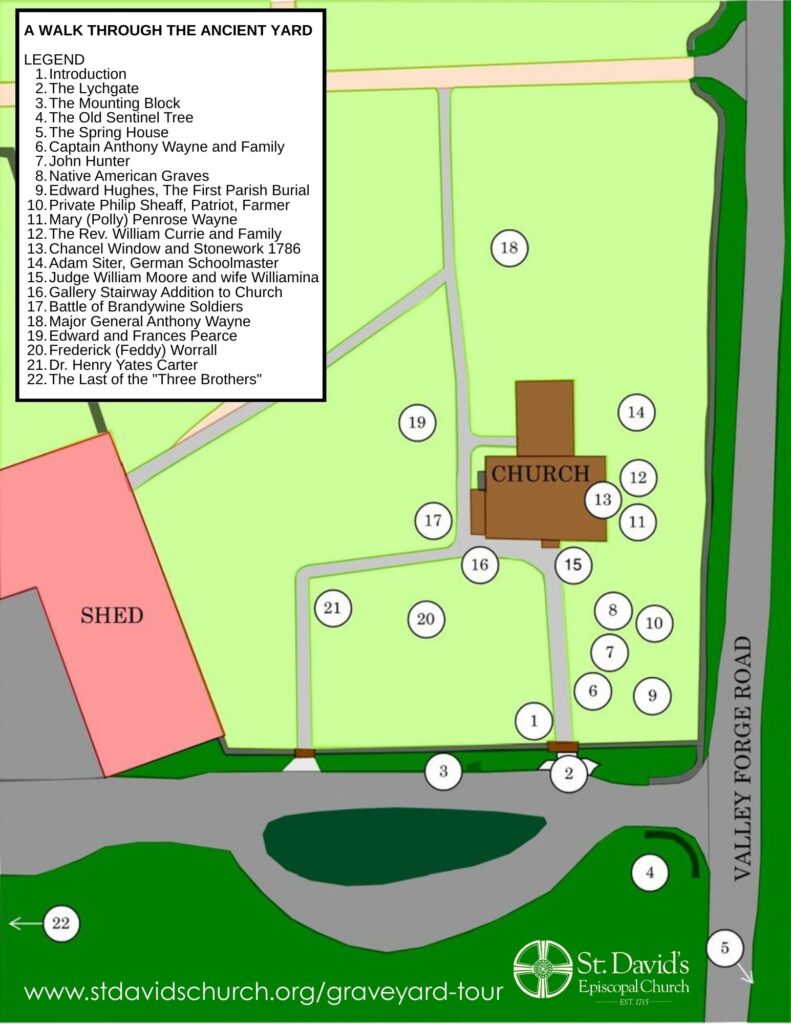
Cook said the habit of creating such materials eventually led to a self-guided audio tour of the churchyard, where visitors can explore 22 significant landmarks and gravesites, including those of Revolutionary War figures like Wayne.
The walk-through is one of the church’s events commemorating America’s 250th anniversary. Visitors taking part in the audio tour, which is scheduled to open to the public on May 17, will learn not only about Wayne, but also about his grandfather and relatives.
 At stop No. 12, visitors encounter the grave of the Rev. William Currie, located just outside the chancel window of the old parish.
“He was a man of God who believed that to be true to his ordination vow he must pray for the King,” listeners hear after activating a QR code placed on a stake. “When members of the Radnor Church objected, he stepped aside from officiating at services. Rev. Currie’s struggle was an indication of the troubled times.” Radnor Church was St. David’s earlier name.
In a history of Currie prepared by Michael Merritt and Cook, readers learn that the Scottish missionary supported the establishment of a militia and preached a sermon titled “The Lawfulness of Defensive War.” In 1784, Currie represented St. David’s at a meeting convened by the Rev. Dr. William White that established the Diocese of Pennsylvania.
The following year, the Protestant Episcopal Church in the United States was established and held its first General Convention in Philadelphia. The 1785 convention authorized the preparation of an American prayer book. For less than a year White served as the first presiding bishop, succeeded by Presiding Bishop Samuel Seabury.
The tour’s 22 stops closely align with the story of the parish, now the largest of the Diocese of Pennsylvania’s 157 parishes. The church website also features a page dedicated to the walk-through, allowing visitors to read the history connected to each stop.
The tour begins in an area containing the oldest graves in the churchyard, predating the 1715 church building. Following the map prepared by the archives and history committee, the next stop is the main entrance gate, or lychgate, a prominent feature in English church architecture.
The lychgate was restored in 2013 using lumber from an early 19th-century barn.
Richard Mammana, archivist of The Living Church and a member of the Association for Gravestone Studies, is a leader in the online tapophile community, a term describing people with a deep appreciation for cemeteries, gravestones, and the stories they hold.
He said the history of parishes in this part of Pennsylvania will likely receive greater attention as Philadelphia prepares for the nation’s 250th-anniversary celebrations. Mammana said the tour developed by Cook and her fellow volunteers is a creative and engaging way of sharing parish history.
The Old Sentinel Tree, one of the trees used by Washington’s army as a watchtower during encampments near Valley Forge and the Radnor Piquet, is featured at stop No. 4.
“Churchyards have also become understood as green oases where congregations support permanent undeveloped space that is a haven for birds and other wildlife, or forms of vegetation threatened by urban encroachment,” Mammana told TLC, speaking positively about the parish’s efforts to highlight the historic trees under its stewardship.
Cook, who has served on the committee for 11 years, purchased the iron stakes holding the plaques that mark each stop of what Hill describes as a “walk through living history.” Elliot VanHoy, a pastoral associate who works with the committee, said the group’s passion for parish history has helped him and other parishioners feel part of something larger.
“That we are part of a lineage of people in this area and in this country who have wrestled with questions of God, of community, of what the present moment demands of us,” VanHoy said.
Cook, reflecting on the significance not only of the new initiative but of the larger mission of telling St. David’s story, noted that when White convened the meeting that founded the diocese, Currie was not the only representative present; senior warden Richard Willing was there as well.
“We have played a part from the beginning of the Episcopal Church in America. We have a story to tell,” she said.
Both Hill and Cook also pointed out that this is especially relevant in an age of deep political polarization.
On the parish’s “About Us” page is a line describing the church’s role during the Revolutionary War, which claimed thousands of lives: 6,800 Americans killed in battle, 17,000 dead from disease, and 24,000 British casualties.
“The church building provided shelter for soldiers of both sides,” the website reads.
According to the committee’s historical records, Wayne sat in the second pew from the altar on the left-hand side when the parish building held a maximum of 125 people. Worshipping in the same parish was Judge William Moore, a prominent Loyalist at the start of the Revolution.
“So you think about these people all being together, fighting each other in a war,” Cook said. “It’s remarkable to think about.”
The churchyard helps bring to life stories tied to America’s history, Hill said. Echoing Cook’s sentiment, she noted the impact the site can have on visitors, who can imagine a time when St. David’s was a place “where people stood on both sides, on all sides of what was happening and worshipped together and are buried together.”
Moore and his wife, Lady Williamina, were also buried at St. David’s. Their graves mark stop No. 15. Three stops later, visitors arrive at Wayne’s grave.

Caleb Maglaya Galaraga is The Living Church’s Episcopal Church reporter. His work has also appeared in Christianity Today, Broadview Magazine, and Presbyterian Outlook, among other publications.