
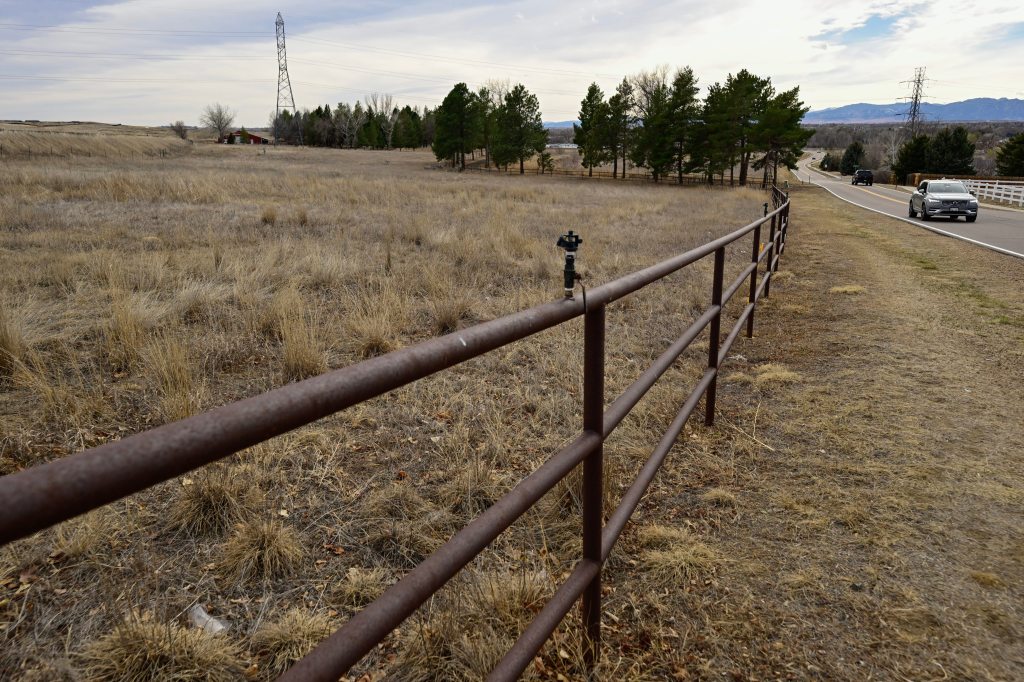
Town-owned property just north of Erie’s Old Town that has been the subject of months of debate is likely to become open space after the Town Council on Tuesday directed staff to move forward with a zoning process.
The roughly 50-acre piece of land lies east of Reliance Park, near where County Road 1 ½ turns into Briggs Street, and has been known as both the Page Property and the Village at Coal Creek.
Erie bought the property in 2023 for $6.9 million using about $3.6 million in federal funding along with money from Erie’s Trails, Natural Areas and Community Character fund. According to town staff, Erie’s Open Space and Trails Advisory Board had expressed interest in the property but could not afford to purchase it alone, leading town leadership to use part of Erie’s allocation from the American Rescue Plan Act — a COVID-era federal relief policy — to complete the deal.
Around the time of the purchase, the land was envisioned as a place for open space and a mixed-income neighborhood that could include affordable housing. But the land’s future has since spurred disagreement among the Town Council, residents and the advisory board after an assessment showed only its middle portion is buildable.
Erie staff earlier this year heard from St. Scholastica Catholic Church about building a new location on the property, but the church has since rescinded that interest.
OSTAB members have argued that building any development in the middle of the land would leave fragments of open space scattered on its outskirts.
“OSTAB’s position is that the property should be preserved in its entirety only for appropriate open space uses, and that no development should occur on any portion of the site,” the board wrote in a letter dated April 13 to the council.
Residents who identified themselves as living near the Page Property attended Tuesday’s meeting to advocate for the land becoming entirely open space, with one telling the council: “I think it’s worth keeping some nature around us. It’s beneficial for all of us.”
Mayor Andrew Moore said the council has also been receiving emails from residents about the property’s fate, and “the vast majority of those are about open space.”
Council members unanimously voted to direct town staff to bring forth a zoning ordinance “sometime this summer” that would designate the land as open space. (Zoning refers to local government rules that determine what types of developments — such as residential, commercial, or industrial — can be built in different parts of a town.)
Councilmember Emily Baer, who has previously advocated for affordable housing on the site, supported the open space direction but encouraged the council to seek compensation for the ARPA dollars spent on the land purchase that were intended to support affordable housing.
The town’s finance director, Sarah Hancock, in September said the ARPA money used for the purchase is considered a “completed project” in federal reporting terms, and “the town is not legally required to construct housing on the property.”
“I do think it’s important for us to keep our promises to the community, whatever that looks like, so we’re able to make those investments in the future for affordable housing,” Baer said on Tuesday.
The council also on Tuesday voted to discuss — during its process for the 2027 budget — “ARPA funds revenue replacement for affordable housing, possibly with a payment plan from the TNACC fund,” Moore said, referring to the Trails, Natural Areas and Community Character fund.
“Assuming funding is approved in the budget,” Moore added, the council could explore the feasibility of some amenities on the land, such as a nature or historical center, a trailhead connecting nearby paths, and a paved or gravel parking lot — though acting Town Manager Meredyth Muth said completing a historical center on the property would be a lengthy process that could take “many, many” years.
Councilmember Anil Pesaramelli advocated for the Town Council to create a housing-related advisory board in the future.
“I’m OK with the open space and all of the other ideas, but I want to see a housing needs advisory board which will make sure the efforts are continued. … Because this is something that came up in (a town survey), and I want to keep it moving,” Pesaramelli said.
Moore said a potential advisory board could become a discussion point at the council’s upcoming joint session with the Erie Planning Commission.