
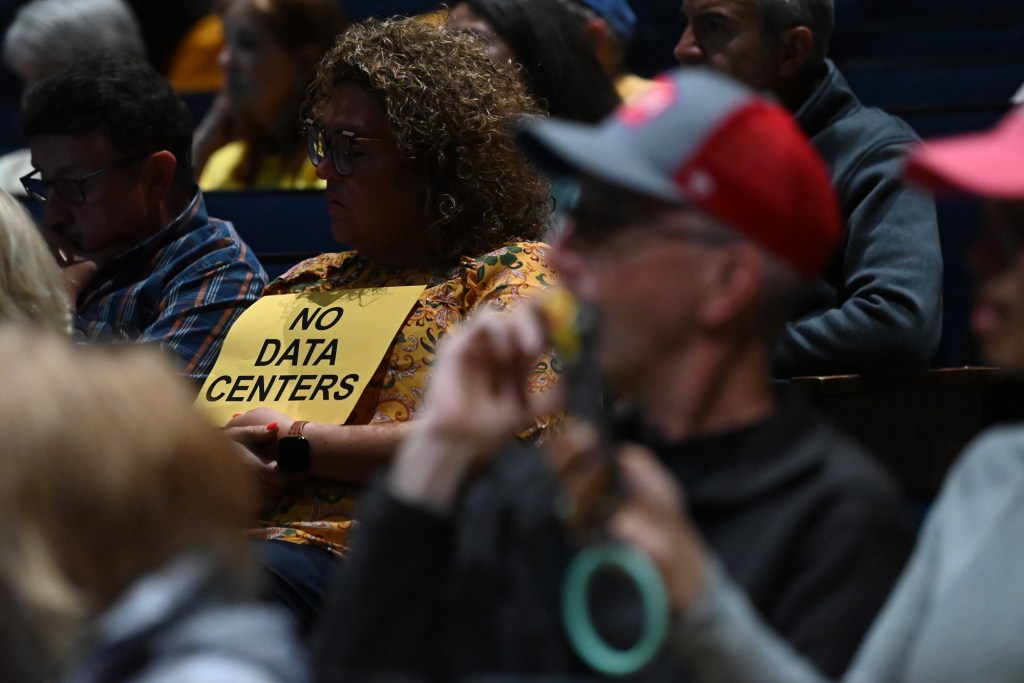
ARCHBALD — With 14 data centers, 840 rooftop chillers, 168 pieces of HVAC equipment and 588 emergency diesel generators requiring routine testing, the Wildcat Ridge Data Center Campus would be quieter in surrounding residential areas than a neighbor’s lawn mower, a household refrigerator or a nearby conversation, according to testimony Thursday from representatives with Lackawanna County’s largest proposed data center development.
Opponents challenged the reliability of the equipment used to establish a baseline for those sound figures, contending the sound-measuring devices lacked a necessary certification.
More than 400 community members packed the Valley View High School auditorium for Archbald’s fourth conditional use hearing on the Wildcat Ridge Data Center Campus, listening for four hours to extensive testimony and cross-examination debating the noise impacts of 14 two-story, 80-foot-tall data centers that would rise above the borough’s Sturges and Eynon sections. All seven borough council members attended the hearing as they consider whether to approve or deny Brooklyn-based Cornell Realty Management LLC’s request to build more than a dozen data centers, each with a 202,340-square-foot footprint, across 574.2 mountainside acres along Business Route 6 and Route 247, or Wildcat Road.
Thursday’s hearing focused on noise from the data centers, including more than 1,000 pieces of rooftop-mounted equipment for cooling and 588 backup diesel generators subject to monthly testing and maintenance.
Because Wildcat Ridge plans to use 1.6 gigawatts of power, its fleet of backup generators must provide that same amount of electricity to operate the data centers in the event of an outage. By comparison, the Lackawanna Energy Center natural gas-fired power plant in neighboring Jessup produces just under 1.5 gigawatts, which means Wildcat Ridge’s generators will collectively produce more power than the entire power plant in Jessup.
Wildcat Ridge is one of six data center projects proposed in Archbald, totaling 51 individual data centers. If every campus moves forward, they would cover 14% of the entire borough, or about 2.44 square miles of the 17-square-mile town.
Elsewhere in Lackawanna County, there are at least eight other proposed data center campuses, accounting for 40-plus additional buildings across Clifton and Covington townships, Dickson City, Jessup, Newton Twp., Olyphant and Ransom Twp. Most recently, developers applied to build 16 data centers in Olyphant across two campuses.
In Archbald, data center opponents and council members sounded off throughout the night, questioning the study’s methodology, the potential noise impacts on nearby homes and how the developer accounts for nearly 600 backup diesel generators that, while exempt from the noise standards applied to data center cooling equipment, would still be tested routinely.
The hearing concluded with Wildcat Ridge attorney Edmund J. Campbell Jr. of King of Prussia-based Campbell Rocco Law offering Archbald a community benefits agreement worth $17 million if all 14 data centers go online, followed by half an hour of public comment where all seven speakers opposed the development.
Council will reconvene the hearing on June 15 at 5 p.m. at the high school auditorium, 1 Columbus Drive, Archbald.
‘Can you guarantee it?’
Archbald’s zoning limits data centers to 5 decibels above ambient noise levels, or background noise, measured using the common dBA scale, and Wildcat Ridge’s acoustical consultant, Caitlin Ormsbee, presented projections based on an April sound study to explain how the data centers will abide by the borough’s noise standards. The borough’s data center zoning requires the study to include residential areas within 2,500 feet; Wildcat Ridge placed 19 measuring devices throughout the borough to capture the ambient noise in the vicinity of the proposed campus. Once it calculated the ambient sound, which averaged in the 30 dBA range, according to testimony, Wildcat Ridge could then exceed that by 5 dBA.
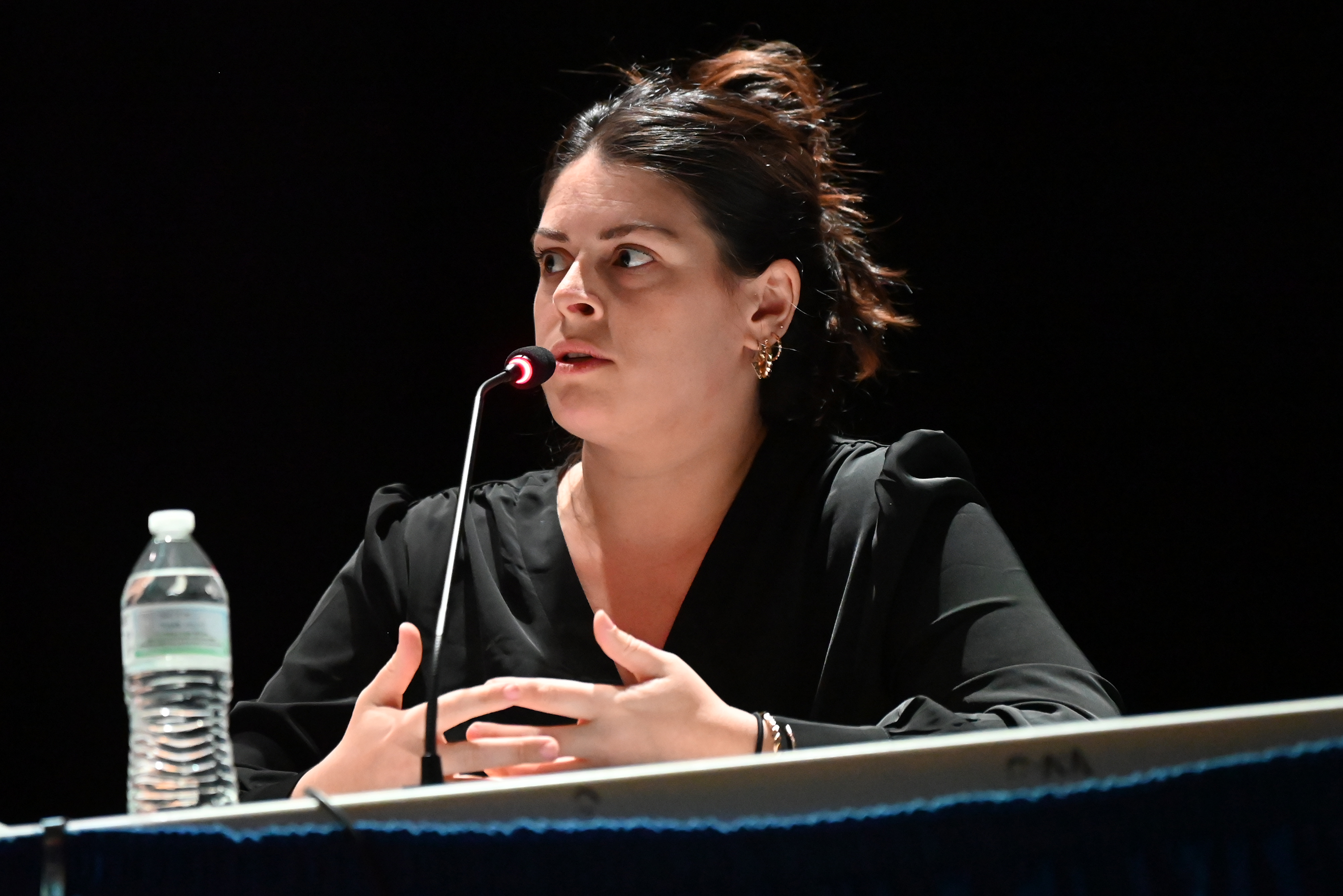
Acoustical Consultant Caitlin Ormsbee answers questions during the hearing regarding the proposed Wildcat Ridge data center campus at Valley View High School in Archbald on Thursday, May 14, 2026. (REBECCA PARTICKA/STAFF PHOTOGRAPHER)
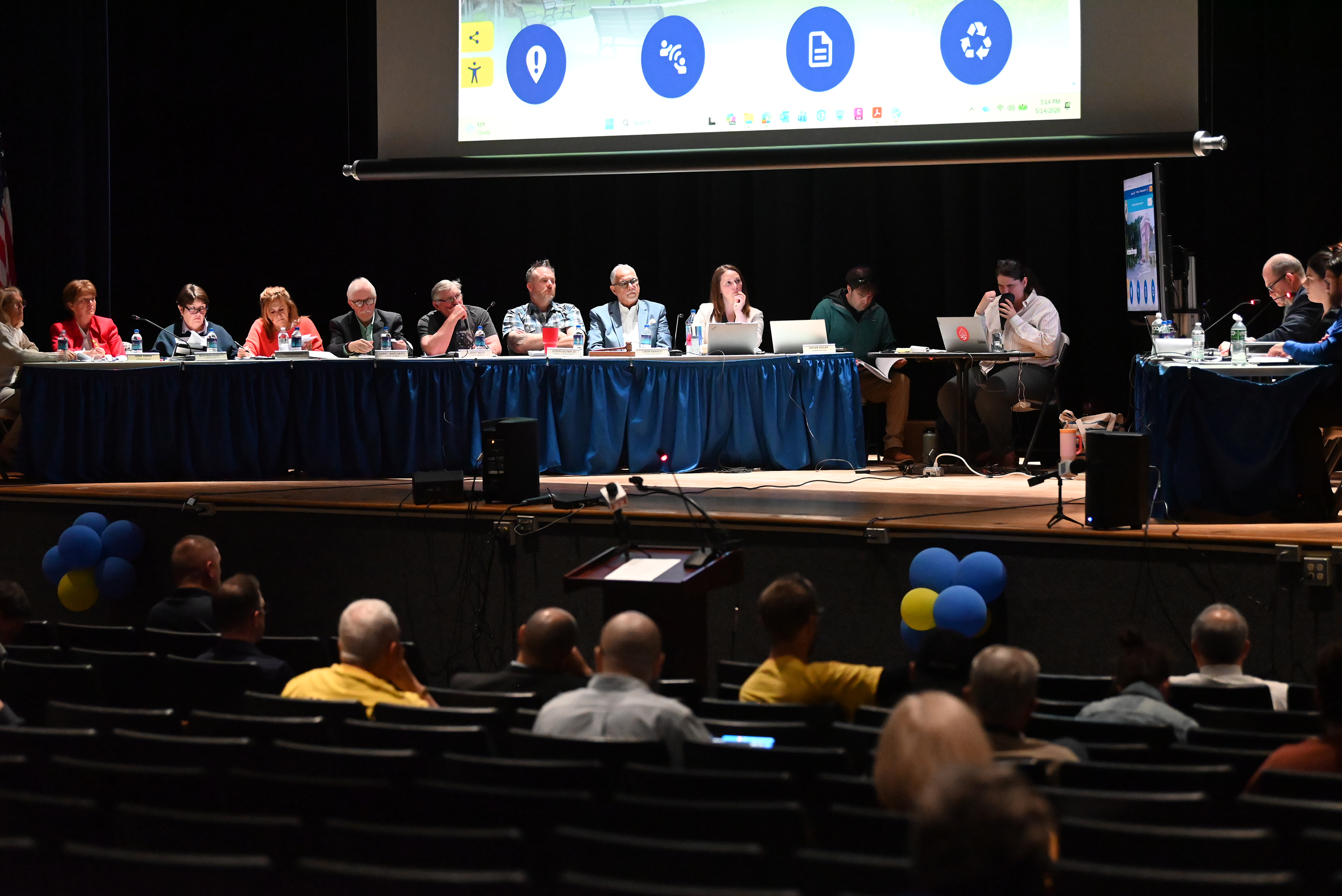
Community members and borough councilmembers listen to Attorney Edmund Campbell ask acoustical consultant Caitlin Ormsbee questions about the noise pollution study conducted for the proposed Wildcat Ridge data center campus during the public hearing at Valley View High School in Archbald on Thursday, May 14, 2026. (REBECCA PARTICKA/STAFF PHOTOGRAPHER)
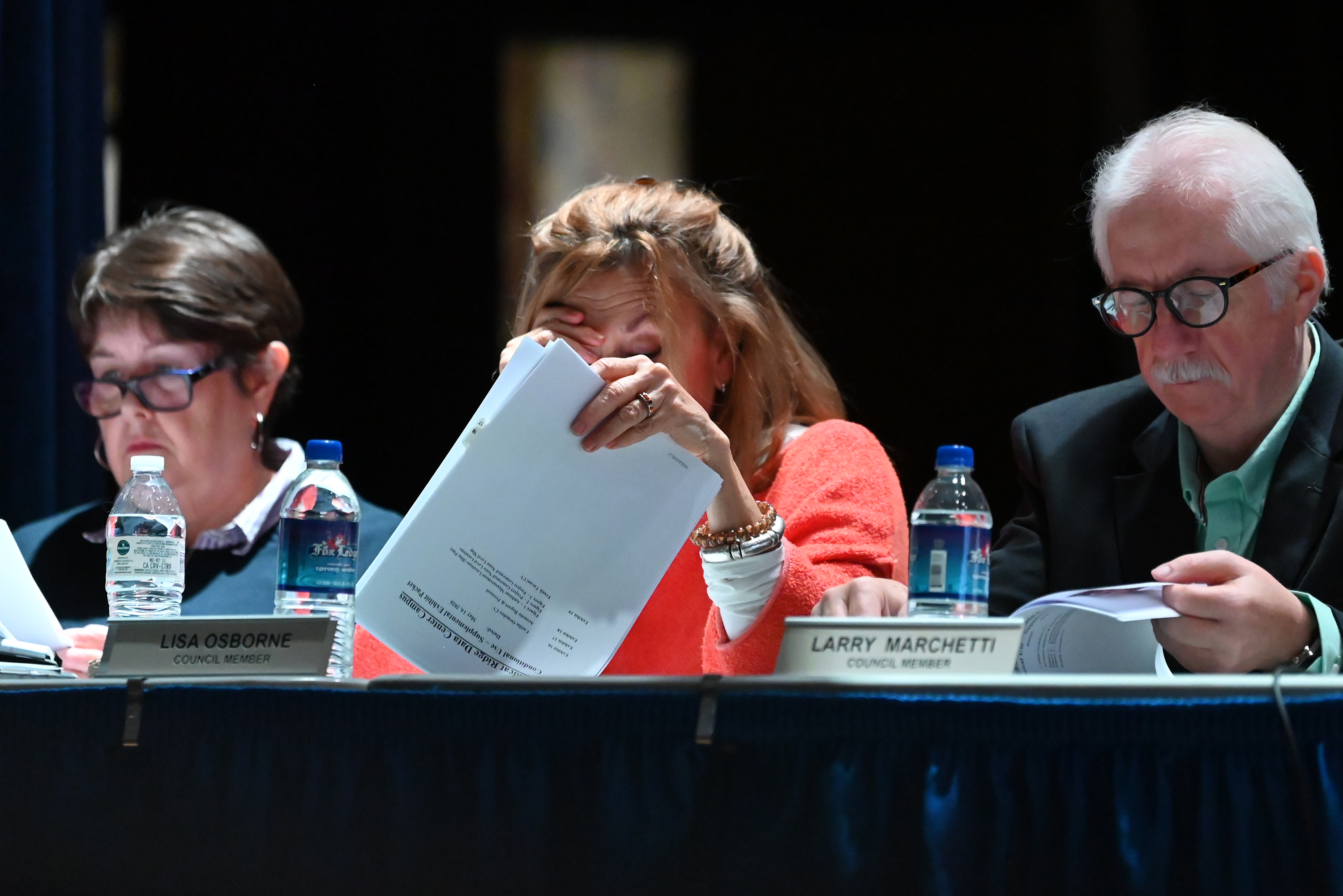
Borough councilmembers Madonna Munley, Lisa Osborne, and Larry Marchetti look at packets regarding noise pollution during the Wildcat Ridge data center campus hearing at Valley View High School in Archbald on Thursday, May 14, 2026. (REBECCA PARTICKA/STAFF PHOTOGRAPHER)
Show Caption
1 of 3
Acoustical Consultant Caitlin Ormsbee answers questions during the hearing regarding the proposed Wildcat Ridge data center campus at Valley View High School in Archbald on Thursday, May 14, 2026. (REBECCA PARTICKA/STAFF PHOTOGRAPHER)
However, attorney Justin Richards, who represents borough residents opposing data centers, argued the equipment used to measure the ambient sound did not meet the requirements in Archbald’s zoning ordinance. He pointed to missing calibration certificates for multiple devices used to record ambient noise levels around the proposed campus. Without those certificates, Richards contended they do not comply with the American National Standards Institute standards, or ANSI, required in Archbald’s zoning ordinance.
Ormsbee maintained that they complied with the ordinance by conducting a study following protocols reviewed and approved by the borough’s own sound consultant.
Following the hearing, Richards attributed his discovery of the missing certificates to prior experience as a criminal prosecutor, explaining he had to verify that police equipment was properly calibrated and certified in case the defense attorney tried to question, for example, the accuracy of a radar gun.
During subsequent cross-examination from Tamara Misewicz-Healey, the co-founder of the Stop Archbald Data Centers movement, Ormsbee acknowledged she could not guarantee the equipment that was lacking calibration certificates.
“How do we know how accurate that is to the true value? … If it wasn’t certified, then there is no guarantee without that, correct?” Misewicz-Healey asked. “Is there a guarantee without it? Can you guarantee it?”
“No,” Ormsbee replied after a brief pause.
Through questions from Campbell, Ormsbee explained that they modeled the sound by taking the site plan and anticipated equipment on the data center buildings, and then creating a 3D model to propagate the sound from the buildings to the study area within 2,500 feet of the project site.
Archbald’s data center zoning exempts backup generators from the maximum noise limits, both during power outages and routine testing and maintenance. The ordinance allows testing from 7 a.m. to 8 p.m., though Campbell said they could tailor testing schedules to times when ambient sound is louder.
To retain some borough control over the generators, Misewicz-Healey focused on language in Archbald’s zoning ordinance about protecting the health, safety and welfare of the community. She argued that, even if the generators are exempt, the developer has a duty to ensure the generators don’t pose a risk to public health.
Campbell countered that when there are subjective versus objective criteria, council has to apply the objective criteria.
Misewicz-Healey also questioned Ormsbee on the noise levels of the data centers.
“The report claims 14 industrial buildings running 840 chillers, 168 RTUs and 10 large transformers at 100% load will register at or below 30 decibels at some residential boundaries. Do you have any comparable real-world facilities data showing that they can operate at this scale and still being able to achieve that level?” she said.
“The equipment and sound attenuation measures produced and shown in this study are based on real-world examples that we have used,” Ormsbee said, explaining the equipment could be as quiet as 30 decibels with sound-reduction equipment.
At one point during the hearing, Campbell asked Ormsbee to provide examples of different decibel levels: 65 dBA is akin to a neighbor mowing the lawn or a conversation a few feet away; 55 dBA could be an HVAC system in a large atrium, or a household refrigerator.
‘Why I’m concerned’
Councilman Joseph Altier III pressed the developer on using better enclosures to muffle the 588 diesel generators.
The generators would have enclosures reducing their sound to 85 decibels from 23 feet away, according to testimony, but the data center’s representatives also referenced more restrictive enclosures to muffle the noise an additional 10 dBA.
“Let’s try whatever we can do to limit what comes off that campus,” Altier said.
The ordinance doesn’t prohibit noise, Campbell said in response.
“What is available? What would be considered the best to use? That’s all I’m asking,” Altier said.
Campbell told Ormsbee if she modeled that or knows it, she can answer the question.
“For this location, we did not model anything other than the 85,” she said.
Councilman Larry Marchetti focused on the diesel generator testing. Citing National Fire Protection Association standards, Marchetti said the generators are generally required to be tested monthly for 30 minutes. With one month to test 588 generators, that means testing about 20 generators per day, he said.
“We focused a lot of the sound issues on the intensity of the sound, but I think what we’re overlooking is the duration,” Marchetti said, calling the testing perpetual. “You’ve got an 11-hour window a day to test 588 generators in one month, and by the time you get to the end of that, it’s time to start the next month.”
Marchetti also noted the size of each generator.
A 2.5- to 3-megawatt generator like the campus would use is more than 4,000 horsepower, Marchetti said.
“They’re as big as a bus,” the councilman said. “I work with them all the time.”
Generators also undergo a more intensive load bank test where they run for two hours, Marchetti said.
“The reason why this whole generator issue is such a big thing is we’re focusing on just your campus. Now we’ve got to extrapolate that out to multiple campuses,” Marchetti said. “This is going to be a constant — a constant — sound that’s emanating from just this one campus, and that’s why I’m concerned and certainly the folks out here are concerned.”
Marchetti continued, “We have a plot of land where there is no sound generation now, and now, you’re going to add, just inherently from all this equipment, you’re going to put sound where it didn’t exist before, and it’s going to be noticeable.”
Following the sound study testimony and cross-examination, council held just over half an hour of public comment to whittle down a lengthy list of speakers. Seven community members spoke, including Archbald resident Mike Rogan reading a statement from retired Lackawanna County Senior Judge Thomas J. Munley. Munley, a Jessup resident, testified against Wildcat Ridge during its last hearing in April.
Munley apologized in his statement for being unable to attend while he is out of town but offered his support.
“Decisions made here will shape our community for generations,” Rogan read from Munley’s statement. “The people who live here, the people who built this town, deserve to be heard, respected and protected. Stay united, stay informed, and do not lose sight of why you are here.”
Jermyn resident Janessa Bednash, a core member of Stop Archbald Data Centers, concluded Thursday’s hearing with the night’s most fiery remarks. Criticizing testimony from the three preceding hearings, Bednash asked, “What trust should be put in an applicant who has never built a data center but chooses to propose what would be the fourth largest data center in the world?”
“We will not sit back and be the ocean floor to the bottom feeders trying their latest get-rich-quick scheme at the expense of our health, our land, our wildlife, our neighbors or our children,” Bednash said as the audience erupted into applause. “To them, we’re just another iron in the fire, a wall they can throw their pasta on to see if it sticks. For us, this is our home. This is our life. This is our health.”
She asserted that developers underestimated the community.
“Just because a handful of people in this town sold their souls for the almighty dollar, doesn’t mean our community is for sale. They made a great mistake in choosing this community,” Bednash said. “They thought they were strolling into Podunk, Pennsylvania, with uneducated residents who wouldn’t know what hit their community until it was too late. Instead, they were met with a force that has driven so much change that they had to spend who knows how much money on a PR propaganda campaign that did nothing more than insult our intelligence and show the total lack of theirs.”