
Votebeat is a nonprofit news organization reporting on
voting access and election administration across the U.S.
Sign up for
Votebeat Pennsylvania’s free newsletter here.
In a rare unanimous decision last month, the Pennsylvania
Supreme Court ruled that the public should have access to
super-granular election results data, making it easier for
researchers to analyze electoral patterns and for those concerned
about voter fraud to inspect the results.
But it’s unclear how many counties will be able to release the
data due to unanswered technological questions and concern about
keeping ballots secret in some jurisdictions.
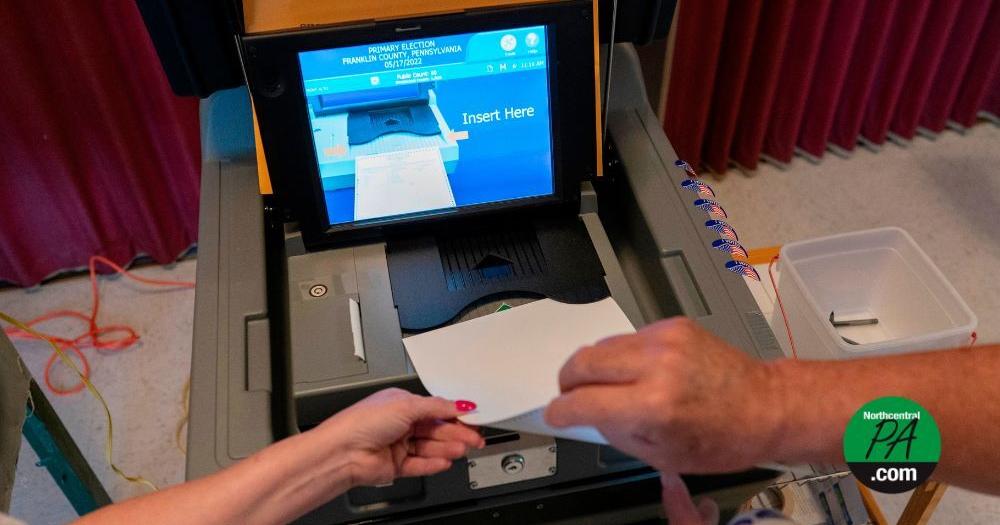
The data, known as a cast vote record or CVR, is essentially a
log of each ballot cast in an election and what candidates it voted
for. It does not reveal the names of the voters who cast those
ballots (election officials don’t even keep that data), but it does
include the precinct where the vote was cast.
“Disclosure of CVRs allows the public to ‘check the math’ of
[Lycoming County] Voter Services to ensure the number of reported
votes match the number of recorded votes,” Justice Daniel McCaffery
wrote for the majority. “Such disclosure promotes fair, honest,
and transparent elections, which strikes to the heart of ‘trust but
verify.’”
In October 2021, conservative activist Heather Honey, who is now
the Trump administration’s deputy assistant secretary of homeland
security for election integrity, requested Lycoming County’s cast
vote record for the 2020 election. The county initially denied her
request — a decision upheld by the state’s Office of Open Records.
But a local court overturned that ruling, only to be overturned
itself by the state’s Commonwealth Court, a decision that was then
overturned by the state Supreme Court in late April.
Court case hinged on technology, ballot secrecy
The disagreement in the case stemmed from whether a cast vote
record counts as the “contents of ballot boxes and voting
machines,” which are exempt from disclosure under state law.
While the Commonwealth Court ruled that cast vote records, and
the ballot tabulation machines that create them, are the equivalent
of physical ballots in ballot boxes and voting machines, the
Supreme Court disagreed.
“CVRs are spreadsheets of raw data pulled from the cast ballots.
They are not the physical ballots contained in the ballot box,”
McCaffery wrote. “Here, Lycoming County’s scanners constitute
voting devices but not voting machines. Similarly, Lycoming
County’s tabulators (which no party disputes are responsible for
generating the CVRs) are automatic tabulating equipment.”
The justices faulted the legislature for the confusion, noting
the state’s election code was written in 1937, long before
spreadsheets or electronic voting equipment were ever
envisioned.
“Citizens should be entitled to expect their legislators to
address and account for advances in voting technologies more
frequently than on a centennial basis,” Justice David Wecht
wrote in a concurring opinion.
The other issue the case dealt with is ballot secrecy.
Under Pennsylvania law, voters are entitled to have their votes
kept secret. Lycoming County expressed concern that, if a cast vote
record is made public, it could be analyzed in conjunction with
other public documents to identify how specific people voted.
To prevent this, Lycoming County’s equipment randomizes the
order of the ballot data in the cast vote record, so that the order
of the ballots in the spreadsheet is not the same as the order in
which they were cast.
The technique is not foolproof. Individual voters’ choices could
still be divulged if, say, everyone in a precinct votes the same
way in a given race. But the court pointed out that uncommon
scenarios like that already jeopardize ballot secrecy even in the
absence of cast vote records. The court argued that voters’ right
to a secret ballot needed to be balanced with the public’s right to
transparent data.
How the cast vote record decision will affect Pennsylvania
counties
The decision means Lycoming County will now have to release its
cast vote record.
“The court has made its decision that the CVR is a public record
and anyone who requests it, we will provide it,” Lycoming County
Elections Director Forrest Lehman said.
It’s unclear, however, how many other counties will have to
release cast vote records as a result of the ruling. That’s because
the randomization process that protects secrecy in Lycoming County
is specific to tabulation machines manufactured by the company
Clear Ballot, which is used by
only seven other counties in the state.
“We acknowledge Voter Service’s concern that not all counties
may follow the same randomization procedures that are established
on this record,” McCaffery wrote. “We recognize that, under certain
circumstances, it is possible that a county’s method of generating
CVRs may violate the secrecy mandate. But that is a question to be
addressed on a case-by-case basis.”
A Votebeat and Spotlight PA review of the voting equipment used
by Pennsylvania’s other 59 counties found that most are capable of
randomizing the data in cast vote records, but some may not be. The
most recent software certifications for the equipment used
throughout the state don’t mention randomization, and the
Department of State did not answer a question about whether all of
the state’s vendors randomize their data.
It’s also unclear whether the specific randomization processes
used by machines other than Clear Ballot’s would pass the court’s
test.
“The Pennsylvania Department of State is reviewing the court’s
decision and is working with our county partners to provide
appropriate guidance,” a spokesperson for the department said in a
statement.
Most Pennsylvania counties, including Philadelphia and
Allegheny, use tabulation machines manufactured by Election Systems
& Software. A spokesperson for ES&S told Votebeat and Spotlight
PA that the CVR data is randomized twice, eliminating any
connection to the voter.
At least two less commonly used companies are also capable of
randomization. Margia Hansen, the Warren County election director,
said Liberty Vote, which serves Warren and 11 other counties, told
her that their equipment does randomize the data.
And Jim Allen, the Delaware County election director, said his
county’s Hart equipment — which is used by three other counties —
generates randomized cast vote records as well. He plans to make
Delaware County’s cast vote records available once he gets official
guidance from the Department of State.
Allen applauded the Supreme Court’s decision as a win for
transparency.
“I think it’s an excellent ruling in terms of setting the record
straight and in terms of transparency and giving voters one more
way of verifying election results,” he said. “As long as we can
randomize them sufficiently to make it impossible to associate a
ballot with one individual, this is stuff we should get out
there.”
Allen, as well as the court’s opinion, noted that some places,
such as counties in Colorado and Wisconsin, have been releasing
cast vote records for years.
Some election officials still have privacy concerns about cast
vote records
However, some smaller counties might not even have cast vote
records to provide. Matthew Repasky, the Columbia County elections
director, said his county opted not to buy additional software that
would generate cast vote records for its Unisyn equipment because
they didn’t feel it was a worthwhile expense.
He also worried that there was no way to protect the secrecy of
voters in especially small jurisdictions, such as Centralia, which
has only four voters.
“How do you randomize that?” he asked.
Even in more populous precincts, an election with low turnout,
like a primary, could make it easier to identify voters. As a
result, election directors may not release the cast vote records
for precincts with low turnout so as to not violate secrecy
requirements.
“You’re not going to be able to give those out, and people are
going to be angry,” Repasky said.
Sean Drasher, the Lebanon County elections director, also raised
the possibility that a person could theoretically bribe or threaten
someone else to vote a certain way, and then use the cast vote
record to confirm they voted that way.
The cast vote record might also contain information other than
votes, he said, such as machine-testing records that could look
confusing to viewers if they’re presented without explanation — or
even images of ballots, which could raise new legal questions about
being “contents of ballot boxes.”
“When these decisions come down, you have to be really careful
to look at every word in every paragraph to see what is the
fallout,” Drasher said, adding that he will be consulting closely
with the Department of State and his county attorney before
releasing any cast vote records.
Carter Walker is a reporter for Votebeat in partnership with
Spotlight PA. Contact Carter at cwalker@votebeat.org.