
Some 90 minutes after the polls closed Tuesday night, Allegheny County Council President Pat Catena contemplated the still-evolving but discouraging results of his effort to win the Democratic primary race in state House District 45.
With 67 percent of the ballots counted, Catena was trailing his primary opponent — Robinson Township attorney Brittany Bloam — by more than 22 percentage points. As he waited for results at Mama Lena’s pizza restaurant in Kennedy Township, Catena told WESA that “a lot of polling places haven’t reported yet,” and said he wasn’t ready to concede the race to Bloam.
Still, by 9:20 p.m., Catena admitted that “It’s going to be hard to catch up” to Bloam, adding, “Of course I’m disappointed.” He then announced he was leaving to go home, saying he was “still hopeful” but preferred to spend the rest of the evening with family.
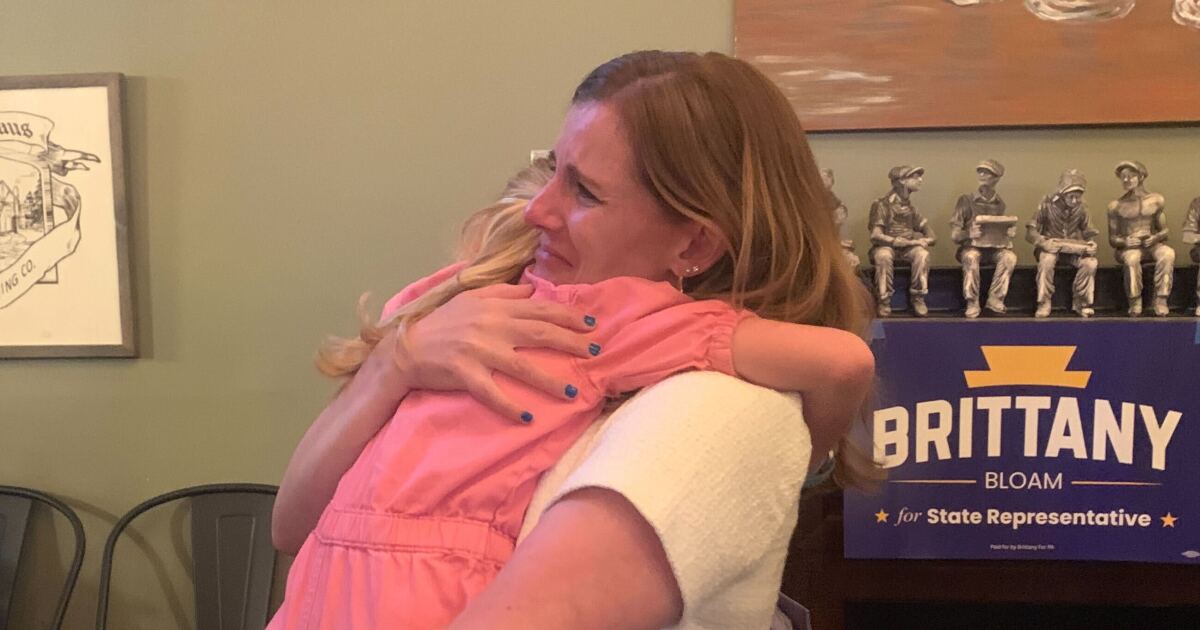
Moments later at the Cobble Haus Brewing Company in Coraopolis, Bloam’s father began a congratulatory victory speech before a packed room of supporters: “All the work’s been done, the votes have been counted … Damn, I’m happy.” Looking on were state Rep. Jessica Benham and Coraopolis Mayor Michael Dixon, who called Bloam “the right candidate for this spot.”
“She’s got the heart that is needed to really kind of represent this area,” he said. “I’m really looking forward to seeing the results and her coming out on top.”
Bloam herself then stepped to the podium and spoke from the vantage point of the assumed winner, although The Associated Press had not yet declared a result in the primary race.
“As we look forward to the general election, my promise stays the same. Our kids and our communities deserve better,” she said. “This promise is one that I know crosses party lines, and we’re all feeling the pain of rising costs at the gas station [and] grocery stores.
“We know that our childcare workers who are essential to keeping parents in the economy deserve a living wage,” she added. “We need to make real, meaningful investments in our communities without pricing seniors out of their homes because we all deserve better.”
Bloam also thanked many of the people surrounding her — including her young daughters Anna and Rosie, who hovered nearby while she spoke. She told of how Anna planned a campaign fundraiser for her in the family’s backyard, while Rosie announced to everyone she encountered: “My mom’s wunning for office!”
Also receiving special thanks was retiring state Rep. Anita Kulik, who threw her support behind Bloam after announcing her plans to relinquish her House seat. Bloam said Kulik was out of town and unable to join her to await primary results Tuesday night, but she thanked Kulik in absentia.
“ I really hope I made you proud,” Bloam said. “And I look forward to continuing to work with you and learn from you.”
The Associated Press did declare Bloam to be the winner of the primary race at 10:51 p.m. With 94 percent of votes counted, more than 63 percent had been cast for Bloam while slightly more than 36 percent had been cast for Catena.
Bloam said she received a concession call from Catena, calling it “very cordial.” Speaking later with reporters, she credited her primary outcome to a campaign message about “the things that are important to working families, the things that everyone’s talking about right now.
“I think that resonated with a lot of people, and I think that people are looking for new leadership,” she added. “ We’re gonna take a breath, and we’re gonna regroup, and we’re gonna start working for November.”
The race in state House District 45 had been one of the few contested races in the Democratic primary. It certainly became the most contentious, dominated by criticism about lightning-rod social issues and accusations about anonymous mailers.
The battle to replace the retiring Kulik in the county’s western suburbs didn’t begin that way.
The race pitted Catena, who boasted years of holding office in county government and in his hometown of Carnegie, against Bloam, a political newcomer. When Catena launched his bid in January, the race seemed his to lose.
“No one brings the depth of experience I do” in local government, Catena said during his kickoff speech, which followed a lengthy recitation of the officials who’d turned out to support him. Those included a broad array of Democratic leaders from across the county and the district itself, which includes communities to the west and southwest of Pittsburgh, such as Bridgeville, Carnegie, Collier, Kennedy, McKees Rocks and Robinson.
Catena also easily won the endorsement of party leaders in March, a testament to his long-established political ties.
But the tenor of the campaign altered significantly when Bloam, a first-time candidate, entered the race in February, telling WESA that, “The old way of doing things just isn’t working anymore. … I think we need more outside fresh perspectives.”
When the candidates appeared on stage together at a League of Women Voters forum earlier this month, there was little rancor and few obvious differences between them. (Both spoke in support of paid family leave, for example.) But their campaigns followed very different trajectories.
Bloam, who practices in the field of property law, racked up the support of socially progressive groups. And she outraised Catena financially. Campaign finance reports show that Bloam had raised a whopping $127,924.90 by early May, while also receiving nearly $29,000 worth of “in-kind” donations of non-monetary support.
Catena had raised $91,100 by that point, but more than half of that was money transferred from his county council committee, much of which Catena had paid into from his own pocket.
The 45th has a reputation of being a more moderate, “old-school” district. Communities in the district have previously backed Republican candidates such as 2023 county executive hopeful Joe Rockey — and Kulik, though a Democrat, often opposed abortion rights in Harrisburg. The area’s politics have long been shaped by the family of John Weinstein, who served as county treasurer for nearly a quarter-century until stepping down in 2023.
Mel Weinstein, John Weinstein’s father, chaired Catena’s election committee.
But there were signs of the old order fraying: Kulik, though long friendly with the Weinsteins, endorsed Bloam, citing her understanding of the challenges that working parents face as well as her willingness to take tough votes.
Meanwhile, Catena, who as county council president had held together a coalition of both progressive and more traditional Democrats, seemed to struggle with keeping a foot in both of those camps during his own campaign.
While Bloam was able to garner the support of both Kulik and groups that support abortion rights, Catena distanced himself from a group that had long supported him and did so again this year. He also found himself on defense when an anonymous mailer, for which Catena denies any knowledge or responsibility, published Bloam’s home address at a time when public officials have increasing concerns about their physical safety.
Catena was also pummeled for another mailer, this one sent by his campaign, which attacked Bloam for having the support of “an extreme left group that advocates for transgender athletes in our sports.”
That prompted an outcry from LGBTQ advocates, who called on Catena to withdraw from the race, and to step down or be forced out of his role leading county council. A vote on that matter is likely to come before council at the end of the month.
Catena, who as council president previously backed a compromise measure limiting the availability of “conversion therapy” that targets transgender people, apologized for the mailer. He met with some of his critics on Saturday. And his closing message the weekend before the primary included a 47-second Facebook video in which he twice pleaded with supporters, “You know me.”
“Aren’t we all sick of gotcha politics?” he asked then. After saying “the other side wants to make political hay out of this rather than accept my apology,” he urged voters to consider “my lifetime of service to you, and our communities. Consider my history of always being inclusive, and my pledge to be inclusive in the state House.”
Still, the topic of the mailers remained fresh Tuesday night at the campaign gatherings for both candidates. While waiting for Bloam to speak, Dixon — the Coraopolis mayor — said the “ mailers that came out from you-know-who are disgusting.”
“They should definitely be condemned,” he said. “If anyone does that again in the future, they should be ashamed of themselves for running a campaign like that. It’s disgusting, and I won’t tolerate it.”
Benham, too, criticized both the mailers sent out by Catena’s campaign and the anonymous ones.
“ I think if what you and your friends are stooping to, to try to win a race, is to bully vulnerable people and to doxx your opponent, I’ve got an issue with that,” she said. “We can have conversations about the substance of issues.
“We can talk about the nuances of policy, but the minute friends of yours send out a mailer with your opponent’s home address on it, we’ve got an issue,” she added. “The minute you start bullying a very small portion of the population rather than focusing on the real quality of life, cost of living issues impacting this district, we’ve got a problem.”
At Catena’s gathering, fellow county council member Bob Palmosina said he was “a big believer in Pat. He’s a good man. But the words that were chosen offended a lot of people. He didn’t mean that, and that’s why he apologized.”
Palmosina lamented the criticism Catena had received from fellow council members and their efforts to strip him of his council presidency.
“Even the people on council calling to remove him — he put them on the committees they wanted to be on,” Palmosina said. “He’s a stand-up guy.”
Still, Palmosina said he expected Catena’s council critics would continue the effort to remove him from the presidency next week. But he said before that happens, “I believe that he’ll make the right decision.”
Did that mean he expected Catena to step down on his own?
“Put: ‘the right decision,'” Palmosina said.
Republican James Julius faced no opposition on the Republican ballot this spring and is all but certain to compete for the seat in November.
Other state House races
There were a handful of other contested primaries in Allegheny County on Tuesday’s ballot, one of which involved a challenge to a seated Democrat. Two others had Democrats selecting a champion to take on a Republican incumbent this fall, in both the Mon Valley and Allegheny County’s northern tier.
Democrat Jeremy Ferderber defeated Robert Bertha in the primary for state House District 28, a longtime GOP bastion that includes the far-flung suburbs of Bradford Woods, Hampton, Pine, Richland, and West Deer.
Bertha, a native of West Deer, was a casualty of the Trump Administration’s “DOGE experiment,” having lost his job working in international affairs in the name of cost-cutting. Ferderber, who works for a natural foods distributor, grew up on a family farm just outside the district. He’s garnered the endorsement of a number of Democratic groups, including the leaders of the county’s Democratic Committee.
Ferderber said his run was buoyed by the fact that “ I am kind of just a normal guy — a member of the community, somebody who volunteers, somebody who talks to my neighbors, and somebody who engages with people in conversation. And I think that’s what we need and what we miss desperately these days.”
Ferderber will take on first-term Republican Jeremy Shaffer this fall — a tough challenge in a solidly red district where Republicans have a 10 percentage point registration advantage. But Ferderber said he’s optimistic that “folks on both sides of the aisle agree on most things.
“And I know it sounds very cliché, but there is definitely room in the middle for everybody to come back together” while “not sacrificing the things that I definitely stand for,” he added.
In the 39th House district, located in the county’s southeastern corner, Democrat Dylan Altemara defeated Kellianne Frketic. Altemara will challenge two-term Republican Andrew Kuzma in November. The primary was a rematch of sorts: Altemara and Frketic, who both draw on backgrounds in political advocacy, ran for county council last year but lost to Aaron Adams. Altemara faces a tough fight in a Mon Valley-centered district that, while once tightly bound to Democrats, swung to the right years ago.
In the 24th House District, incumbent La’Tasha Mayes fended off perennial challenger Will Anderson in a contest to represent East End neighborhoods of Pittsburgh. The district includes a number of majority-Black communities, and since being elected to represent it in 2022, Mayes has made Black maternal health a signature issue. Anderson is the owner of a Homewood automotive business and a longtime activist in the Democratic party.
Outlying counties
Outside of Allegheny County, Ethan Nicholas and Scott Timko are vying to replace Stephenie Scialabba, who resigned this spring, in Butler County’s 12th District. A special election to complete the last few months of Scialabba’s term will be held late this summer, but the outcome Tuesday night will shape that race and the direction of the district for the next two years. As of 1 a.m. on Wednesday, Timko held a slight lead over Nicholas, but The Associated Press had not called the race.
This is another rare open seat on the ballot this year: The winner of the Republican primary will likely face Democrat Brandon Duke in a traditionally Republican district where Democrats nevertheless have been trying to make inroads.
To the south of Allegheny County in the 50th House district, incumbent Bud Cook lost to challenger Benjamin Humble, a battle in a broader fight among factions within the Republican Party in Greene and Washington counties.
East of Pittsburgh, two Democrats sought to challenge Republican incumbent Leslie Rossi in the 59th House District this fall. Jordan Omlor beat Lisa Gephart in the primary. Omlor hopes to become the lone Democrat representing Westmoreland County in Harrisburg in November.