
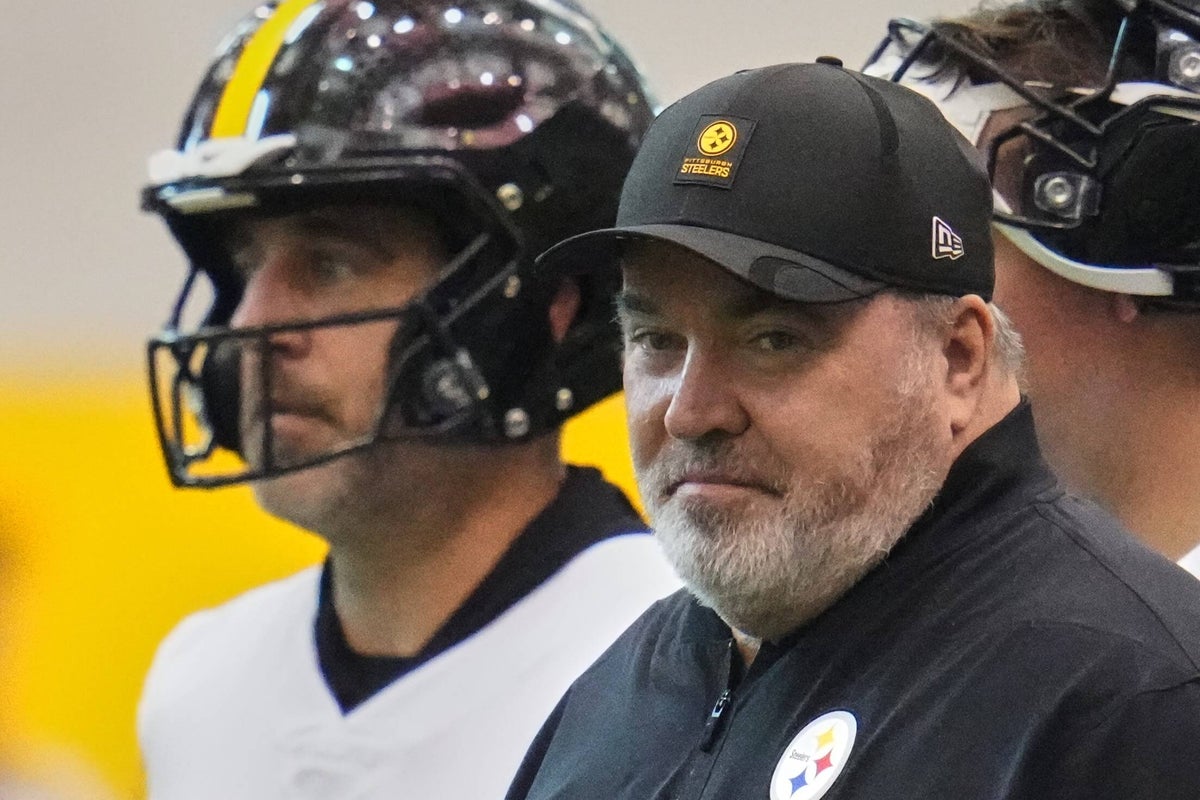
PITTSBURGH — Monday morning at 8, Aaron Rodgers was listening to his new head coach lead a team meeting when a wave of déjà vu swept over him. The veteran quarterback felt himself transported two decades and 600 miles.
“It was surreal, honestly,” Rodgers said. “It took me back to being a 22-year-old kid sitting in Green Bay, listening to Mike (McCarthy’s) first meeting in 2006. A lot of pinch-me moments have been happening the last few days.”
When they first united in 2006, McCarthy was a first-time head coach and Rodgers was a second-year understudy to Brett Favre, with nine career passes on his resume. During their 13 seasons together with the Packers, they leaned on each other as they wrote many of the defining moments of their football lives — two MVPs for Rodgers, a pair of No. 1 scoring offenses and one Lombardi Trophy.
Now, for the first time since McCarthy’s Week 13 dismissal from the Packers in 2018, the 62-year-old head coach and 42-year-old QB reunite with the Pittsburgh Steelers — the same team they beat in Super Bowl XLV — for what Rodgers expects to be his final chapter.
“There’s definitely a full circle aspect to it that piqued my interest from the start,” Rodgers said. “I love Mike. Mike and I spent a lot of time together, a lot of great highs over the years. A lot of respect for him.”
You cannot write Rodgers’ story without McCarthy — or McCarthy’s without Rodgers. In a similar way, their paths back to Pittsburgh this offseason have been intertwined more than anyone realized before Wednesday. McCarthy may not have been given the opportunity to coach his hometown team without his former QB’s recommendation. Rodgers likely would not be in Pittsburgh for a second season if not for the chance to play for his former coach.
A year ago, Pittsburgh’s appeal for Rodgers was Mike Tomlin. After two tumultuous seasons with the New York Jets, Rodgers was looking for an opportunity to end his career with a stable franchise and a coach whom he had long respected from afar. When Tomlin decided to walk away in January after 19 seasons, Rodgers thought his time with the Steelers was also over.
“When he said he was stepping away, that was an emotional moment, just because we all love him so much and care about him,” Rodgers said. “I thought that was probably it for me in Pittsburgh, but when the decision was made to hire Mike, I started to open my mind back up to coming back.”
Not long after Tomlin’s exit, Rodgers had a conversation with general manager Omar Khan. The QB recognized that the trendiest coaching candidates in recent years have often been young assistants who worked under Sean McVay, Kyle Shanahan or Matt LaFleur.
“I encouraged him, from an outside perspective, to interview Mike (McCarthy), not thinking that he even would, honestly,” Rodgers said. “Then when it became more serious, I was thinking, ‘Wow, that’d be a really interesting thought to come back and play with Mike.’”
Rodgers’ return to Pittsburgh is a Green Bay reunion that stretches beyond just the head coach. Several members of the staff are familiar — or even close friends — from Rodgers’ time with the Packers, particularly offensive line coach James Campen.
But, especially for McCarthy and Rodgers, it’s a reunion they couldn’t have anticipated. On Monday, this next chapter began when the Steelers started OTAs.
“We both talked about the moment, walking out on the field together for the first time,” McCarthy said. “It was special.”
From their first practice together on Monday, McCarthy said he could tell that Rodgers still has the elite arm of his prime and the polished footwork that’s a foundational piece of the West Coast offense.
“Now, when I watch him play, and I say, ‘Damn, that guy had a hell of a coach as a young player,’” McCarthy joked.
While Rodgers and McCarthy talked often over the last couple of weeks and months, their focus now is on speaking the same language in meeting rooms and in the huddle. Since 2018, McCarthy has evolved some of his terminology. In an effort to streamline things for players, the new coach is adapting his play calls to be more similar to last year’s. In that way, there are parts that are new or tweaked for both parties.
“I’ll battle him on a couple things that I’ll be stubborn about, terminology-wise, but I think part of the process is just growing,” Rodgers said. “A couple times today, he’s calling plays in the huddle, and I’m asking, ‘Hey, what does this mean?’”
The offense itself has also evolved, to a degree, since 2018. For example, there are more pre-snap shifts to fall in line with the more modern approach. But from a fundamental level, the overarching philosophy remains.
“It’s all about the quarterback’s timing,” Rodgers said. “There’s been good detail on all the route concepts of when you need to be open and how important the depth is. As a quarterback, Bill Walsh used to say, ‘You should be able to throw balls blind, knowing guys are going to be in certain spots.’”
Rodgers was talking about the West Coast offense. But when it comes to this reunion, it turns out it really was all about timing.