
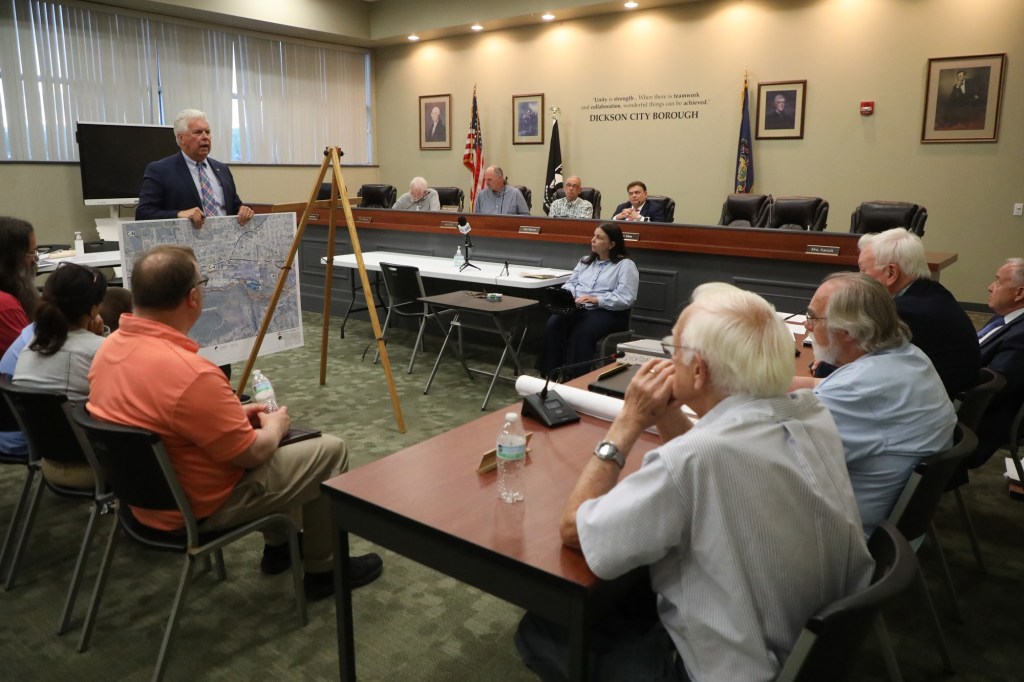
DICKSON CITY — The zoning hearing board upheld the borough’s data center regulations Wednesday, unanimously denying a zoning appeal from a local developer trying to build four data centers and at least three power plants across Bell Mountain.
Dickson City’s zoners voted 3-0 to reject Dickson City Development LLC’s appeal that sought to invalidate the borough’s data center zoning ordinance, which defines and regulates data centers by restricting them as special exceptions in Dickson City’s light manufacturing zoning district. Council adopted the land-use legislation Feb. 12, limiting data centers to Enterprise Street near Eagle Lane and undeveloped land southeast of Railroad Street.
Dickson City Development LLC, a firm linked to Kriger Construction Inc., challenged the validity of that ordinance, filing a substantive validity challenge with the borough zoning hearing board and a land use appeal with the Lackawanna County Court of Common Pleas. The latter challenge is ongoing in county court.
The developer is also actively appealing Dickson City Zoning Officer James Damski’s denial of its applications for four data centers on Bell Mountain. Other limited liability companies tied to Kriger Construction and its leadership are seeking zoning approval from the borough for power plants near the data centers.
About 30 residents attended the two-and-a-half-hour hearing Wednesday, where they listened to Dickson City Solicitor Bill Jones and borough Planner Thomas Shepstone defend the borough’s decision to place data centers in its light manufacturing district.
Dickson City Development’s attorney, Michael Mey, contended the ordinance has “self-defeating deficiencies” and lacked a section to repeal previous zoning standards that he argued allowed data centers in commercially zoned land above Business Route 6, which Shepstone disputed.
The majority of the hearing focused on Shepstone’s testimony, questions from Jones and his subsequent cross-examination from Mey.
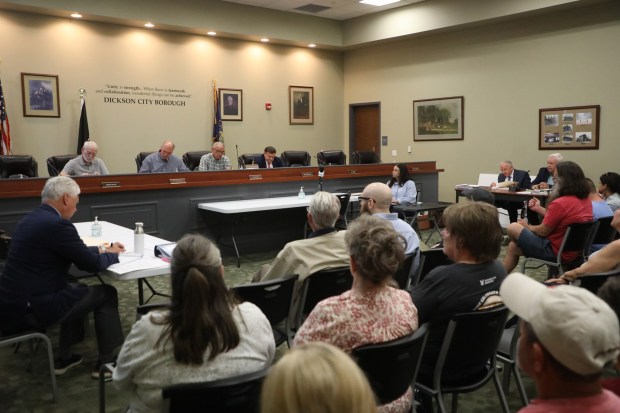 Community members gather at the Dickson City Municipal Building in Dickson City to listen to the zoning board hearing regarding potential data centers in the borough’s M1 district on Tuesday, May 20, 2026. (REBECCA PARTICKA/STAFF PHOTOGRAPHER)
Siting data centers
Mey frequently cited a lack of available land and utilities to support data centers in Dickson City’s light manufacturing district, compared to the accessible land and 230-kilovolt and 500-kilovolt power lines where his client wants to build data centers on Bell Mountain.
Dickson City’s zoning ordinance previously principally permitted “data processing and record storage” in the highway commercial zoning districts immediately above Business Route 6, though the February amendment removed that language.
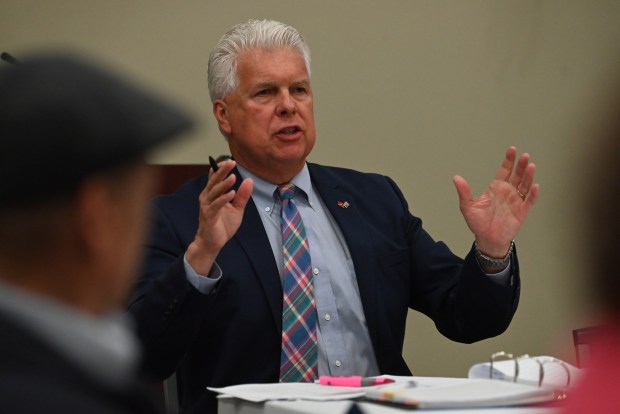 Attorney Michael Mey, representing Dickson City Development LLC, asks city planner Thomas Shepstone questions during the zoning board hearing at the Dickson City Municipal Building in Dickson City on Tuesday, May 20, 2026. (REBECCA PARTICKA/STAFF PHOTOGRAPHER)
Whether “data processing and record storage” includes data centers has been an ongoing dispute between Dickson City Development and the borough, and that debate continued Wednesday. Shepstone maintained the language pre-dates data centers going back to the borough’s 2003 zoning ordinance. Data processing, Shepstone said, referred to operations like an insurance company’s back-office operations to process claims — not manufacturing data.
Mey objected to Shepstone’s definition, arguing, “What Mr. Shepstone is attempting to do is assert only his opinion as a post-hoc type of attempt to pigeonhole the definitions contained in the prior ordinance in such a manner to make them inconsistent with data centers.”
Shepstone testified that there are 70-plus acres contained in Dickson City’s light manufacturing zone, about 21 acres of which are undeveloped near the Lackawanna River by Dickson City’s border with Olyphant. Some of that land falls into a floodplain, but between 8 and 10 acres remain “very developable land,” with 7 to 8 of those acres being “very suitable” for a building, plus some of the additional area being suitable for buffers and parking, Shepstone said.
There is also a significant acreage of undeveloped land along Enterprise Street, Shepstone said, adding that a developer could acquire existing buildings on the road for more space.
“We know buildings can come and go, so somebody could easily buy any of those buildings and tear them down,” he said.
Pointing to Dickson City Development’s applications to build data centers with footprints from 107,820 square feet to 147,000 square feet, Jones asked Shepstone if the vacant land could accommodate a data center of either size, factoring in 200-foot residential setbacks and floodplain requirements.
They would fit, Shepstone said.
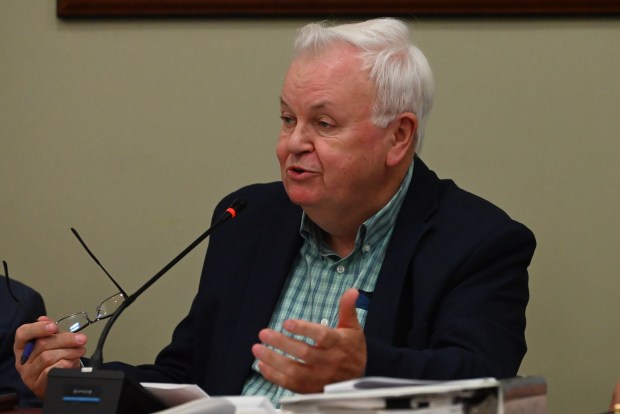 City planner Thomas Shepstone responds to questions regarding potential data centers in the borough’s M1 district during the zoning board hearing at the Dickson City Municipal Building in Dickson City on Tuesday, May 20, 2026. (REBECCA PARTICKA/STAFF PHOTOGRAPHER)
Mey questioned Shepstone on why the borough felt the manufacturing district was suitable for data centers but not the mountain where his client applied to build them. Mey noted the manufacturing district borders residential areas.
Shepstone acknowledged a portion of the manufacturing district does border residential areas, but he said that data centers’ water use, electricity use, sound concerns and the creation of a product fall under a manufacturing use. He characterized it as “digital manufacturing.”
Mey emphasized in his questioning that there is no physical product created and asked Shepstone if he is testifying that data centers are manufacturing centers.
Yes, Shepstone said.
“It’s not just a question of what goes out the door, it’s what goes into the product,” Shepstone said. “We talked about water use being significant, and electrical use being significant, and we also have very sophisticated equipment involved, which is what you would typically have with manufacturing equipment.”
Feasibility of data centers
Addressing utilities, Mey focused on the difficulty of powering a data center in the manufacturing district. He asked Shepstone multiple times, as a planner, how he would run high-tension power lines from Bell Mountain where the existing lines are to the manufacturing district.
“I’m not an expert on that. I just know that it’s been done,” Shepstone said, describing the Canpack can manufacturing facility on East Lackawanna Avenue in Olyphant having to spend millions to run power lines to its site. “It would be the responsibility of the developer to craft that solution.”
Mey contended they would have to run through numerous residential properties. Jones objected that Shepstone is not an electrical expert.
“As a planner, tell this board how you get from Route 6 to the (light manufacturing) zone with high-voltage electricity going through what’s clearly a majority residential area. How do you do it, Mr. Shepstone?” Mey asked.
“That is not my job, it’s a developer’s job to do that,” Shepstone replied. “We’ve identified land where you can put this use, and the bottom line is that it has been done before.”
It’s up to the developer to find the power, but if there is ultimately a problem getting electricity to the site, that is a basis to come back to the borough seeking a curative amendment or variance, Shepstone said, though he does not believe there is a case for that at this point.
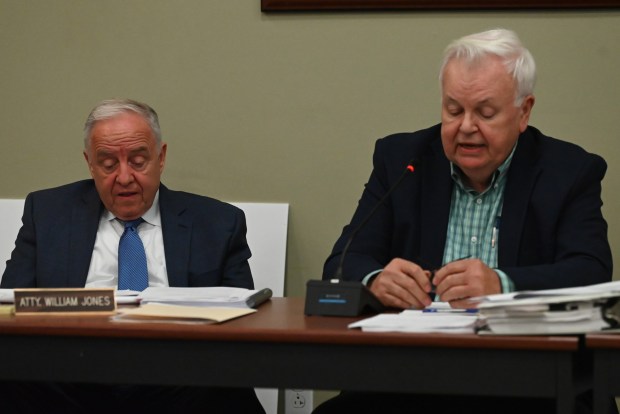 Dickson City Solicitor William Jones asks city planner Thomas Shepstone questions regarding potential data centers in the borough’s M1 district during the zoning board hearing at the Dickson City Municipal Building in Dickson City on Tuesday, May 20, 2026. (REBECCA PARTICKA/STAFF PHOTOGRAPHER)
Mey later challenged that if it is impossible to get power to the site, it is de facto exclusionary.
Jones countered that there was no testimony saying a developer would have to connect to the high-tension power lines above Business Route 6. Jones offered running a power line from Olyphant as one example of another way to get power, or developing a smaller data center that would have lower electricity needs.
Board’s decision
After both Jones and Mey concluded their arguments, the zoning hearing board briefly recessed to deliberate before rendering a 3-0 decision to deny Mey’s appeal.
The board will now issue a written decision within 45 days, board Solicitor Frank Marcin said.
Mey declined to comment on the decision or whether he intended to appeal.
Jones lauded the board’s denial, calling it the appropriate outcome.
“It went through the whole planning process, and it was well substantiated and well reasoned by the borough to create a zone that could provide for that particular use in a manufacturing area,” Jones said.
If Dickson City Development appeals the denial, it will go to the Lackawanna County Court of Common Pleas.