
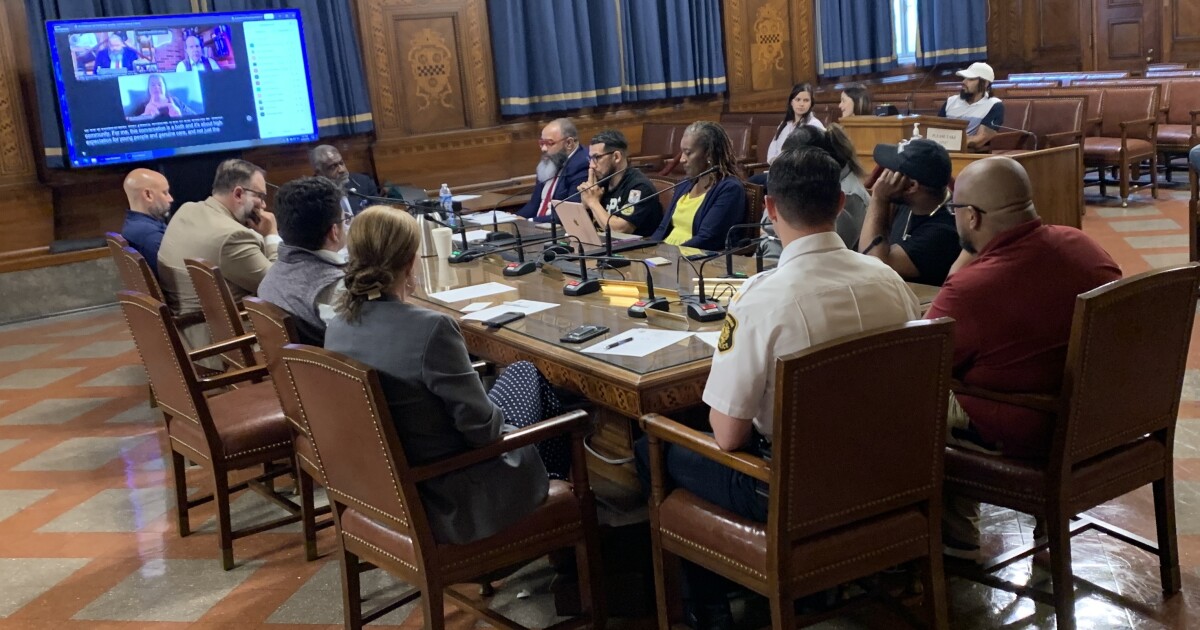
Experts on youth behavior and violence prevention encouraged Pittsburgh city councilors to look for nuanced solutions to working with the city’s young people at a post-agenda meeting this week.
Organized by councilor Khari Mosley, the Wednesday afternoon meeting came amid ongoing discussions about youth gatherings across the city. Businesses and public safety officials have complained of recent disruptions from rowdy groups of teenagers. The city responded to concerns Downtown with a new policy restricting young people from spending time in Market Square during certain hours.
Young people, parents and advocates have raised concerns about the rule in the weeks since it went into effect.
Experts at the gathering included local activists, outreach professionals, police officials, and professors. All emphasized different priorities, but expressed a desire to find a longer-term solution beyond the current restrictions.
Cynthia James, president and CEO of Youth Places, an outreach organization that works downtown, said young people can’t be treated as a monolith. Their life experiences vary widely, she said, ranging from those who are just hanging out to those who are “highly retraumatized on a consistent basis.”
“Large groups of teens are not automatically a threat,” she said. “I think we need to be careful not to confuse youth presence with youth violence. Those are two totally separate challenges.”
Dr. Valerie Adams-Bass, a developmental psychologist from Rutgers University, warned against “deficit-based approaches” that restrict young people’s autonomy and treat them as problems to be fixed, especially when working with young people of color. She recommended youth be invited to collaborate and work with adults to encourage more enthusiasm, leadership and buy-in to activities.
Adams-Bass said at least two young people should be included in meetings that discuss future solutions. (The panel Wednesday did not include any teens at the table, though some spoke to councilors afterward.)
“ If you say, “Go ahead and drive the car,” and they’ve never driven before, how would they know to drive the car if you’ve never given them the opportunity?” she said. “You’ve gotta make space for them.”
Jason Rivers, a violence prevention coordinator who works with Pittsburgh Public Schools and the A.I.M. Initiative outreach program, noted that spaces that appeal to young people may not necessarily be highly regimented.
“ They’re not looking for structured program[s]. They’ll tell you all the time, ‘I don’t wanna go back to school after I’ve come out of school,’” he said. “They want soft space where they can gather, where they can do some social-media stuff, where they can engage with one another.”
James concurred, noting that the needs youth programs meet sometimes go beyond academics.
“ It’s not just about the kid going from a C average to a B average. It’s about the kid who needs a lot more nuanced work than people are willing to support,” she said.
Other speakers stressed their desire for some safety precautions and consequences.
“ We obviously don’t wanna treat all juveniles like they’re criminals because 50 are gathered in Market Square and two of them get in a fight,” said Pittsburgh Police Commander Lance Hoyson. But he added, “ I think for those most serious offenders, who are giving the crowd a bad name, then there needs to be an understanding that the police are gonna do their job, because we’re failing that young man or that young woman if we just allow them to continue down that path of criminality that they’re on.”
Ayodeji Young, a REACH violence prevention coordinator who works in the city’s eastern neighborhoods, described a situation in which a group of teenagers threatened him in Market Square when he tried to talk them out of throwing bottles at a restaurant.
“There’s nothing wrong with a rule or two,” he said, while emphasizing that he does not want to promote criminalization of Black youth. “A little order is all that people really want.”
Young said stipends and training programs could help motivate kids to stay with outreach programs instead of getting into trouble.
“ Kids will come in the door by the droves if there was something behind that monetarily to make them wanna come in the doors and say, ‘I don’t wanna go downtown, I wanna go to this because this program is paying me,’” he said.
Following the discussion, Mosley said he hopes Council can look at the root causes of challenges with youth. His own office is currently working with several organizations in his district to start a new street-team initiative this summer to reach out to young people.
“ There’s some generational angst where the young people feel like the older people don’t care about them, and then some of the older people have really strong feelings about the young people, and that’s something we also have to deal with,” Mosley said.
The task ahead, he said, is to balance accountability measures with pathways to redemption.
“ I think we took a step today more towards solutions and not more focused on venting about the problem,” he said.