
Researchers, Forest Service employees and industry concerned about the future of the tree census
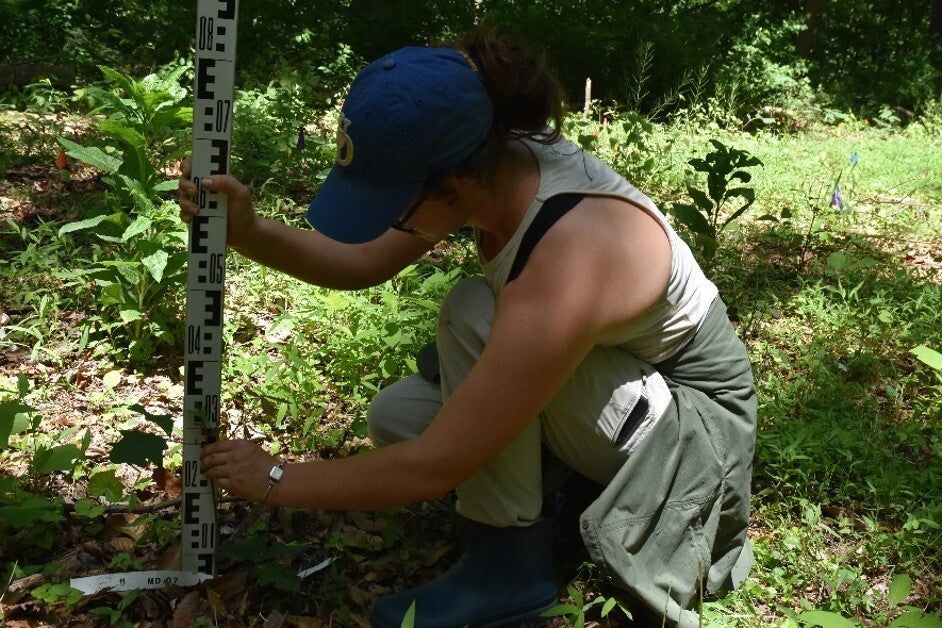
Several researchers and foresters also said they were worried about what would happen to the Forest Inventory and Analysis program, which some call the “tree census.” The Forest Service workers in this program regularly collect data on forests across the U.S., which is useful to governments, companies and scientists.
For example, Myla Aaronson, assistant professor of ecology at Rutgers University in New Jersey, said she relies on this data to study how forests change because of storms, droughts, pollution and the expansion of nearby cities.
“We wouldn’t be able to understand the trajectories of forests without this long-term data,” she said.
She said the program is already strained from budget cuts in 2025, which led to thousands of Forest Service workers being fired, resigning or retiring.
Michael Hoppus has retired from the Forest Service, but used to work on the Forest Inventory and Analysis Program as a research forester based in Pennsylvania. He said there are a handful of staff in York who work on the program, but the agency is thinking about closing that office.
“Of these people that are still hanging on in this area where I live, they have been given letters saying, ‘You might have to move, you might not have to move. We’ll let you know,’” he said. “So, very unclear what’s going to happen.”
He added that he has talked to many current Forest Service employees and none are pleased with the plan.
“I just talked to a high-level state and private forestry employee who is livid at what she considers to be very unwise elimination, essentially, of the good work,” he said. “I was a high-ranking officer in the Navy. I quit the Navy [at] 32 years old to become a forester. And I was bound and determined that I was going to work for the Forest Service and I was lucky enough to do just that. I don’t like it being messed with.”
The USDA said part of the point of reorganizing is to support U.S. timber production. However, that industry also uses data from the Forest Inventory and Analysis Program, said Dallin Brooks, executive director of the National Hardwood Lumber Association, a trade organization that represents hardwood sawmills in the U.S. and Canada.
Brooks explained that the industry relies on this “critical” inventory data to decide where to build mills, and whether to expand specific locations.
He also said the industry is concerned about the plan to close an office in Starkville, Mississippi, where the Forest Service tests the durability of wood as part of a network of sites around the country.
“The durability of a piece of wood in Louisiana is different from one in Chicago. And so we need these different sites to do this,” he said. “We just don’t have answers to what’s going to happen with these test sites. But the industry is funding a lot of this research with them, providing samples, and we don’t want to see that research disappear.”
He said that companies will always support the government being good stewards of taxpayer funds, but the current uncertainty around the future of the Forest Service is bad for business.
“You can’t make long-term investments if you don’t know how things are going to change. And so the uncertainty, which is across the board the number one concern of the industry, is something that was very much on everybody’s mind,” Brooks said.