
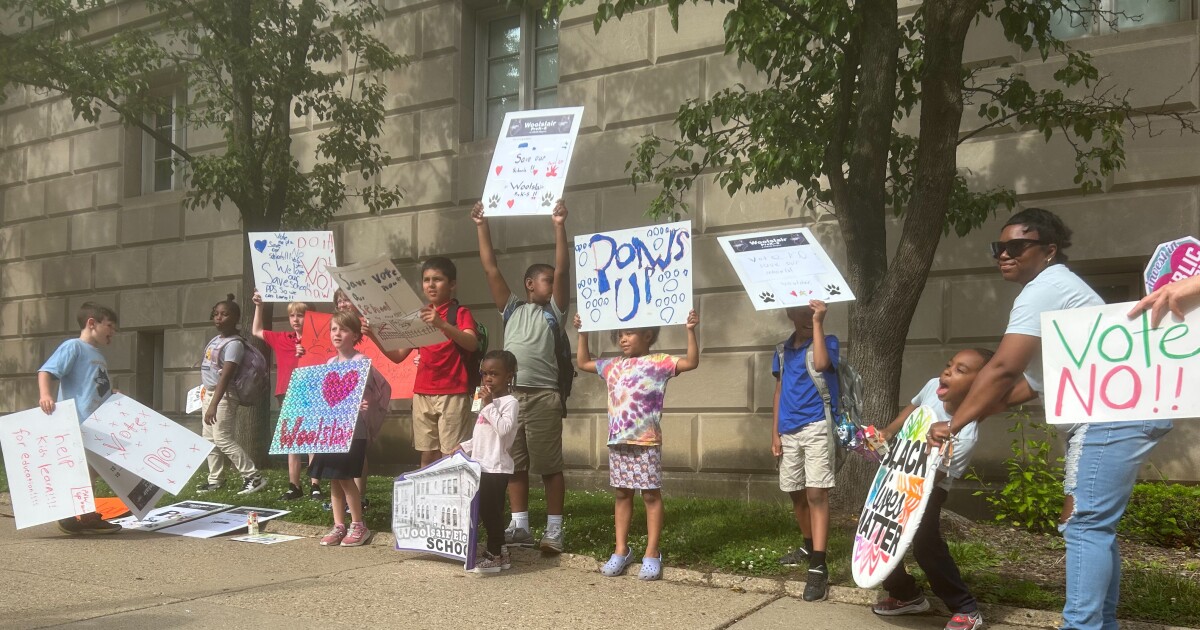
Dozens of elementary school students filled the conference room inside Pittsburgh Public Schools’ administration building on Tuesday night. Third grader Serenity Brewer came to tell board members not to close her magnet school in Bloomfield, Woolslair PreK-5.
Brewer said her school is worth saving “because it’s where kids learn, and it’s kind of like a kid’s safe place.”
“And we have this one nice teacher in fifth grade, and I really want to get to be in her class,” she added.
Woolslair is among the nine school buildings and 12 student programs slated for closure in 2027 under the district’s proposed Future-Ready Plan. Board members will decide the plan’s fate on Wednesday night for a second time, having turned down the same consolidation proposal in November.
At Tuesday’s hearing, Brewer and her peers from Woolslair sat playing games in a circle on the hallway floor as parents shuffled back and forth to the microphone. Other students sporting Montessori PreK-5, Fulton PreK-5 and Miller African Centered Academy logos sat scribbled in notebooks and rehearsed their testimony as they waited for their turn to speak.
“After they do it, they’ll regret it,” said third grader Nina Louise Dagavarian, who has been rallying to keep Woolslair open since closure conversations began nearly three years ago.
“I’ll lose my friends. I’ll lose almost everything, and other people will too,” she said.
Mounting opposition
Like many districts nationwide, PPS has faced continuous declining enrollment for the past several years. PPS leaders estimate that closing and consolidating some of its small and aging school buildings would save them up to $7.9 million annually and avoid roughly $102.9 million in future facility costs (although parents at Tuesday night’s hearing say the numbers don’t account for rising inflation and interest rates).
But board members say the value of the Future-Ready Plan isn’t purely financial. In a letter sent to district families earlier Tuesday, school board president Gene Walker cited the many underutilized buildings spread throughout the district, as well as the inequitable distribution of specialized and advanced courses.
The district has promised to better distribute its resources under the Future-Ready Plan, framing it as an opportunity to expand foreign language, STEM and arts programs to all district elementary schools.
Yet many parents and community groups have voiced doubt that the district will make good on those promises. Last week, advocates with Black Women for a Better Education and 412 Justice, along with several school-based Parent-Teacher Organizations and community stakeholders, delivered a letter to board members that pointed to critical gaps in information and staffing they say will hinder a successful transition.
“[G]iven the lack of details about key elements of the plan; the ongoing leadership, capacity, organizational, and financial challenges in PPS; and the lack of vision to situate this plan in the broader context of the future of our region, we implore our Board of Directors to vote ‘no’ to the Future-Ready Plan,” the groups wrote.
Community advocates successfully pushed the district to delay the plan’s implementation timeline by one year and begin the process to hire a new deputy superintendent to oversee the transition. But they say realistic staffing strategies, defined accountability metrics and specifics on how this plan mitigates financial insolvency are still missing.
They are also urging PPS to collaborate with City of Pittsburgh and Allegheny County officials to ensure that the Future-Ready Plan is aligned with broader regional goals and trends.
Pittsburgh Mayor Corey O’Connor told WESA earlier this year that he’s already held initial discussions with district leaders about future uses of vacant school buildings.
But Sauntee Turner with the city’s Housing Authority said that closing Miller, located in the Hill District, would be a devastating blow to the ongoing work to redevelop Bedford Avenue and the greater neighborhood.
Turner said the school was also part of the housing authority’s winning $50 million federal grant application to redevelop its Bedford Dwellings apartments, just a few blocks from Miller African-Centered Academy.
“These families see Miller as a safe space, a neighborhood anchor, and a source of stability in a community that has already experienced generations of displacement and disinvestment,” Turner said. “As a community partner, the district would be wise to consider investing into the Hill rather than taking away this valuable resource.”
In a letter this week, Pittsburgh NAACP president Jacqueline Hill called the move to vote on the plan without making significant revisions “deeply troubling.”
“The NAACP understands that Pittsburgh Public Schools faces real fiscal pressures. Declining enrollment, aging infrastructure, and budget deficits are not abstractions — they are genuine challenges that require genuine solutions,” Hill wrote. “But closing majority-Black schools without a fully developed, community-informed, and equitably designed plan is not a solution. It is a harm.”
Quiet support
While the majority of speakers on Tuesday spoke in opposition to school closures, Perry High School English teacher Jason Boll expressed optimism. He challenged the district to dedicate some of its best leadership to redesigning Allegheny Traditional Academy, which would become the North Side’s sole middle school under the plan.
While officials with the district’s teachers union were absent Tuesday, Pittsburgh Federation of Teachers president Billy Hileman urged school board members to vote in favor of the plan last fall.
Boll echoed that support, saying “every student needs opportunities, otherwise we’re not a public good.”
“We know exactly what we have now, and it is simply not good enough,” he continued. “…A ‘no’ vote feels like a continuation of what we already know, which is budget challenges, unfilled positions, declining morale and communities growing more discouraged.”