
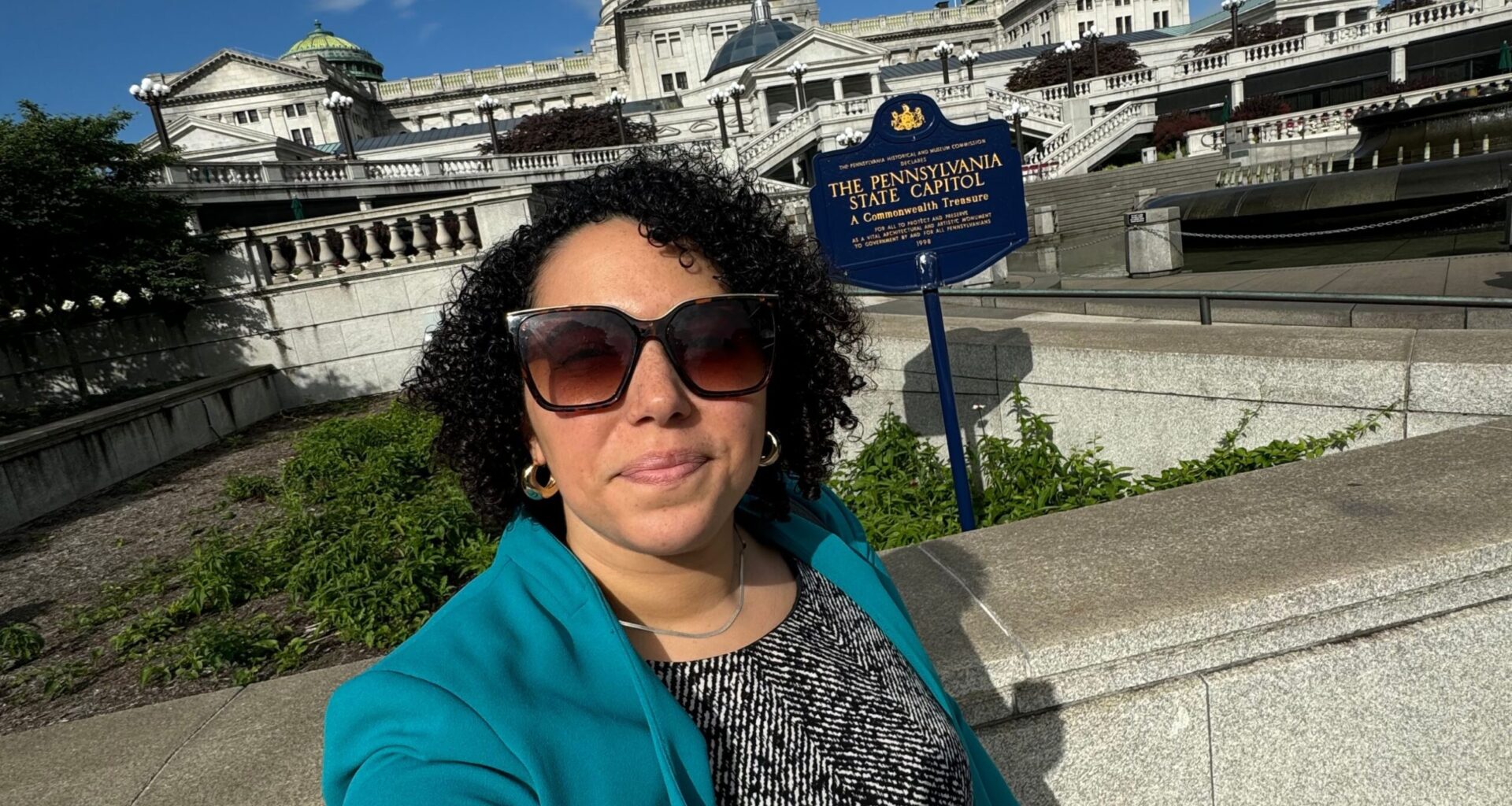
This is How I Got Here, a series where we chart the career journeys of technologists, entrepreneurs, tech workers, builders and people in the innovation economy. Want to tell your story? Get in touch.
Before Sara Hall was helping Pennsylvania rethink how residents navigate state services online, she was studying how people move through buildings.
Early training in architecture and human-centered design followed her from Philly’s digital services team to the top role at the Commonwealth Office of Digital Experience (CODE PA), where she focuses on making online government services easier to use, maintain and improve across the commonwealth.
“One of the things I was always longing for was talking to people and really understanding their experience.”
Sara Hall, CODE PA
Her path into human-centered design started in college, when she studied architecture and learned to center people’s needs in her work.
After trying out a few roles related to digital design, she landed at the City of Philadelphia. Hall helped build out the city’s website and eventually went on to found the city’s digital services team.
After her role at the city was eliminated, she made the jump to state government, starting as a product manager for pa.gov, and working her way up to head of product, then acting executive director before taking on the role permanently earlier this year.
The common thread throughout these roles, she told Technical.ly, has stayed the same: building tools around the needs of the people who use them.
Throughout her career, she also taught subjects related to UX design at Thomas Jefferson University and Temple University. Teaching allowed her to keep up with trends in the subject and have conversations with students who are still learning and growing, she said.
In this edition of How I Got Here, Hall shares her journey into government technology, why digital services matter and her plans as the new leader of CODE PA.
This Q&A has been edited for length and clarity.
How did you first become interested in design?
I went to a math and science high school, and thought I wanted to do civil engineering. I ended up on a soccer scholarship at Philadelphia University and because they didn’t have civil engineering, I studied architecture because it seemed close enough.
Architecture is a five-year degree, and in your first few years, you get to understand design, systems, how structures are built, what layouts are and things along those lines.
As I was moving into my third and fourth years, I was thinking about who the users are and what it looks like to design for people. I was still designing buildings, but I was really thinking about the human experience in these spaces.
I went to University of the Arts for a Master of Science in industrial design. It was focused on human-centered design and looking into solving for end users. At that time, it was not focused on digital spaces. It was really, how do you solve problems for people based on their needs?
How did your early-career roles lead you to digital services?
I got my first role as an information architect, and that role doesn’t really exist as its own anymore.
What that taught me was formal thought process and flow. It required me to learn how to articulate decision-making on paper and then pass it off to a designer.
Then, I became a multimedia experience designer in the healthcare space. I was doing everything from interviewing patients about their experiences using a certain program to creating e-commerce sites, to editing video, to taking pictures, to project managing some of our digital app builds. It was a really great experience.
However, one of the things I was always longing for was talking to people and really understanding their experience.
What was your experience like working for the City of Philadelphia?
Throughout my career, I’ve tried to think more about my goals and my needs as a person, in terms of being happy in my work and finding my work meaningful. I started listing those goals separately from a specific industry, or role, or place, and I started to see more of the things that I wanted to do align with civic tech and government work.
When I started, I got to join this small, high-impact team rebuilding the city’s website. In 2019, we officially launched phila.gov and we had the opportunity to move into the larger IT organization and branch out our work into UX.
I was able to get back to my UX roots, helped found the UX team, and we expanded from building the website to a broader product and framework. We were really strengthening that collaboration that forms modern digital services teams, or more formally established digital services teams.
When the pandemic hit, we pivoted back to phila.gov to really launch and support the COVID-19 efforts. It really was a testament to the thoughtful work we put in the previous three years.
The digital services team was officially formed in 2022 and we saw content and UX get elevated.
Why did it make sense for you to move to state government work?
When I was offered the role for pa.gov that felt like a very strong next step, because it aligned so much with the work I did with the city.
It was time for me to move on and I wanted to get a little bit more exposure to scale, and the scale of the state is so much larger. I also wanted to expand the breadth of the work and the impact.
Throughout your career, how have you known it was time to move on?
I was finding places that I didn’t want to go.
I went around and talked to folks that I networked with in the community and what I found was that the type of work I like to do within an organization is more of an in-house team to better support the people I’m working with on the things that they’re looking to deliver.
I like to work on the overall mission. I wasn’t in love with going on one project for an agency and then switching off of that in a year and then moving to another one. I’d like to see the evolution.
What are you focused on right now in your current role?
My immediate focus in the next few months is really strengthening our product workstream.
Those workstreams are focused on permitting, payments, identity access management, pa.gov, grants and a legislative mandate we’re working toward.
We also have some projects that we’re finishing up with the Board of Pardons, and some maintenance work we’ve been doing on our content management system. As well as growing and supporting our multidisciplinary teams, including content, UX research, UX design, front-end engineering, back-end engineering and quality assurance.
In October, we made the switch from supporting one-off products to enterprise products. This was kind of due to the budget impasse, but it also helps ground our work in sustainability over time.
What are your long-term goals at CODE PA?
Six months and beyond, I’m focused on reinforcing our team and figuring out what CODE PA is built for and really good at.
It’s expanding our enterprise products and reach, but also building in feedback loops to make sure we’re hearing from Pennsylvanians, to make sure that our improvement on our products is continuous.
Long term, I want to see digital services in Pennsylvania that are intuitive, accessible and resilient, and make sure that CODE PA is seen as a trusted partner in solving our complex service challenges here at the commonwealth.
What common lessons have you learned from city and state governments?
There’s really great institutional knowledge across these organizations. The problems that we’re solving are maybe not new, but how can we understand how they’ve been attempted to be solved before?
We can also collaborate with the folks who have been a part of these problem areas. We can’t just slap a digital solution on something and call it a day. It’s really making sure that we have a deep understanding of the problem area and the process surrounding it.
Do you have any advice for people interested in government technology work?
Have conversations with people working in the spaces and make sure you understand the reality.
Working in government is really hard and I don’t think people understand that completely. You have to be resourceful, understanding and willing to put a little effort in, or fill a gap somewhere.