
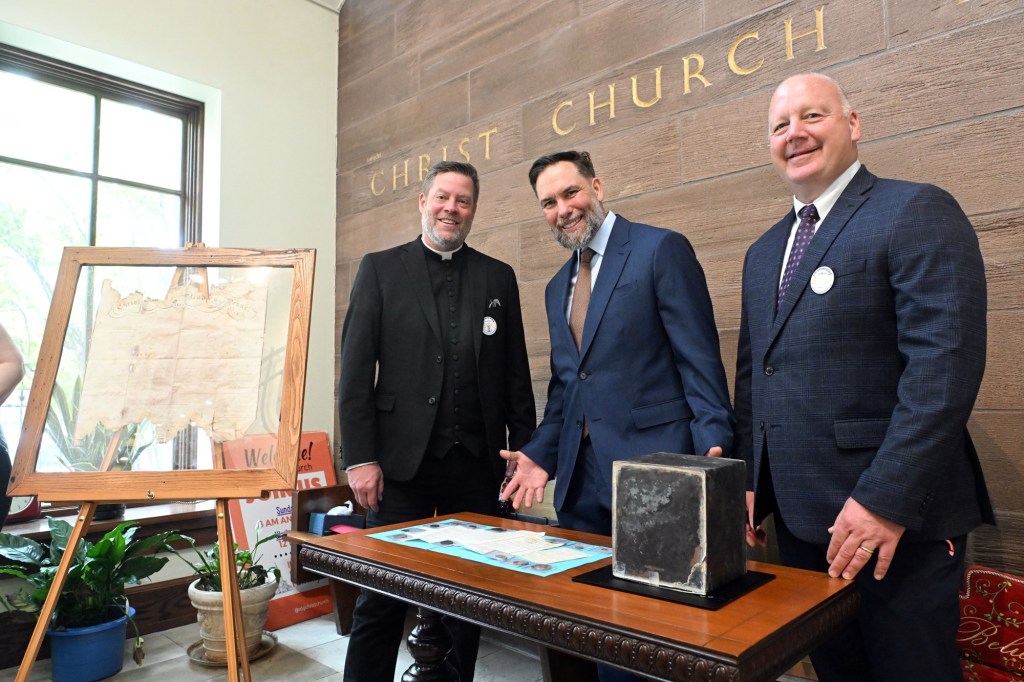
It was a blend of local history, preservation and faith.
More than 150 people gathered at Christ Episcopal Church on the northwest corner of Fifth and Court streets to mark the church’s 200th anniversary.
The occasion featured music, historical reflections and the public the public unveiling of newly restored portions of the historic building.
But the highlight of the day was the opening of a time capsule, sealed inside the cornerstone of the church’s brownstone steeple in 1863.
Diane Morris, chair of the church’s bicentennial committee, said the capsule contained coins and ephemera dating to the Civil War era, including an 1863 Indian Head penny, silver coins, and copies of the Reading Daily Times and Berks and Schuylkill Journal newspapers.
“It was interesting to see what survived and what sort of disintegrated over time,” City Council President Donna Reed said during a council meeting after attending the recent event with Councilman O. Christopher Miller. “The newspapers that were in there looked like they were hot off the press yesterday.”
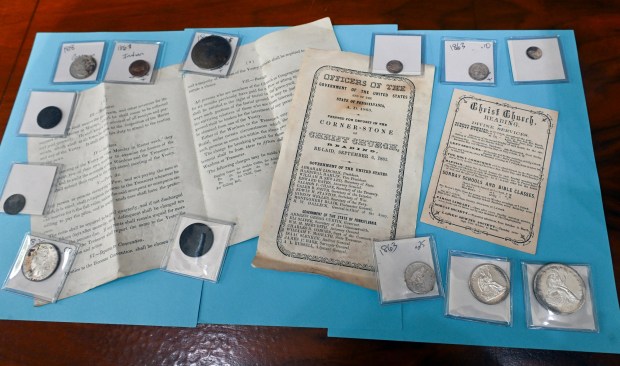 Coins and other ephemera from 1863 that were preserved in a time capsule that was displayed during the Christ Episcopal Church’s 200th anniversary celebration on Saturday, May 9, 2026. (BILL UHRICH/READING EAGLE)
One of the most striking discoveries, Morris said, was a printed government document listing President Abraham Lincoln and others in federal office the year the capsule was sealed.
The capsule also contained a church service bulletin from Sept. 6, 1863, the day the cornerstone was laid following a major expansion of the church.
Morris said some items from an earlier time capsule placed when the oldest section of the church was consecrated in 1826 were placed in the 1863 capsule.
“There were even some coins in there from like 1804,” she said.
Church leaders said they plan to preserve and periodically display the artifacts.
The capsule was removed by Ken Saul, president of Restoration Artisans, who used a diamond chainsaw to cut through the 163-year-old brownstone cornerstone. Morris said the work highlighted the growing challenges of preserving historic structures and materials.
“Pennsylvania brownstone isn’t even quarried anymore,” she said.
Attendees heard remarks from Saul, church Rector the Rev. Bryce Wandrey and Bishop Daniel Gutiérrez of the Episcopal Diocese of Pennsylvania, who offered a blessing for the church and congregation.
The moment carried historical symbolism, Morris said. Two centuries earlier, the church was consecrated by Bishop William White, the first bishop of Pennsylvania and a prominent Revolutionary-era Episcopal leader who helped guide the American church after independence from England. The church timeline notes that White consecrated Christ Church on May 10, 1826.
Reading’s historic Christ Episcopal Church undergoing interior restoration
Guests toured the church’s newly restored nave and sanctuary, where extensive plaster repairs were completed this year after deteriorating sections of decorative plasterwork began falling from the ceiling.
Morris said contractors discovered improperly repaired sections hidden behind earlier work, including heavy plaster pieces that were no longer properly anchored.
“All the plaster work is done now, and it looks gorgeous,” she said.
Megan McNish, eastern region coordinator for the Pennsylvania State Historic Preservation Office, spoke about the importance of preserving historic places.
“Our efforts to preserve pieces of our past are what we pass on to future generations,” McNish said. “We preserve to pass the baton, not to freeze these places in time, but to build a collective foundation for a bright and vibrant future.”
The Berks Youth Chorus performed inside the restored sanctuary beneath stained-glass windows and the church’s 1911 Austin pipe organ.
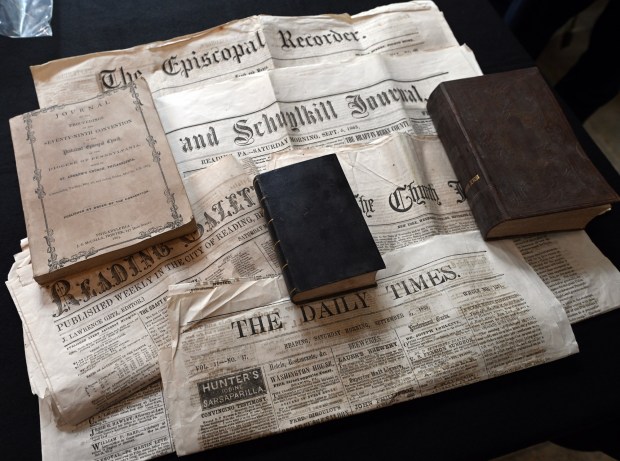 Newspapers and books, including a Bible, from 1863 were preserved in a time capsule that was displayed during the Christ Episcopal Church’s 200th anniversary celebration on Saturday, May 9, 2026. (BILL UHRICH/READING EAGLE)
During the reception, Reed and Miller presented the congregation with a certificate of appreciation from City Council in recognition of the church’s longstanding contributions to the city and its role in the Callowhill Historic District.
The church received a Pennsylvania Senate congratulatory citation sponsored by Sen. Judith Schwank.
Christ Church Pictorial Timeline
Founded in 1763 as St. Mary’s, Christ Church is the oldest English-speaking congregation in Reading. According to the church’s bicentennial timeline, early members worshipped in homes, public buildings and an earlier church at Sixth and Walnut streets. The congregation moved to its current location in1826.
The church’s history also intersects with the American Revolution. Congregation member Edward Biddle presided over a July 2, 1774, public meeting in Reading supporting early steps toward independence and later served in the First Continental Congress.
Christ Church is not only rooted in history, its leaders said, but also in the present. The congregation continues its mission of faith and outreach efforts, ranging from community meals and shelter partnerships to neighborhood events and interfaith initiatives.
Its guiding vision, Morris said, “is to remain in the city, with our neighbors, for everyone.” It’s a philosophy she said continues to shape the church’s ministry and its role in downtown Reading.