
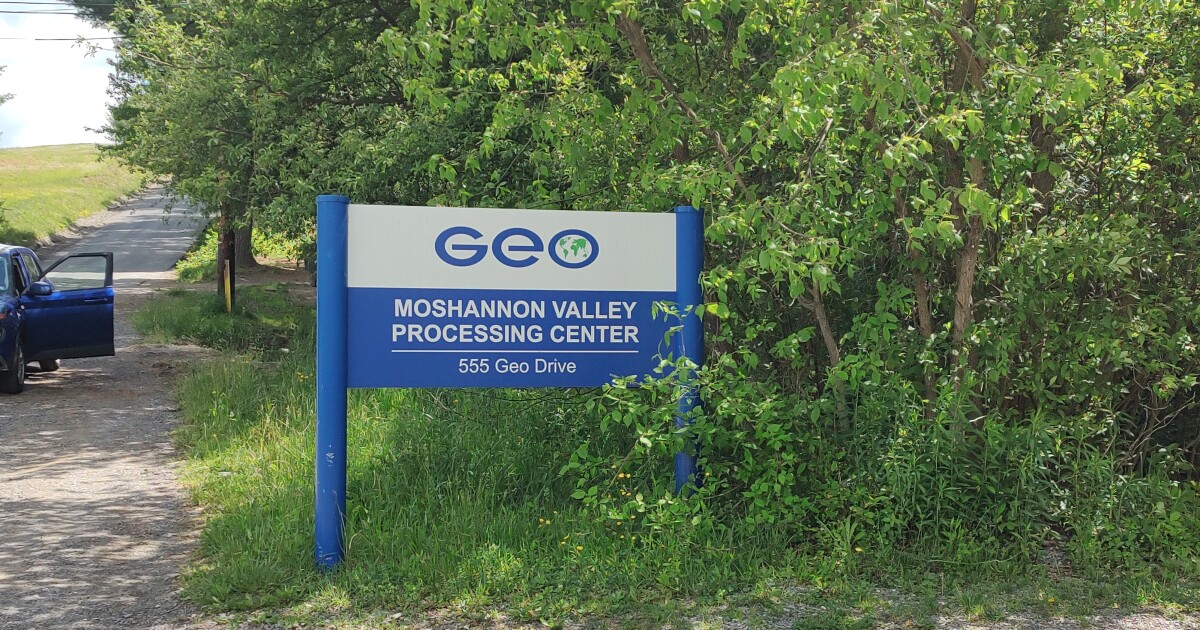
Allegheny County Congressional members Chris Deluzio and Summer Lee are visiting the controversial Moshannon Valley Processing Center outside Philipsburg today.
The facility is one of the largest detention centers in the country for immigrants taken into custody by the federal Immigrations and Customs Enforcement.
Deluzio and Lee’s visit was unannounced, but they were permitted into the site around 11 a.m., after waiting about half an hour. They drove into the facility as detainees in colored jumpsuits could be seen behind barbed wire fencing outside. Their visit was stretching into its second hour early Thursday afternoon.
Congressional staff, including a translator to help Deluzio communicate with incarcerated Springdale resident Randy Cordova-Flores, were not permitted to accompany the representatives. But Lee and Deluzio appear to be the first members of Congress to gain access to the facility: Lee’s efforts to visit it last summer were rebuked, though courts have since upheld the right of members of Congress to inspect the facilities.
The visit came at a time when President Donald Trump’s hardline approach to immigration enforcement is filling the Moshannon Valley Processing Center almost to capacity.
Located roughly three hours from Pittsburgh, Moshannon holds people arrested by immigration authorities while they await a hearing before an immigration judge.
Those incarcerated there have include such high-profile local detainees as Bruno Guedes da Silva, a Brazilian immigrant who was released as his 6-year-old girl was being treated for cancer, and Oakmont resident Jose Flores, who was also released amid outcry from residents and support from his employer, a prominent local bakery.
Today, Moshannon is among the top 10-largest detention facilities in the country, and the largest operating in the northeastern United States, with a capacity of 1,876 prisoners. In recent months, it’s housed roughly 1,650 people, according to the Transactional Records Access Clearinghouse, a widely cited data-gathering project tied to Syracuse University.
Moshannon housed around 1,170 detainees at the end of 2024, just before Trump took office.
For Lee, the trip to Philipsburg was a repeat visit: She was previously barred entry to the facility after an hour-long wait there last August, despite a February 2025 policy statement assuring that “ICE will comply with the law and accommodate [Congress] Members seeking to visit/tour an ICE detention facility for the purpose of conducting oversight.”
That refusal, Lee said at the time, “should call the public to question what is happening behind these walls that the administration is trying to hide.”
Frustrated Democrats sued over being kept out of such facilities. Earlier this month, a federal appeals court upheld their right to gain access to them, agreeing with Congress members that the law funding those operations gives them the right to oversee how the money is being spent.
Concerns about the center predate the Trump administration: A 2024 report by a law project at Temple University contended that “people in immigration detention at Moshannon are being held under punitive, inhumane, and dangerous conditions,” and were often taken from their families and communities unnecessarily.
As the center’s census has grown, so have concerns about conditions there.
Some detainees reportedly began a reported hunger strike there this spring, and earlier this week, immigration-rights advocates held a news conference decrying a lack of medical attention for a 40-year-old Egyptian detainee, Izzy Aly, who’d been living in Florida and who has been held at the facility since this past winter. Aly, they said, is suffering from stage III kidney disease but has received inadequate treatment. He’d recently seen blood in his urine, they added,
“The level of medical care that he needs so he doesn’t have permanent damage to his body … he will never get at Moshannon because that’s not how the detention centers are designed,” said Jasmine Rivera, Executive Director of the Pennsylvania Immigration Coalition, in a call with reporters.
“That prison should not be allowed to operate any further,” Rivera said.
There have been deaths at the facility: In December 2025, ICE disclosed the death of 46-year-old Fouad Saeed Abdulkadir after he complained of chest pains. Abdulkadir, an Eritrean taken into custody while serving a prison sentence for wire fraud, had been in the facility for seven months.
Months before that, a 32-year-old Chinese man, Chaofeng Ge, was found dead in a shower, apparently as a result of hanging. He’d been in custody for less than a week after being charged with the fraudulent use of electronic devices.
The facility is operated by The GEO Group, which describes itself as “a leading diversified government service provider” that specializes in “design, financing, development and support services for secure facilities, processing centers, and community servicings,” in the United States and three other countries. Worldwide, it oversees nearly 100 such facilities with 75,000 beds.
Clearfield County Commissioners, who hold the contract with GEO, have reportedly begun discussing whether to scrap or revise the arrangement to provide more outside oversight when the current agreement expires in September.
The company’s chairman, George C. Zoley, recently reported strong results for the first three months of 2026 driven by “the new growth opportunities we captured in 2025 and are normalizing in 2026.”
Thanks to contracts with the federal government, contracts in other sectors, the company said, it had received new revenues of $520 million — “the largest amount of new business we have won in a single year in our company’s history.”
Shortly after Lee and Deluzio entered the facility, a charter-style bus marked with the Geo logo drove in behind them.
The company’s contracts with immigration authorities include housing detainees as well as transporting them. It drove out roughly half an hour later.
This story is developing and will be updated.