
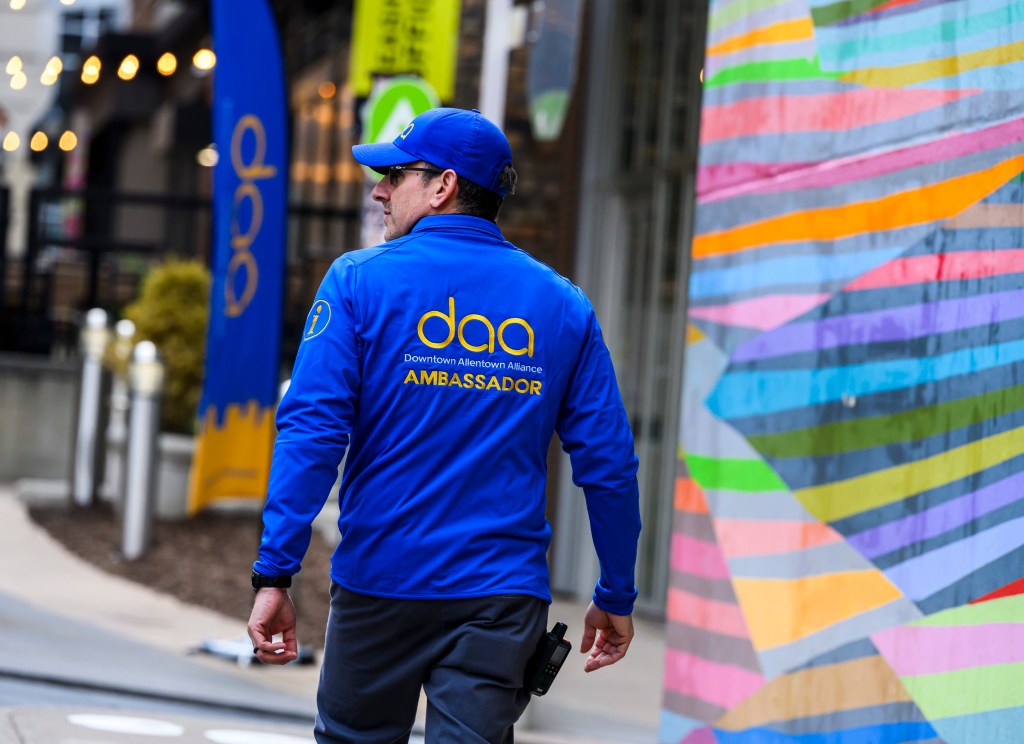
If you have been attending a hockey game or concert, going to a museum exhibit or eating at a restaurant in downtown Allentown in recent months, you likely noticed the group of people in blue uniforms emblazoned with a gold “DAA Ambassador” logo.
Need directions? An ambassador will help you find your way around. Want to know where to get a smoothie or buy a shirt? They will tell you which merchants have those items, and maybe give you a tip on which one is having a sale.
The Downtown Allentown Alliance has been building operations since it was founded a year ago, and the ambassador program is the first visible part of the public-private partnership whose goal is to promote downtown Allentown.
The umbrella organization coordinates communication between the city, small businesses, property owners and residents in the downtown core between Fifth and 12th streets and Walnut and Linden streets. The goal is to get everyone on the same page to promote and enhance the area. A website is being developed, while stakeholders receive weekly email updates.
“How do we attract visitors, locally and regionally, into the downtown to take advantage of all that there is here and to have them stay?” DAA Chair Matt Malozi said. “Not just to drive in for a show or a meal and leave, but to stay and linger.”
DAA Executive Director Lisa Finkelstein, who started her job in January, said the goal is to not only make people feel welcome, but also to want to do two or three things while visiting.
“What we have to form is the [impression] that there is something to do downtown,” said Finkelstein, who previously worked as director of the Main Street program and downtown director for Fernandina Beach, Florida. Before that she was in the Lehigh Valley for many years as a fundraiser for the Minsi Trails Council of Scouting America.
“And as you get more people doing it, then the experience you have of not seeing people on the street will hopefully go away,” she said.
Santo Napoli, owner of Assembly 88, the men’s clothing store that has been at 544 Hamilton St. since 1999, said the DAA is “long overdue.” Before it was formed, publicity in the downtown area was handled by a variety of groups ranging from the Greater Lehigh Valley Chamber of Commerce to developer City Center Group.
“We essentially had three chefs in the kitchen,” said Napoli, who also is president of Allentown City Council. “It didn’t go as smoothly as it should have.”
He said everyone was committed to the downtown’s success, but “they weren’t communicating with each other. They weren’t coordinating with each other. And that’s where I think the inefficiencies occur and the missed opportunities.”
How it started
With the advent of the Neighborhood Improvement Zone — the city’s unique taxing district — in 2012 along with the arrival of PPL Center, new businesses and residents, the downtown saw an uptick in activity. However, things stalled after the COVID pandemic, said Malozi, vice president of corporate development for Remington and Vernick Engineers, which has an office at 600 Hamilton St.
A steering committee led by state Sen. Nick Miller was formed and an outside consultant, Public Sphere Projects, conducted a study involving more than 1,700 residents. It revealed that while downtown Allentown was considered clean and safe, there was a perception problem and it lacked someone to organize the spaces between the venues.
“We’re like a puzzle, right?” Napoli said. “And you can’t have all corners and outlines. You need puzzle pieces in the middle to show the picture. Right now, I think we’re missing some key puzzle pieces that hopefully DAA can help in recruiting and bringing to downtown.”
Inspiration, Malozi said, came from the Greater Easton Development Partnership, which has spent years transforming that downtown into a destination for many.
The DAA received $800,000 for its launch from a variety of sources. The money is going toward the ambassador program along with a marketing campaign.
The city put up $300,000, while the Allentown Neighborhood Improvement Zone Development Authority kicked in $150,000 for marketing within the NIZ. An additional $114,000 from the state was secured by Miller, D-Lehigh, whose district includes the downtown.
Another $240,000 was awarded by the Downtown Allentown Community Development Initiative, which includes several prominent Lehigh Valley businesses.
Malozi was appointed chair in May 2025 with Kyle Edwards, an Allentown art educator and artist, as vice chair.
What does it do?
Malozi said the DAA has been executing a multipronged plan focusing on visibility and foundational growth, including hiring Finkelstein, launching the ambassador program, unveiling its branding and marketing program, and organizing pocket events such as face painting or street performers around bigger venues.
The ambassador program is supervised by DAA Operations Manager Jim Stang and is contracted through a national company, Block by Block, that acts as the “eyes on the street,” according to Finkelstein. It serves such roles as greeting people, observing and reporting safety issues, and keeping an eye out for maintenance needs such as broken drain covers or icy sidewalks.
Visitors will also find DAA-sponsored pop-up events that align with the schedules of venues such as Archer Music Hall, Miller Symphony Hall, Da Vinci Science Center and PPL Center, and regular happenings such as Walk This Way Thursdays.
For merchants, a weekly email newsletter details upcoming events and gives marketing tips, such as displaying school colors during graduation ceremonies at PPL Center and giving a heads-up for potential foot traffic.
“We said, ‘Not only are these 12 [commencement] dates and the times for them, so you know which meal they’re going to want, but here are also all the school colors,’ ” Finkelstein said. “ ‘This should help you think about how you can promote your business.’ The goal is to welcome the people that are coming downtown so that they feel like, ‘Wow, this was really cool, we want to come back.’ “
Moving forward
Upcoming priorities for the DAA include diversifying the funding stream as it moves beyond its initial $800,000. It will encourage smaller businesses to invest at their own scale and help sponsor events.
Finkelstein said it is also applying for the state’s Neighborhood Partnership Program to help with long-term sustainability. There is also a partnership with the United Way of the Greater Lehigh Valley.
“In my opinion, we’ve got it all,” she said. “It’s just pulling it all together. And we need those connector pieces. We need the street level businesses to be healthy, to be here. And I think those are the keys right there.”
To measure how things are evolving, Finkelstein said she is working with the city’s economic development department to establish a data dashboard that will measure first-floor vacancy rates, visitor traffic and demographics, diversity of business ownership, and cooperation between local entities such as the chamber and City Center.
“The million-dollar question is, how do you measure results?” Napoli said. “Everyone’s going to have their own version of results, but ultimately, it comes down to our cash registers. And if our registers are ringing, that’s obviously how most merchants will measure it.”
Morning Call reporter Evan Jones can be reached at ejones@mcall.com.