
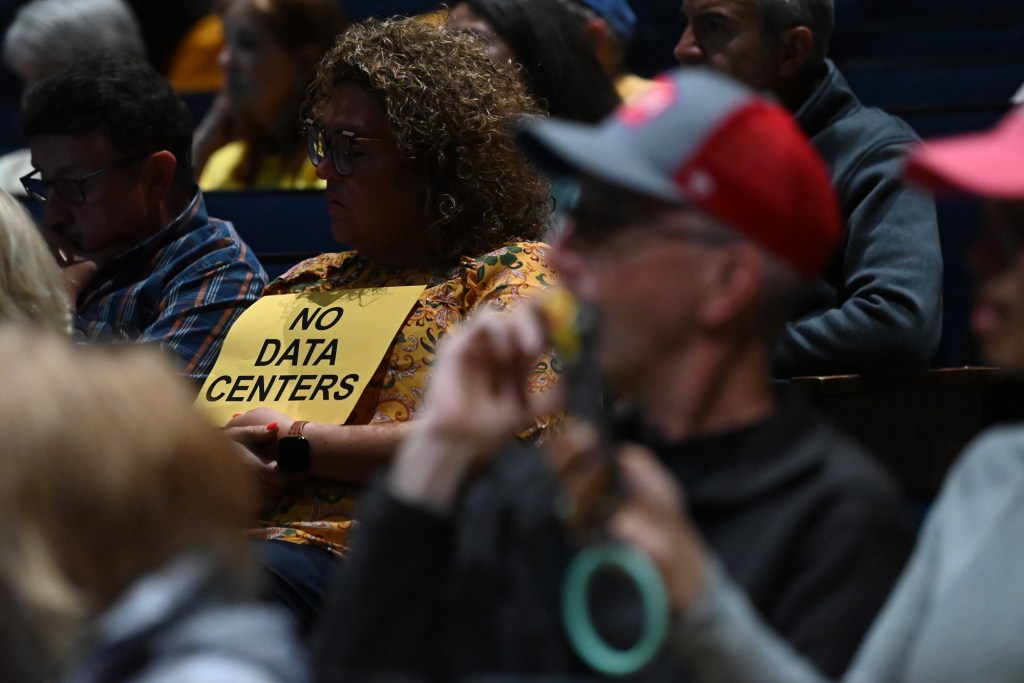
The Valley View School District officially entered the fight against data centers “dangerously close” to its schools.
Just over a week after the district’s board of education voted to join the battles against data centers in Archbald, the district’s solicitor formalized that fight Wednesday with two petitions filed in the Lackawanna County Court of Commons Pleas and a letter Thursday to Archbald Council President Louis Rapoch. The district is now opposing the two largest data center campuses proposed near its schools in Archbald — the 18-data-center Project Scott and the seven-data-center Project Gravity — while joining residents in their challenge to the validity of Archbald’s controversial data center zoning regulations, which council adopted in November.
Valley View’s actions coincide with a new land-use appeal filed Tuesday by the same group of residents challenging borough zoning. Those residents are now challenging the developer of Project Scott’s contention that its 400-acre data center campus is automatically approved due to a procedural issue. Valley View intends to file its own land-use appeal against the project Monday, Solicitor Larry Moran Jr. said in a text.
Archbald has the highest concentration of proposed data centers in Lackawanna County, accounting for 51 of the 90-plus proposed facilities. Of those 51 data centers, 30 are proposed along a roughly 1-mile stretch of Eynon Jermyn Road near Valley View’s intermediate, middle and high schools on Columbus Drive. A data center developer also wants to build a 400-megawatt power plant on the road, about half a mile from the nearest school.
The cluster of data centers on Eynon Jermyn Road has been one of the most hotly contested issues in the local data center debate because they are directly next to Archbald’s popular Staback Park; near residents in the Highlands Archbald housing development, the Valley View Estates mobile home park and homes in Jermyn; and their proximity to the Valley View School District’s campuses on Columbus Drive where 2,000 students go school everyday.
Zoning challenge
The overall zoning issues in Archbald are two-fold. The borough’s initial March 2023 zoning ordinance that did not define data centers but allowed them as permitted uses in commercial zoning districts throughout the borough laid the groundwork for developers to rush in early applications before Archbald could amend its zoning to regulate the industry, giving developers a more direct path from applying to breaking ground, with the borough unable to impose conditions on developments.
Then, in November, council adopted a controversial data center zoning ordinance during a meeting overflowing with residents. While the ordinance limited where developers could build them while applying a slew of restrictions and conditions, residents overwhelmingly opposed the legislation, urging council to further limit where they allowed data centers and apply additional restrictions. Council’s initial attempt to adopt the ordinance in October failed when a motion to consider it did not muster a second, preventing it from even coming to a vote. The ordinance designated data centers as conditional uses in several overlay districts, requiring developers to testify at public hearings about their plans and abide by conditions imposed by the borough. The designation gives council the power to approve or deny a conditional use application.
Every member of council who voted in favor of that ordinance has since either left office or resigned.
Archbald residents Phillip Sardo, Jack and Amy Swingle, Marilyn Jones, Robert and Phyliss Paone, Joseph Sabia and Justin Healey filed a December land-use appeal against the borough, asking the court to invalidate it due to alleged procedural issues. Their attorney, Justin Richards of Elliott Greenleaf PC, is an objector on their behalf at every public hearing on data centers and a related power plant in Archbald.
In its petition to join the appeal with residents against Archbald, Valley View, through the law firm Joyce, Carmody & Moran PC, argues that the district, which has four schools serving about 2,400 students, has legally enforceable interests in the operations of its schools, safety of students, ingress and egress for school busses and emergency vehicles, noise levels at school property lines, sewer and water capacity serving its schools, electrical service reliability, and air and water quality.
“The data center projects at issue are sited in dangerously close proximity to Valley View School District’s campuses, where the District is responsible each day for the care, supervision and safety of approximately 2,400 students and staff,” attorneys Brendan N. Fitzgerald, Larry Moran Jr. and Kyle Callejas wrote in the filing. “The projects anticipated impacts — including industrial-scale electrical loads and substation infrastructure, sustained low-frequency noise and vibration, diesel backup generation and associated air emissions, high-volume water and evaporative cooling demand, heavy construction and operational truck traffic on roadways used by school buses and pedestrian students, and the cumulative effect of these conditions on emergency egress, shelter-in-place planning, and first-responder access — fall squarely within the zone of harm the School District is statutorily obligated to anticipate and mitigate.”
Project Scott
Valley View also petitioned the court to join Archbald in its defense against Archbald I LLC’s contention that its 18-data-center Project Scott campus, which would be next to Staback Park on Eynon Jermyn Road, should be automatically approved due to a procedural issue that prevented the borough from holding a hearing within a legally allotted timeframe.
Archbald received a conditional use application for the data center campus Dec. 16 when Provident Realty Advisors of Dallas, Texas, which operates as Provident Data Centers, applied for 18 data centers, each up to 90 feet tall with a 154,850-square-foot footprint across about 400 acres.
State law requires municipalities to hold its first hearing on a conditional use application within 60 days and subsequent hearings within 45 days. Failing to meet those deadlines results in deemed approval of an application.
Council met the deadline by holding its first hearing Feb. 11, but due to time constrains, the borough only heard testimony from two of Archbald I’s five planned witnesses. The borough and developer then agreed to reconvene the following month.
At the end of the Feb. 11 meeting, Archbald Solicitor Jay O’Connor announced the next hearing would be March 19 — satisfying the state’s requirements for public notices by announcing it on the record during the hearing. The following day, attorney Jeffrey Esch McCombie of Harrisburg-based McNees Wallace & Nurick LLC, who represents Archbald I, emailed O’Connor that project manager Nick Farris, the director of acquisitions and director of data center development at Provident who testified in February, had a planned family vacation the week of March 19 that he could not reschedule.
“I understand that this creates some procedural due process and planning hurdles for you,” Esch McCombie wrote.
Archbald accommodated the request by rescheduling the hearing to March 23, but it required the borough to run public notices in the newspaper of general circulation — in this case, The Times-Tribune — for two consecutive weeks announcing the new date. O’Connor’s law office submitted notices to run March 8 and 15, but the day of the hearing, the borough discovered that due to a clerical error at the newspaper, the notices were not published, preventing them from holding the hearing.
Amid several procedural moves, Archbald I filed a mandamus complaint May 12 asking county court to order Archbald to recognize its deemed approval.
Both Valley View and the same group of residents appealing Archbald’s data center zoning are now challenging that deemed approval contention.
In Valley View’s petition to intervene, which joins Archbald and its borough council as defendants against Archbald I, district attorneys note the proximity of the data centers to its intermediate, middle and high schools, encompassing grades 3-12 and about 2,000 students. Direct impacts from the “dangerously close” data centers will include noise levels, construction and operational vehicle traffic on school transportation routes, lighting, air emissions from emergency generators, water and sewer demands, demand on public water supplies serving the district, and emergency egress, according to the filing.
The day before Valley View filed its petition to intervene, Archbald residents, through their attorney, filed a land-use appeal Tuesday against Archbald I LLC, the borough and its council.
Their appeal alleges that there was no deemed approval. Richards, their attorney, wrote in the Tuesday filling that the borough acted in good faith to honor Archbald I’s request for a rescheduled hearing, but the developer failed to act in good faith by denying the extension due to a failure of notice caused by the publishing newspaper.
It demonstrates Archbald I’s intent to have its conditional use application decided based on a timing issue rather than substantive grounds, Richards wrote.
The residents’ appeal further asks the court to reject the deemed approval because the developer failed to satisfy the standards and criteria in Archbald’s zoning, calling the use “substantially detrimental to the public health, safety and general welfare of the community.”
Valley View intends to file its own land-use appeal Monday, according to its solicitor.
Esch McCombie declined to comment because it is active litigation.
Project Gravity
Project Gravity was one of Lackawanna County’s earliest data center proposals when developers submitted plans to Archbald on April 2, 2025, to build seven data centers with 138,000-square-foot footprints across 186 acres between Eynon Jermyn Road and Business Route 6. The campus would be next to Project Scott.
Because the campus applied before Archbald amended its zoning, it received a principal permitted use designation, which means council cannot regulate or deny the project like a conditional use designation.
Valley View’s attorneys disagree with that long-standing characterization.
In a letter Thursday to Archbald Council President Louis Rapoch, the district asks council to reject the campus and instead schedule a conditional use hearing for it, essentially contending the data center campus lost out on its claim to operate under Archbald’s original, more permissive data center zoning.
Rapoch declined to comment.
The district’s solicitor asserts that Five Up Realty LLC — the original property owner, tied to local data center developer Jim Marzolino — submitted sketch plans April 2, 2025, as a “non-binding per-application submission.”
Borough council subsequently published notices for its amended data center zoning Sept. 3, 10 and 25, before adopting it Nov. 24, according to the letter. Archbald 25 Developer LLC acquired the property for Project Gravity on Oct. 9, and the firm behind the limited liability company, Western Hospitality Partners — Jermyn LLC, did not rename itself to Archbald 25 until Oct. 10, according to the letter.
Under state law, vested rights are personal to the applicant — they do not stay with the land, the district’s attorney wrote.
As a result, Valley View wants borough council to determine, on the record, that Archbald 25 Developer LLC has no vested rights under the original zoning ordinance from March 2023, to schedule a public hearing on the project, and to require executed letters of authorization from its electric service provider, a sound study, a water feasibility study, a traffic management plan and a security plan.
Attorney Raymond Rinaldi, who represented the developer, did not respond to an emailed request for comment by press time Friday.