
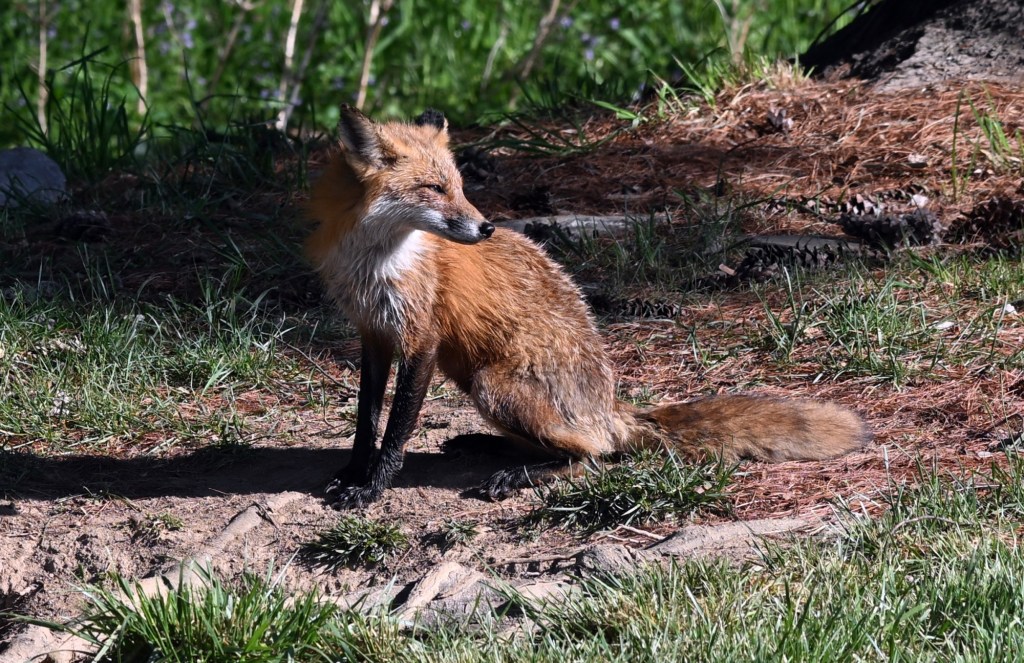
The acclaimed wildlife filmmaker Sir David Attenborough had just turned 100.
That day, as the world celebrated Attenborough’s many achievements, David Richie walked out onto the back balcony of his Wyomissing home, turned on a small, tripod-mounted video camera and channeled his inner Attenborough.
For the past few months, Richie has been recording the antics of a den of foxes that took over a groundhog burrow just outside his backyard adjacent to the Wyomissing park system.
He and his wife, Dail, first saw the foxes on April 10, after a neighbor sent them an eight-second video and said, “Hey, look at this.”
“Then we started looking out, and so there was a mama fox and then there’s a baby fox, and a couple days later, there were four baby foxes,” Richie said. “For most of the week, there were four, and then we noticed what seemed to be five more, just playing and playing.”
 David and Dail Richie look out from the balcony of their home into the Wyomissing Park where a fox raised a family of nine kits this spring. (BILL UHRICH/READING EAGLE)
Although a fox family with nine kits in the suburbs seems to be an extraordinary occurrence, it’s not that surprising to Kate Hasapes, wildlife management supervisor for the Pennsylvania Game Commission.
“That just tells me that it’s a healthy pair with a healthy food resource to have around them to be able to support that many,” she said.
Foxes are omnivores and generalists, she explained, and that makes them one of the more adaptable species for suburban or even urban environments.
“When you think about the suburban landscape, besides the development, we also have random blocks of farmland and stream corridors, and so you have this interspersion of habitat and a suburban environment where it blends very well for the foxes’ prey species,” Hasapes said.
Any area with groundhogs, squirrels, chipmunks, mice and other small creatures makes a suitable habitat for predators.
“All those small rodents are really good prey species for foxes, and so if you have those good prey species around it, that good resource for food, you know your predators are going to come after that.”
And with that comes opportunities for wildlife study that previously required trips to rural areas.
The Richies had watched the groundhogs that created the burrows the foxes took over.
“The groundhogs were moderately entertaining,” David said. “The foxes are much more attractive. They’re much prettier, and they’re more interesting. The little groundhogs just kind of put their heads up and they eat. And that’s about it.”
The fox barked in the distance, a sound the Richies have become accustomed to.
“There she is,” David said. “You can hear her. Maybe she’s barking to gather them all together or something. It could be. I’m not a foxologist, right?”
But through reading about foxes online and watching and recording the various behaviors over the last few months, the Richies have become much more knowledgeable about the species.
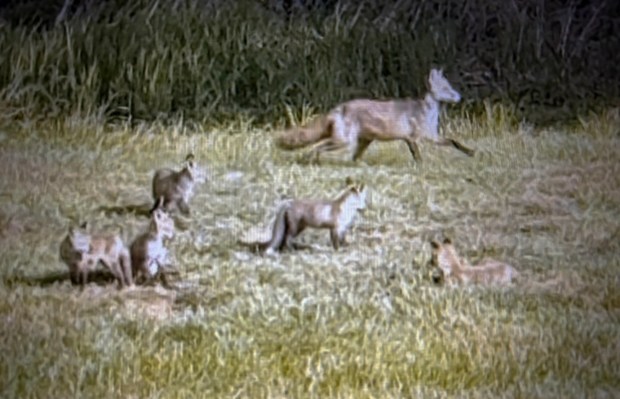 A fox family romps in the Wyomissing Park. Video still courtesy of David Richie
“I learned red foxes can mate for life,” David said. “If the mother is killed or disappears, the father will come and help take care of the little ones. And then if the father is killed, the mother will then sometimes take a second mate to help feed and protect the little guys.”
A neighborhood dog barked back in response.
Hasapes addresses concerns about whether foxes will go after family pets.
“Foxes are not going to go after your cat, they’re not going to go after your dog,” she said. “But at the same time, make sure you walk your dog on a leash, and that is your responsibility to keep your pet and your family safe, as these animals live among us.”
Hasapes does caution against direct human contact with wild animals.
“Generally speaking, with any wild animal, we don’t want people going out there and trying to approach them, we don’t want people out there trying to feed them,” she said. “The more these animals are fed directly by humans, and they see humans as a resource, it just makes for a bad ending.”
The Richies and their neighbors have been content to watch the foxes from a safe distance.
Dail has particularly enjoyed watching the kits mature.
“Watching them grow from tiny little ones has just been remarkable,” she said. “It’s a wonderful, life-affirming experience, really.”