
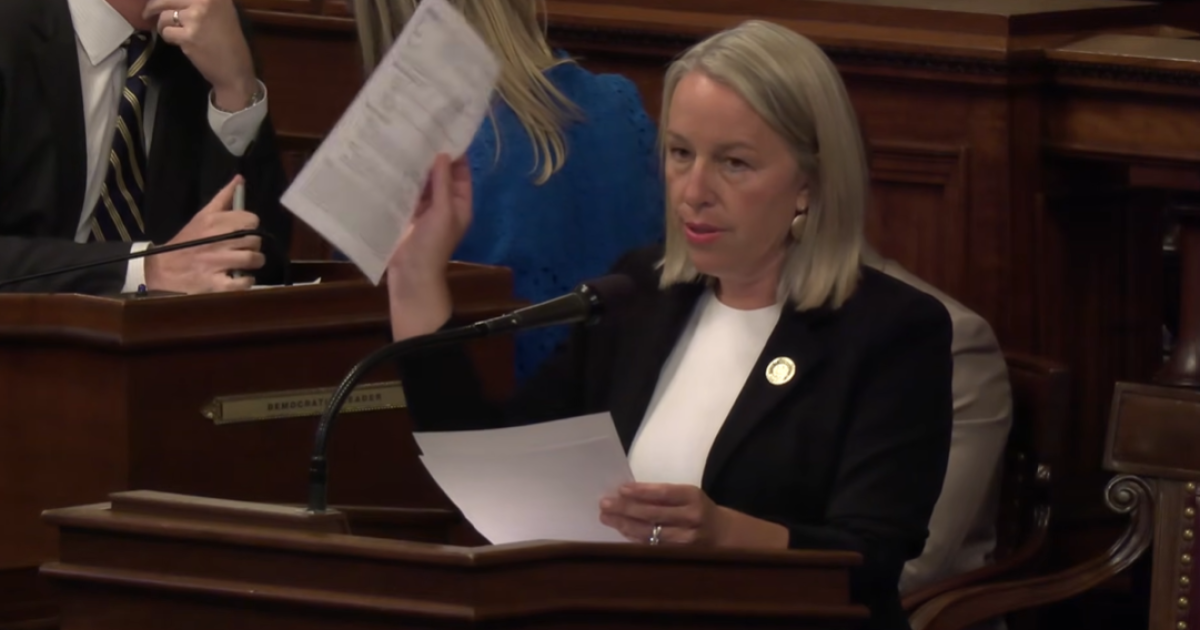
The cellphone policies of Pennsylvania school districts may be changed this summer, after the state House on Monday passed legislation to ban use of the devices throughout the school day.
The legislation, House Bill 1814, would preclude the use of phones from morning bell to dismissal, both in class and in periods like lunch. The bill includes exceptions during emergencies and for students with medical conditions or certified learning impairments, as well as some English-language learners.
“The mental, physical, and academic health of children has plummeted in conjunction with unfettered access to smartphones,” said Fox Chapel Democrat Mandy Steele, prime sponsor of the measure, in a floor speech. She called it a “public health crisis.”
The measure passed by a vote of 126 to 75, and its prospects seem bright. It’s similar to a measure the state Senate passed in February to ban the devices in school, and Gov. Josh Shapiro has advocated for a full-day ban.
If passed as written, it would go into effect in the 2027-28 school year.
When a California jury earlier this year blamed social media companies for negative effects on youth mental health, Steele said the case for a school-day smartphone ban became even more clear.
“Meta and YouTube are putting apps on your kids’ phones that they are knowingly designing to addict young brains and hold them captive for life,” she said. “While there are many steps that must be taken to correct course for our children, perhaps the most obvious one is the subject of this bill.”
Carlynton’s policy mirrors bipartisan legislation that would ban students across the commonwealth from using their cellphones during the school day, with a few exceptions.
Bill supporters such as Elizabeth Township Republican Andrew Kuzma agreed, saying school-aged children already may have too much access to smartphones and social media. Kuzma said that can lead to harmful interactions with strangers — or other classmates.
“By removing [phones], we are minimizing cheating, improving our test scores, and minimizing bullying,” Kuzma said. He also referenced a recent study in which 1 in 3 young teens reported receiving unwanted sexual messages.
“There is no reason for our children to be exposed to addictive social media, sexual advances, nudity, and self-harm content,” Kuzma added.
Notably, the House vote did not fall along party lines.
Pittsburgh-area Democrats, including Lindsay Powell, Emily Kinkead, and Anita Kulik, joined Peters Township Republican Natalie Mihalek in voting against the school-day phone ban. Along with Kuzma, Southwestern Pennsylvania Republicans who voted in favor of Steele’s bill included Valerie Gaydos of Moon Township, Jeremy Shaffer of the North Hills and Jason Ortitay of Cecil Township.
Some critics, such as Mihalek, said policies about phone use should be left to school districts themselves. She has two teenage daughters who use smartphones, she said.
“What works in our house today might not work in our house next year when my oldest starts high school,” Mihalek told House colleagues. “I am struggling to support this one-size-fits-all bill that takes away the power of our local school districts and instead makes the decision for them.”
“When the technology changes, I trust our school boards to be able to pivot much more quickly than Harrisburg ever could and address those changes as they come up,” she said, adding her “no” vote does not mean she supports kids scrolling through their phones during instruction time.
In a message later Monday, Steele pushed back on the idea that decisions should be made locally.
“There are school districts that have policies in place but [many] are ineffective at best,” she said.
And the state’s largest teachers union applauded the bill for letting schools decide how to roll out the ban.
“We commend the state House for passing a bill requiring ‘bell-to-bell’ restrictions on mobile devices while leaving it up to local school communities to decide how best to implement it,” said Aaron Chapin, president of the Pennsylvania State Education Association. “Educators, administrators, parents, and students are in the best position to develop policies that best meet the needs of their school communities.”
Steele’s bill allows districts to decide exactly how to carry out the ban: Local leaders could decide, for example, to take the phones and release them at the end of the school day, or merely ask students to abide by the rules and keep them stowed in a locker.
“Twenty-eight states currently have laws restricting student use of cellphones and mobile devices during the school day, including 19 with ‘bell-to-bell’ restrictions,” Chapin added. “Several school districts here in Pennsylvania have already adopted similar policies. It is time to ensure that every student in Pennsylvania can go to school without distracting smartphones, smartwatches, and tablets derailing classroom learning.”
The Senate version of the bell-to-bell phone ban, sponsored by Bridgeville Republican Devlin Robinson, was also slated for a potential final vote in the House Monday. But because Robinson’s bill was amended in a House committee, the Senate would need to again vote on the revised measure.
A spokesperson for House leadership said Democrats opted to send over Steele’s bill instead, as a gesture of support for a member of their own party. Once the amendments to Robinson’s bill are taken into account, the spokesperson said, the bills are essentially identical.