
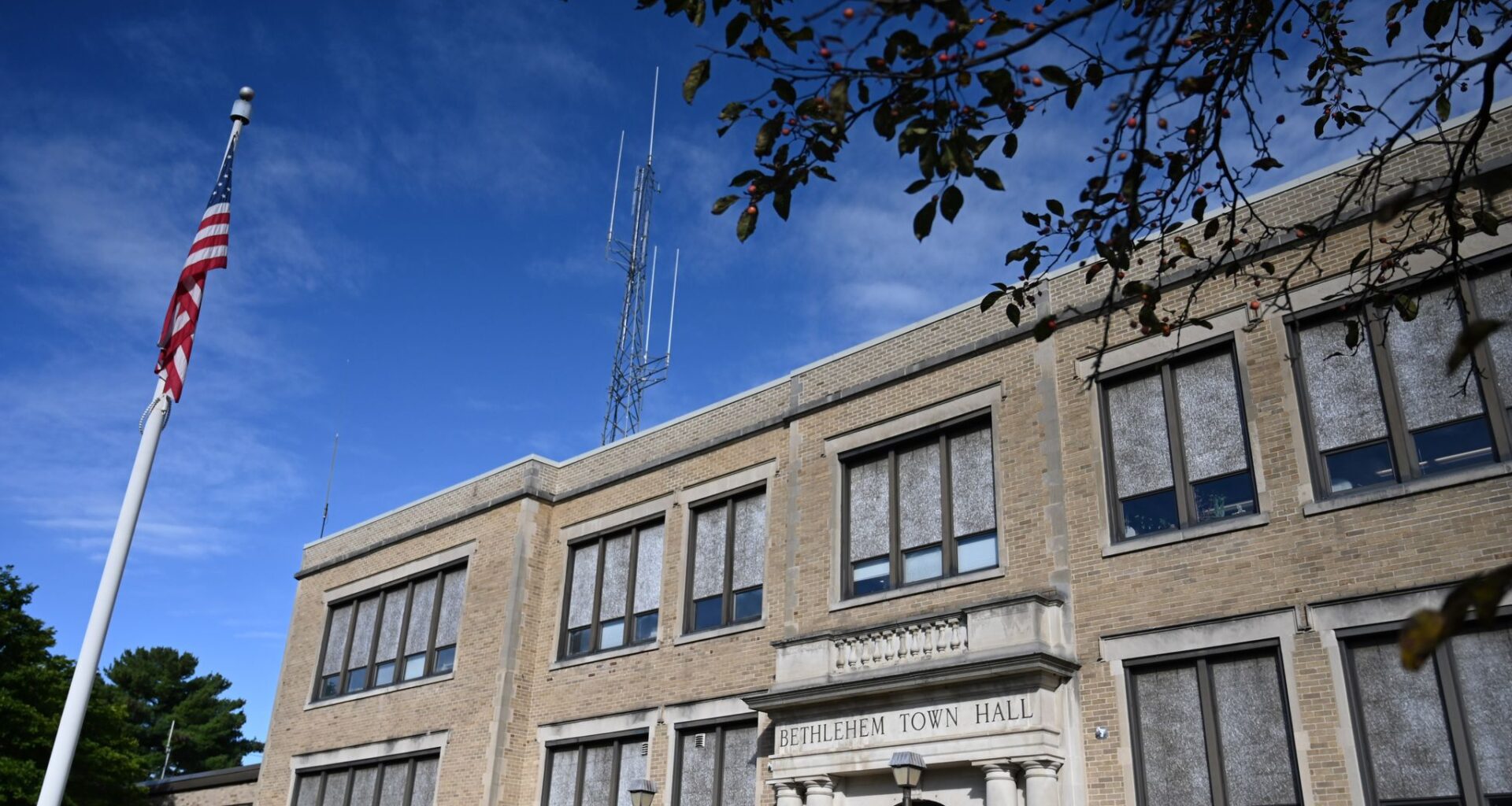
Exterior of Bethlehem Town Hall on Wednesday, Sept. 17, 2025, at in Delmar, N.Y. (Will Waldron/Times Union)
Will Waldron/Times Union
BETHLEHEM — A years-in-the-making plan to rezone much of the town, which, at times, has turned contentious, is headed to a public hearing.

The question is now when, as recent changes to state environmental rules have complicated the proposal’s path to adoption.
Article continues below this ad
Supporters of the plan, including Town Supervisor David VanLuven, have argued that the proposal is necessary to guide growth in the 52-square-mile suburb while also making it more welcoming to those who cannot afford or do not wish to live in single-family homes. New zoning rules with stringent requirements on design and size, they have argued, will make housing more affordable and are necessary to prevent the runaway sprawl seen in other Capital Region communities. (Both supporters and opponents of the rules have cited Wolf Road in Colonie and the town of Clifton Park as models to be avoided.) Town officials have also said the town must adjust its zoning rules to comply with its 2022 comprehensive plan.
Critics of the plan, many of whom live in the Glenmont section of town, have argued that the proposal to rezone some residential neighborhoods abutting unused or underused farmland for mixed-use developments like multifamily homes and multi-unit apartment buildings would upend their communities. Their position, broadly, is that the zoning change would end the rural-adjacent character of their neighborhoods, with traffic and congestion imperiling everything from children’s lemonade stands to response times for emergency calls.
These specific concerns and dozens more were raised during two town board meetings, which, in total, lasted over eight hours last month. At the second meeting, a public hearing was set for June 24. That gathering would have been one of the final steps before the five-member town board held a final vote on the rules.
Make the Times Union a Preferred Source on Google to see more of our journalism when you search.
Add Preferred Source
Article continues below this ad
The state Department of Environmental Conservation in May adopted amendments to the State Environmental Quality Review Act, which take effect on June 12 and may impact the proposed changes. “We may need to adjust the timeline because of the state’s (SEQRA) changes,” VanLuven said Tuesday. “Our attorneys and the Planning Department staff are working on this now. Stay tuned.”
The move by the DEC is another wrinkle in the proposal’s long journey through town government, which included 27 Planning Board meetings since 2023, neighborhood forums with town officials and extensive public comment periods at Town Board meetings.
Adjustments have been made in response to the opposition. The proposal would change portions of the town zoned for single-family homes, a designation known as “Residential A,” to a designation called “low-density residential.” That would allow for a mix of single-family homes and different types of multifamily dwellings, including small apartment buildings. Earlier versions of the LDR designation capped single-family homes at 33% in new subdivisions, with the remaining housing stock made up of other structures. That has been changed to a range of 45% to 60%.
Building height would also be limited to two stories or 30 feet, with a maximum of six multi-family units in each building and a maximum of seven buildings per acre.
Article continues below this ad
“That was a concession and an attempt to address our concerns,” said Colleen Scott, a leading opponent of the proposal who lives off Feura Bush Road in Glenmont.
The concession has not changed her opinion about the plan. In addition to her concerns about the character of the neighborhood, she and many of her allies worry about traffic on and around Feura Bush Road. “Traffic continues to be a source of current concern, which remains unaddressed and more development along the Feura Bush corridor can only result in more traffic exacerbating existing concerns as well as creating new ones,” she wrote in a letter last month to the Town Board.
Town officials, including VanLuven, have said that traffic would not measurably increase with the construction of new multifamily homes and that single-family homes in suburban areas actually lead to more congestion than buildings with multiple units.
“Across the country in suburban neighborhoods, single-family homes generate more vehicle trips than multi-units,” VanLuven said, citing findings by the Institute of Traffic Engineers. Information from that body was also included in materials from last week’s meeting.
Article continues below this ad
Town Board member David DeCancio, who has been sympathetic to the Glenmont-based opposition to the proposal, has suggested rezoning a section of the Vista Tech Park near a now-closed ShopRite supermarket for low-density residential housing. In an email, he described it as an “ideal location” with easy access to Route 85, which would be ideal for commuters who work at the University at Albany or the Harriman State Office Building Campus in Albany.
It has been zoned as a special mixed-use economic development zone, and its use is unchanged in the new plans. “Vista Tech Park was built for technology, but in its 20 years, we only have gotten Plug Power,” he said last month. “We have a need for more diverse housing and this is a great use of a concrete parking lot.”
“Residents in Glenmont continue to strongly express concerns about the proposed zoning changes and overdevelopment, warning that it will worsen already heavy traffic on Feura Bush Road and connecting roads,” DeCancio said Tuesday. “They need to know they are being heard.”
Opponents of the project have marshaled facts and, in some cases, done fairly extensive research on their own to bolster their case. Phil Stevens, who lives in Delmar and owns a construction company, calculated that the change from Residential A to low-density residential zoning would lead to a 133% increase in housing density based on the move from approximately three dwelling units per acre to an upper limit of seven.
Article continues below this ad
“I am not opposed to growth, expansion and construction as I run a construction company with 50 employees,” he wrote in public comments for the Town Board that he shared with the Times Union. “However, the proposed increase is too aggressive.”
For Scott and many of the other vocal opponents of the proposal, the anti-zoning push has been their first foray into political organizing. When pressed, some opponents will say their opposition is based, at least in part, on concerns about what will happen to their property values if more and a wider variety of housing is constructed in their neighborhoods. And for residents on several streets, including Jefferson Avenue and Brightonwood Road, new zoning rules could lead to construction and development almost literally in their backyards.
The opponents have spotlighted other concerns, especially traffic, in their public criticism, though more unvarnished opinions have made it into the debate as well. “To bring in all these people and varied income levels — if we wanted that we’d live in Latham, or Cohoes or Colonie. But we chose Delmar and Bethlehem and paid a lot of money to live here and you’re just going to change our lives and I don’t think that’s fair,” one resident said at the May 28 board meeting. “Unless you want to write me a check.”
Article continues below this ad
VanLuven says he hears the concerns and outright anger from residents opposed to the project. He says change is inevitable with or without the new rules. He drew a comparison to an earlier outcry about a proposed development on farmland near Wemple Road. “‘How is that going to make us feel when the owner of the farmland beside us decides to develop his property?'” he recalled a resident saying.
“It’s probably going to make you feel the same way your neighbors in the development just south of you felt when your house was built,” he replied.