
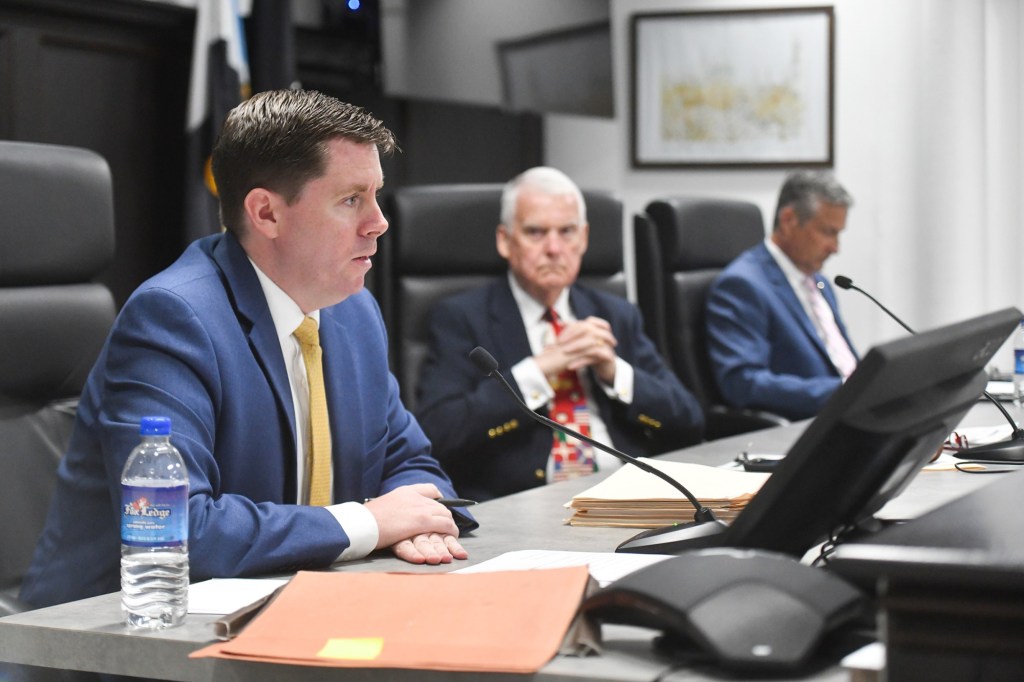
SCRANTON — Lackawanna County should explore commissioning an independent health-impact assessment to gauge the cumulative effects of proposed data center projects and related infrastructure on “residents, parks, schools, housing developments and other sensitive community assets,” Commissioner Bill Gaughan contends.
He called for such a study Wednesday as the local battle over controversial proposals to construct massive data center campuses and power plants continues to play out in the Midvalley region and elsewhere. Archbald, where there are currently six proposed data center projects totaling 51 buildings, has become ground zero in that battle, with the grassroots Stop Archbald Data Centers movement now numbering more than 12,000 members.
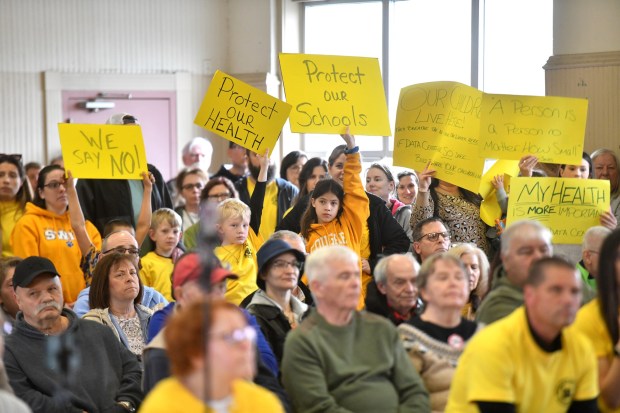 Children hold up signs during a special public meeting for applications to build 18 data centers at the Archbald Borough Building in Archbald Friday, March 27, 2026. (SEAN MCKEAG / STAFF PHOTOGRAPHER)
Gaughan, who supports a proposed three-year statewide moratorium on data center development, is arguably the chief elected critic of the industry in the region. He’s frequently warned of the adverse impacts data centers and related development could have on the environment and residents’ health, utility bills and quality of life.
But his call for a health-impact assessment isn’t a “pro-data center or anti-data center proposal,” he said at Wednesday’s commissioners meeting. “It’s a pro-information proposal and a pro-public health proposal.”
“Over the past year … I’ve sat through countless meetings about data centers and power plants in Lackawanna County,” Gaughan said. “I’ve heard about megawatts, water usage, transmission lines, air emissions, artificial intelligence (and) cloud computing among many other things. Over a dozen proposed data center projects throughout Lackawanna County. Over 100 buildings. Thousands upon thousands of acres of land. Thousands of diesel generators and a lot more.”
“But there’s one question that has not been adequately answered in my opinion,” he continued. “What will all of this mean for the health of the people who actually live in Lackawanna County?”
 Lackawanna County Commissioner Bill Gaughan speak in reference to data centers during the commissioners meeting in the county government center in Scranton Wednesday, June 3, 2026. (SEAN MCKEAG / STAFF PHOTOGRAPHER)
That’s what the potential study would attempt to assess, with Gaughan pointing to a similar study of a data center facility in Loudoun County, Virginia. Commissioned by the Piedmont Environmental Council and conducted by EmPower Analytics Group, it evaluated the estimated public health and economic impacts of fine particulate matter emissions from the permitted on-site power system at the Vantage Data Center there.
The EmPower Analytics analysis, released earlier this year, found that such emissions could result in between $53 million and $99 million in annual health-related damages, “driven primarily by premature mortality as well as respiratory and cardiovascular disease,” a press release about the study notes. The analysis itself “reflects operation at the facility’s maximum permitted annual emission limits.”
Gaughan, who wants a better understanding of the cumulative impact of data centers and ancillary infrastructure proposed in Lackawanna County, said he’s not suggesting every project proposed here “would produce the same results as this report.”
“But what I am suggesting this morning is that when respected public-health researchers produce findings like that, we have an obligation to ask questions, and the first question is: What are we doing here?” he said. “We have an obligation to get answers, because once these facilities are built, once the power plants are operating, once the permits are issued, it’s going to be really, really hard, probably impossible, to rewind the clock. We can’t go back and ask whether we should have studied the impacts; we can only then live with the consequences.”
Whether, when and how specifically county officials might ultimately pursue a data center health-impact study still remains to be seen. The cost of such a study is also unclear, though Commissioner Chris Chermak suggested the county approach data center developers about financing it.
“They’re always telling us how clean and how great they are, so let them put their money where their mouth is,” Chermak said after Wednesday’s meeting.
 Lackawanna County Commissioner Thom Welby listens to Commissioner Bill Gaughan speak in reference to data centers during the commissioners meeting in the county government center in Scranton Wednesday, June 3, 2026. (SEAN MCKEAG / STAFF PHOTOGRAPHER)
Commissioner Thom Welby built on that point, noting developers “have volunteered, too, that they care and they want to do everything they can to be clear and transparent.” Funding or otherwise supporting the study could be a way to demonstrate that, he said.
The question of funding notwithstanding, Welby, who called the EmPower Analytics study “quite startling,” reiterated commissioners have no control over municipal zoning or land-use decisions regarding data centers. But an assessment of their potential health impacts in the county could provide important context for the local officials tasked with making those decisions.
“It’s up to the municipalities to set up the guidelines and rules by which they approve or not approve something,” Welby said. “But this might add something … that they can consider that might cause them to reconsider approval of the zoning requirements needed for this, and maybe it’s something that we can provide for them. And also there is some other things we’ve talked about that we might look at as far as being more careful about the approval of any of these data centers or power-generation facilities that they’re talking about.”
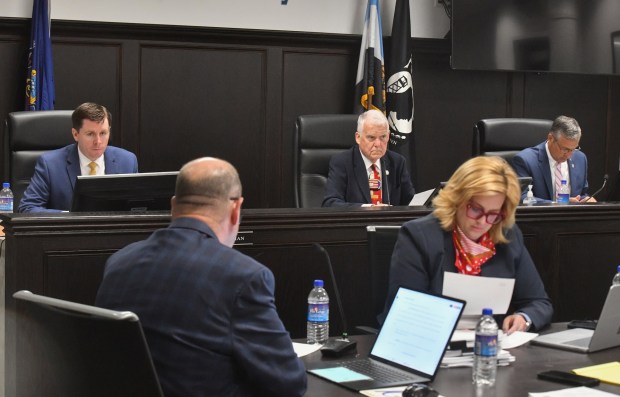 Lackawanna County Commissioners Bill Gaughan, Thom Welby and Chris Chermak hold a public meeting in the county government center in Scranton Wednesday, June 3, 2026. (SEAN MCKEAG / STAFF PHOTOGRAPHER)
From the dais, Gaughan specifically asked the county’s legal team, planning professionals and other officials to “explore what would be required to commission an independent countywide health-impact assessment and to report back on the feasibility and how we can get this done and get the ball rolling as quickly as possible.”
“Because if decisions are going to be made that could shape Lackawanna County for generations, we owe it to our residents to understand not only the economic costs and benefits, but the human costs as well,” he said.