
Three federal judges could decide the future of the slavery exhibits at the President’s House, as Philadelphia gears up to celebrate the 250th birthday of the nation’s founding.
The panel, from the U.S. Court of Appeals for the Third Circuit, heard arguments Tuesday afternoon from attorneys representing the city and the Trump administration over whether to uphold a lower court order that required the National Park Service to restore the panels.
NPS employees took down the exhibit in late January, in response to a March 2025 executive order in which President Donald Trump directed the agency to remove “descriptions, depictions, or other content that inappropriately disparage Americans past or living (including persons living in colonial times)” from the park system.
Mayor Cherelle Parker’s team quickly sued, and U.S. District Court Judge Cynthia M. Rufe agreed with the city’s attorneys, comparing the Trump administration’s actions to the Ministry of Truth in “1984,” George Orwell’s dystopian novel.
Rufe issued a preliminary injunction that compelled the NPS to restore the President’s House within days. Crews began replacing the panels, but work halted when the Third Circuit paused sections of the order. The site has since been in a state of partial installation — and is likely to remain so until the judges make a decision.
The three judges — Thomas M. Hardiman, L. Felipe Restrepo and Peter J. Phipps — did not provide any indication of when they may rule. Supporters of the exhibit say there should be some urgency, with an influx of visitors anticipated for the Semiquicentennial.
Assistant U.S. Attorney Gregory in den Berken told the judges that restoration, or replacement, of the exhibit should take about three weeks, at a cost of $20,000.
The panels in question examine the paradox of slavery and freedom during the country’s founding period, with a particular emphasis on the stories of the nine people George Washington kept in bondage at the property.
Brick walls at 6th and Market streets, near the entrance to Liberty Bell Center, outline the footprint of the long-demolished house, which served as the executive mansion from 1790 to 1800.
In a packed courtroom steps away from the installation, the judges seemed engaged and peppered both sets of lawyers with questions and comments.
“I think they were open and trying to really understand the issues,” said attorney Cara McClellan, who is representing the Avenging The Ancestors Coalition (ATAC) and the Black Journey, two groups intervening in the matter on the side of the city. “It’s a complicated case.”
During the approximately 90-minute oral argument session, participants discussed the city’s rights, or lack thereof, pertaining to the President’s House and whether the NPS was simply curating the exhibit or taking a more substantial action.
In den Berken asserted that allowing the injunction to stand would amount to giving City Hall veto power over all curatorial decisions at Independence National Historical Park (INHP), authority that he characterized as unprecedented.
“It wasn’t just curation,” McClellan told the court. “It was elimination.”
In Den Berken maintained that the park service has the right to remove all references to slavery at the President’s House; however, they do not intend to do so, he added. NPS has posted revised panels on its website, and the topic is the basis for multiple sections of the proposed exhibit.
But Anne Taylor, a Parker administration attorney, said those replacement materials should not be considered because they were made public after the original panels were removed and the lawsuit was filed.
In den Berken later responded by stating that the exhibit’s removal was an obvious interim step, part of a process to remake the installation, not permanently remove it.
The city has argued that the NPS’s abrupt move to tear down the panels violated Congressional legislation in 1948 and subsequent agreements that established INHP. Taylor noted that the city spent taxpayer money — $3.5 million — to construct the President’s House site, which opened in 2010.
“Everybody understood this to be a permanent installation,” she added.
Hardiman expressed incredulity that City Hall believed that the exhibit would never undergo any changes.
While Independence Hall and the Liberty Bell are managed by NPS, the city retains ownership over both, unlike the President’s House property, in den Berken said. The installation was handed over to NPS upon completion, his legal team has said.
“Once the donation happens, isn’t the city out of luck?” Phipps asked. Taylor replied that the city has a legal residual interest in the exhibit’s continued existence.
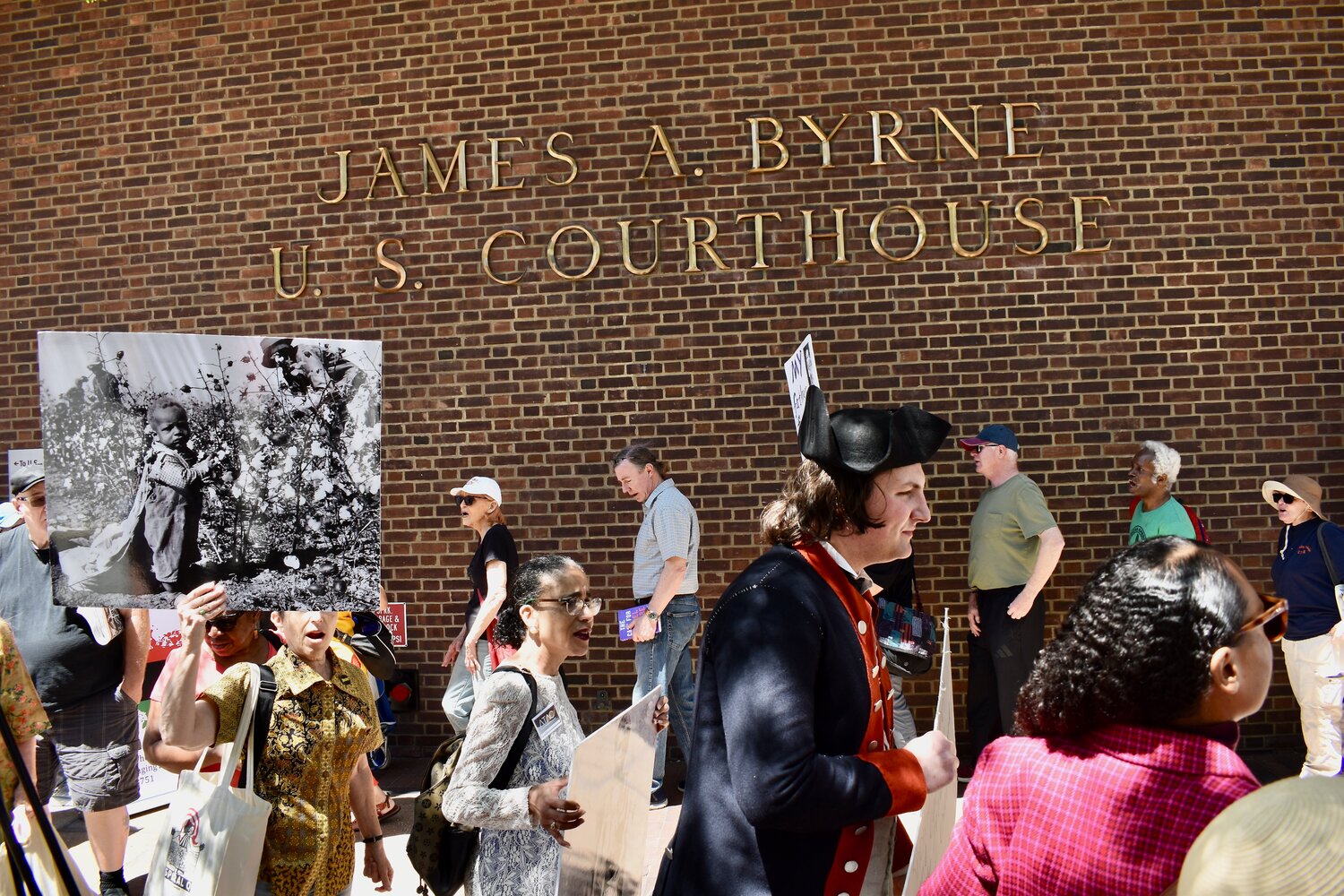
Prior to the hearing, supporters of the President’s House rallied outside the federal courthouse. The removal of the exhibit made national news and angered many local elected officials, historians and community organizers
ATAC leader Michael Coard recounted the backstory, beginning with the 2002 plan to relocate the Liberty Bell to its current home. His organization and others pushed for the NPS to amend its design to incorporate space to honor the enslaved individuals who lived there.
“Thugs and vandals dispatched by the White House came to that site at 6th and Market and ripped the soul, ripped the spirit, ripped the blood, sweat, and tears out of that site,” Coard said into a megaphone.
MORE: Philly DA challenges Jim Jordan to ‘pull up’ after ICE letter
Keywords
President’s House,
Philadelphia history,
slavery exhibit,
National Park Service,
federal court,
Independence National Historical Park,
Liberty Bell,
America 250,
Cherelle Parker,
Trump administration