
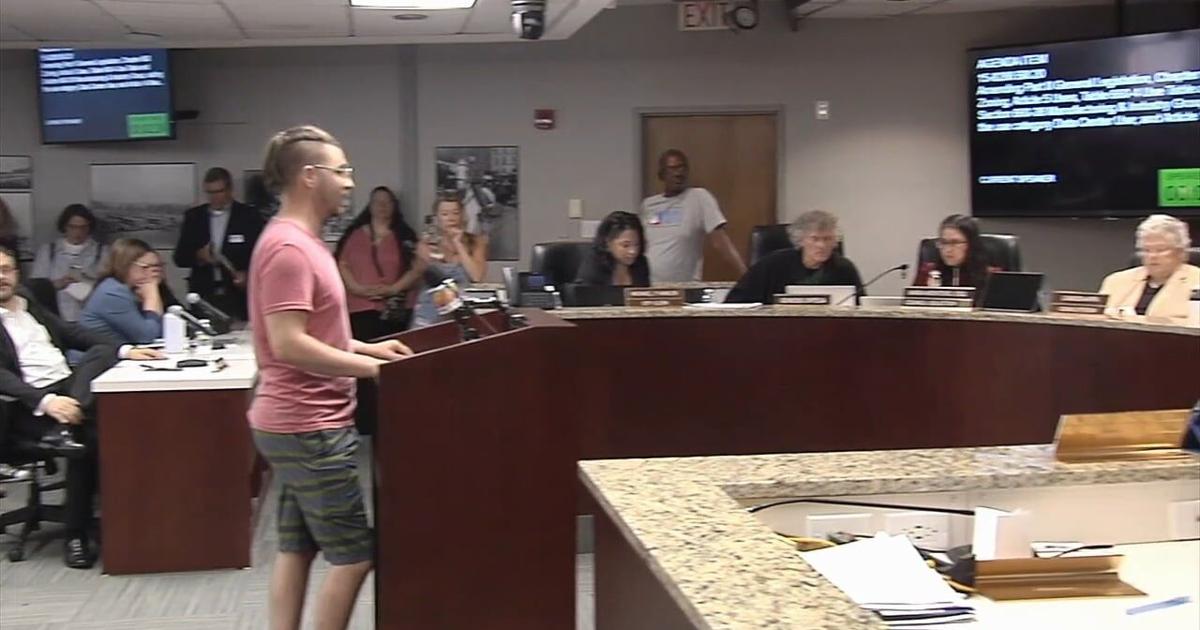
ALLENTOWN, Pa. – After spending close to four hours hearing from a standing room-only crowd, Allentown City Council voted Wednesday night to table a proposed ordinance, known as Bill 20, that would have put zoning regulations in place for artificial intelligence data centers.
The proposal to regulate data center developments was not opposed by the residents in attendance. Instead, most people raised concerns that the zoning amendment did not go far enough.
The proposal would permitted data centers in the General-Industrial and Industrial Manufacturing zoning districts by way of a special exception, which requires a hearing before the zoning hearing board.
The proposed ordinance includes definitions and sets the regulations on a variety of topics such as setback requirements from existing homes and businesses to how the centers must be sustained by existing infrastructure.
After hearing conflicting legal opinions on the matter, council directed its solicitor to conduct a legal service review prior to the June 17 council meeting to determine how if a municipal curative amendment would affect new data center applications for the next 180 days.
A municipal curative amendment can be made by a municipality to make a declaration that its zoning code is insufficient, and that it will be “cured” in six months.
There were conflicting opinions on whether the municipal curative amendment would place a moratorium on new applications for the 180-day period.
The zoning amendment issue is taking place at the same time a data center project is already on the table.
Langan Engineering has been identified as the applicant for a proposed project to convert an existing 224,000-square-foot warehouse at 2401 W. Emaus Ave. into a data center.
The new guidelines within any zoning amendment would not apply to the existing project.
The deficiency in the zoning ordinance — as with many other zoning ordinances the country — is that it does not address the use of AI data centers.
A municipality is required to provide zoning districts for every potential use.
That conflict presented confusion for many in the audience Wednesday night, as they wanted to object to the Emaus Avenue project.
Council President Santo Napoli explained the project is not under the jurisdiction of council and that a planning commission meeting is scheduled to address the matter on June 9 at 12:15 p.m.
Napoli directed residents during a public hearing prior to the regular voting meeting that they had to focus on Bill 20.
He had to interrupt the public hearing frequently to remind people they could only speak on the proposed ordinance and not the Emaus Avenue project.
Planning Director Jennifer Gomez said the city has been working on Bill 20 for the past six months and that it had been endorsed by the Lehigh Valley Planning Commission.
“We’ve heard a lot of suggestions in the last couple days, in particular about ways that the ordinance could be strengthened or improved or have additional standards,” Gomez said. “And for that, I’ll say that we’re open to those discussions. We don’t want this to be the end of the discussion. It can be the beginning of the discussion, but we do want to protect the city and get some rules in place.”
Ginny Marcille-Kerslake, the senior organizer for Food and Water Watch Pennsylvania said for the past year,she has been helping municipalities across the state pass protective ordinances.
“Unfortunately, I would like to say that this ordinance that you have before you is one of the worst ones I’ve seen,” Marcille-Kerslake said. “This is a high-impact industrial use which is not compatible with the description of the general industrial zone; this use should be restricted to the Industrial Manufacturing zone.”
“Secondly, this 200-foot setback from homes and other sensitive receptors is grossly insufficient,” she said. “We are seeing setbacks in other municipalities that are on the order of thousands of feet from sensitive receptors. Recent guidelines released by the Chester County and Montgomery County planning commissions advise that data centers shall be a minimum of 1,000 feet from residential uses.”
Marcille-Kerslake said another problem is that there is no decommissioning requirements in the model presented.
“That’s a very real risk because this technology is advancing and these huge energy and water consuming facilities will no longer be needed and viable and so they (the AI companies) will walk away in five to 10 years, leaving your community with these stranded assets,” she explained.
“What I’m recommending is that you deny this insufficient data center ordinance and instead pass a resolution to enact a municipal curative amendment which is actually in accordance with your own zoning ordinance and give yourself a 180-day pause on new applications until a really good ordinance can be passed.”
Many residents followed similar calls for council to reject Bill 20.
Kyle Ropski, chair of Allentown’s Environmental Advisory Council, said he could not stress enough the importance of the passage of the bill for the sake of the environment and the residents.
“I strongly urge you to bring this monumental effort to the finish line with the protection of our city and our community,” Ropski said. “The people here care about our city; they care about our air quality and our elders who suffer with respiratory issues. They care about our water quality and our children who cannot safely cool off in our waterways on a hot summer day. They care about the future of our city. And that is exactly why I am urging your support for the passage of Bill 20, which is the result of months of transparent, collaborative and diligent work with intent to protect our residents and our environment.”