
When Barbara Greenspan Shaiman’s late mother, Carola Greenspan, arrived at Auschwitz, the Nazi’s took her toothbrush.
That toothbrush was her sole possession, which she’d carried with her out of a Polish ghetto, where she’d been taken without her parents, who’d left to try to find a way for the family to escape.
When Shaiman was growing up, her mother obsessively brushed her teeth five or six times a day, Shaiman told Fideri News Network.
“We never understood why,” said Shaiman.
For years, Carola Greenspan had not wanted to return to Germany or Poland, but after a gathering of Holocaust survivors in Philadelphia in 1989, she decided to go.
“In two weeks, there were over 40 Holocaust survivors who signed up,” said Shaiman.
She accompanied her parents to the former Auschwitz concentration camp, and there her mother told Shaiman that while she was in the ghetto and on the train to Auschwitz, she would “‘Take that toothbrush and the bristles on my teeth would make me feel human. I didn’t have toothpaste, but the feel of the bristles made me feel human. It was the last thing I had left when I got to Auschwitz. They took the toothbrush away from me.’”
Shaiman thought she might cry and left her mother to go into a nearby courtyard where she “broke down hysterically, because we made fun of her brushing her teeth, never understanding what the toothbrush symbolized for her.”
While in the courtyard, there were some teenage boys “clowning around,” speaking in German. German was her first language because she was born in Germany in 1948. Her family came to the U.S. in 1951. So, she spoke to the teenagers in German, telling them this was a place where people were killed. But they ignored her and kept laughing.
“And I had this epiphany,” she said. At that time, she ran a national search firm to recruit doctors. But Shaiman, the daughter of two Holocaust survivors, decided to start a youth leadership nonprofit to promote kindness and understanding.
The name just came to her: Champions of Caring.
“Why can’t we make heroes out of young people who do important social justice work, rather than just straight-A students or athletes?” Shaiman asked herself.
So she gave up her recruitment agency and started a nonprofit foundation to do just that. Since 1995, over 10,000 high school students from Philadelphia and the suburbs have performed one million hours of service in the region, the U.S., and abroad.
Her father, Henry Greenspan, and his mother, Golda, were also Holocaust survivors.
The Greenspans lived in Krakow, Poland, during World War II. Henry was one of the Jews who worked for Oskar Schindler, who is famous from Steven Spielberg’s film, “Schindler’s List.” (Through a friend, NBC CEO Bob Wright, Shaiman received some seed money for Champions of Caring from Spielberg’s Righteous Persons Foundation.)
“Unfortunately, he was not put on Schindler’s List,” Shaiman said of her father.
The Nazis sent him on a “death march” to Theresenstadt, which was the third camp my mother was put in. That’s how they met.”
“They both had typhus, and they were in the infirmary,” she said.
The Russian army liberated them in March 1945.
Together, they went to Lódź, Poland, where her mother had lived, to find her family.
“Out of 65 people, no one was left,” said Shaiman.
So, they went on to Krakow, and miraculously, they found that Henry’s mother, Golda Greenspan, and his brother were still alive.
Before the war, Golda Greenspan had been an entrepreneur, which was unusual for a woman in those days. She spoke five languages and wanted to learn Italian, too. She went to Livorno, Italy, and created a business with a woman who she’d contacted to teach her Italian. They sold coral, exporting it from Italy to Poland.
“And she had one ring that she loved,” said Shaiman. “And when she heard rumors of Auschwitz and concentration camps and that Jews were being rounded up, she took her ring and her sabbath candlesticks to a Polish man who had worked for her and asked him to keep them for her.”
“When my grandmother met my mother, she said, ‘Oh, my God. I have a ring for you!’”
But when she went to the man to get her ring, he claimed not to know what she was talking about. So, her grandmother went and got the police, and the man then turned over the coral ring.
Shaiman’s mother had always valued kindness. When she was a teenager in the ghetto, she gathered up the orphaned children wandering the streets and taught them. She would always ask Shaiman what she had done to be kind to others each day.
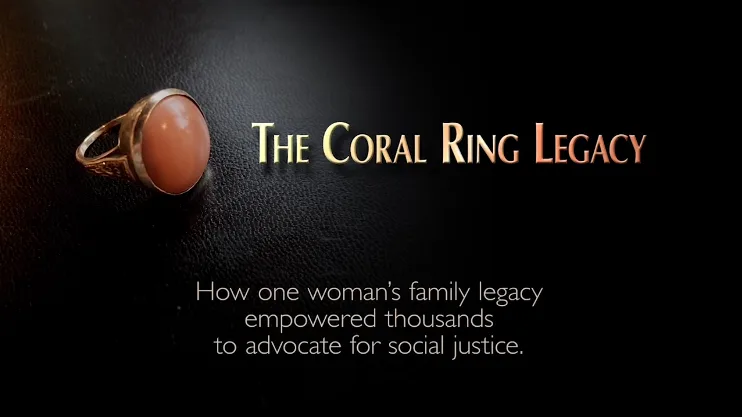
When Shaiman turned 50, her mother gave her the coral ring.
“Every time I look at it, it triggers me to think, was I kind? Would I make my mother happy?”
Shaiman raised two children and is the grandmother of five.
A study by Temple University sociology professor Kimberly Goyette showed that the Champions of Caring program led participants to positive impacts throughout their lives.
Champions of Caring went on a hiatus in 2020 due to the Covid pandemic. During that time, Shaiman expanded the organization’s mission to become intergenerational.
She worked with a psychology professor, Tania Giovannetti, at Temple University to start a class on aging well, contributing to society, and social activism that had students from 19 to 95.
When the course was over, people wanted more.
“So, we created an intergenerational cafe,” she said. They plan an international cafe in Finland, where one of her Champions of Caring, Granger Simmons, has settled.
Simmons, now 42, was 15 and a sophomore at Martin Luther King Jr. High School in Philadelphia when a guidance counselor told him about Champions of Caring. He worked for the Philadelphia Mayor’s Office, teaching kids computer literacy, and volunteered for the Special Olympics.
While at Brown University, he became friends with a woman, who later became his wife, Odette Lee-Simmons. She is the daughter of Gerald Lee Sr., a famous American-Finnish basketball player, Gerald Lee Sr., which is how Simmons came to live in Uusikuupunki, Finland. The couple has four boys, ages 6 to 16.
An entrepreneur, he was running a food and beverage business.
“Newcomers who came to this city had a lot of questions,” from which carton was milk to how to bring their wife and family there, he said. Everything was written in Finnish, and most people only spoke Finnish.
“I was one of the only [person of color] here,” he said, so people would come up to him in the streets and ask for help. He helped them as a volunteer for several years, then called the mayor and told him he should hire him to do this.
Now he has a position helping immigrants and also Finns returning to their country in six municipalities. He’s also in his second term on the city council.
“Champions of Caring played a huge role in my life,” said Simmons, who grew up in foster care. “They were able to see me when I felt invisible and gave me the courage to make a change in the world.”
And now Shaiman co-produced a new documentary that recently debuted at the Weitzman National Museum of Jewish American History: “The Coral Ring Legacy.” She’s in the process of finding a streaming service to air it.
The documentary, by Emmy-winning filmmaker Henry Nevison, includes Champions of Caring participants who used their experiences with their high school projects to become caring adults who are making positive changes in the world.
“Let’s create a caring campaign that goes globally, and that involves young people, old people, black people, white people, Jewish people, everybody–because kindness is not just for one group. It’s for everyone.”
She hopes the “‘The Coral Ring Legacy’” will inspire people to ask themselves, how was I nice today? How was I kind and what can I do?”
That legacy is needed more than ever, with the explosion of antisemitism since the Oct. 7 Hamas terror attack on Israel.
“I feel this can inspire people, especially right now, where we’re very divided,” said Shaiman. “And there’s so much antisemitism and hatred. I hope this can diffuse some of that, that we can respect each other no matter what party we’re with, what religion we are. I hope that we can come together in a collaborative fashion to create a kinder world.”