
This is WESA Arts, a weekly newsletter by Bill O’Driscoll providing in-depth reporting about the Pittsburgh area art scene. Sign up here to get it every Wednesday afternoon.
The production of empathy might be a cardinal benefit of the performing arts. Yet City Theatre has a hit with a protagonist who proudly declares, “I have earned the right to feel nothing for anyone.” Meanwhile, the audience for this hit tells us something about attendance trends in theater.
The show is “Hedwig and the Angry Inch,” the company’s second staging of the landmark 1998 rock musical by John Cameron Mitchell and Stephen Trask. Two years after the 2001 film adaptation came the Pittsburgh stage premiere at City, with Broadway star Adam Rapp playing the delightfully rude, imperiously bitchy East German-born rocker Hedwig.
Hedwig, the story goes, was named “Hansel” upon her birth on the rough side of the Berlin wall. After fumbled gender-reassignment surgery, she ends up stateside as the wife of an American G.I. A rock ’n’ roll true believer, she turned mentor to an aspiring rock star she renamed Tommy Gnosis, who callously left her and who is now the bête noir of the high-decibel show Hedwig has come to deliver at Downtown’s Greer Cabaret Theater.
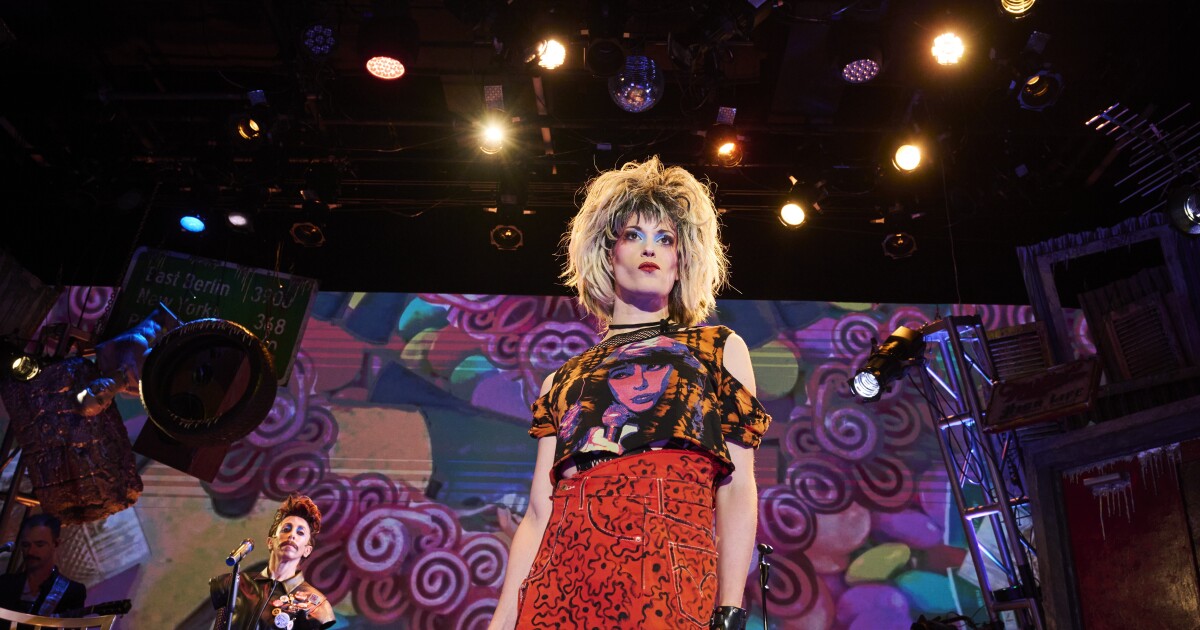
As embodied by Pittsburgh-based stage star Treasure Treasure, deliver she does. On a set that’s giving “American junkyard” — truck grill, trash can, toppled McDonald’s sign — Hedwig is by turns venomous, hilarious, venomously hilarious and unsparingly insightful as she tells her story, roasts Tommy and narrates her life-long search for her “other half,” who might be either a he or a she.
In a series of outrageous costumes, Treasure owns the stage, with great support from Theo Allyn as Hedwig’s mysterious sidekick Yitzhak and a four-piece band — The Angry Inch — that tears through a score recalling late-period Velvet Underground and early-’70s Bowie.
“Hedwig” surely can’t feel as transgressive now as it felt in 2003, let alone 1998. That was all years before even drag was mainstreamed by “RuPaul’s Drag Race,” and even longer before out trans performers and public figures had anything like the visibility they have today.
Visibility, though, has brought political backlash, and trans people today are being targeted as never before. All of which makes the unapologetic — if messy and conflicted — Hedwig feel as relevant as ever.
City Theatre, by the way, stages almost exclusively Pittsburgh premieres. It says it brought “Hedwig” back because it remains a particular fan favorite from its storied half-century.
“Hedwig” might be even more popular today, though in ways that starkly illuminate how audience habits have changed.
The company says, so far, it’s issued some 6,100 tickets for “Hedwig,” making it the troupe’s third most well-attended show of the past 20 years, after only Eve Ensler’s “The Good Body” and Robert Askin’s “Hand to God.” (Because its computerized records go back to only 2006, City can’t easily quantify how big a hit the “Hedwig” premiere was.)
It has also set a record for single/group sales, with some $160,000 in revenue and counting.
That’s great news for City Theatre, and for a theater community struggling with layoffs by its flagship company in the midst of a merger with Pittsburgh CLO.
But data supplied by City Theatre illustrate a big change in audience habits — specifically, the share of the audience that consists of subscribers, who commit to a whole season, as opposed to single-ticket buyers.
Among its dozen top-selling shows from the past 20 seasons, total tickets issued for recent hits like “Hedwig” and “Louisa May Alcott’s Little Women” (how’s that for a pairing?) compare well with pre-pandemic hits like “Hand to God” and “Vanya and Sonia and Masha and Spike.”
But if single- and group-ticket sales have always helped power successful shows, before the pandemic they typically accounted for about 40% of total tickets issued. For hits since 2023, single and group sales have comprised well over half the audience — in the case of “Hedwig,” a whopping 63% to date. In raw numbers, where a hit run at City once drew 2,500 or more subscribers, it now draws fewer than 2,000.
Thus, in the steaming age, audiences will still turn out, but perhaps only for exactly what they want to see. (Also notable: Three of City’s five biggest hits since the pandemic have had classic literary associations, including two of Lauren Gunderson’s Jane Austen-inspired “Christmas at Pemberley” plays.)
For its part, “Hedwig” has proved popular enough that City extended its run a full week. Eleven performances at the Greer remain Wed., June 3, through June 14.