
A geomagnetic storm is expected to hit the Earth’s atmosphere tonight, offering a chance to catch the aurora borealis, also known as the northern lights, in Pennsylvania tonight.Forecasters at the Space Weather Prediction Center (SWPC) in Boulder, CO are forecasting a “potentially strong geomagnetic storm” to impact Earth late Thursday and Friday morning.As of Thursday afternoon, the official SWPC forecast calls for Kp index values of 7 between 00z to 03z (8 p.m. – 11 p.m. EDT), which would be equivalent to a G3 Geomagnetic storm. However, the exact timing can change by a few hours due to changes in the speed of the solar wind. Geomagnetic storms are rated on “G levels” ranging from G1 to G5, with G5 being the most extreme.G1 | MINORG2 | MODERATEG3 | STRONGG4 | SEVEREG5 | EXTREMEViewing conditions in South Central Pennsylvania look excellent with very little cloud cover after sunset. High clouds currently over the area are expected to dissipate after sunset. To see the aurora in Pennsylvania, you need at least a G3 geomagnetic storm to occur. The stronger the storm, the more likely Pennsylvania will see the northern lights. However, just because you have a strong geomagnetic storm does not mean you are guaranteed aurora. The direction of the solar wind is critical!Solar Wind’s Magnetic Field Needs To Be SouthIn addition to the strength of the storm, the orientation of the solar wind’s magnetic field is critical. For strong geomagnetic storming to occur, you need the polarity of the solar wind’s magnetic field to be south, or the opposite of Earth’s magnetic field. Why? Opposites attract when it comes to magnets, and this attraction allows the maximum solar wind particles to reach and interact with the Earth’s atmosphere and produce aurora. If the solar wind’s polarity is north, or the same as Earth, you get a bumper car effect and signifcantly less solar wind particles can reach Earth’s atmosphere. In most solar storm events, the direction of the solar wind’s magnetic field is the determining factor on who sees the northern lights and who misses out. Unfortunately, there is no way to know for certain what the solar wind’s polarity is until it reaches our satellites about 1 million miles away. Due to the speed of the solar wind, this only provides a 30-60 minute warning to us down on Earth. Share Your Photos!If we are lucky enough to see the northern lights tonight, be sure to share your photos with us and the rest of the Susquehanna Valley!DIRECT UPLOAD: There is a form here to let you upload photos or video.EMAIL: Just send to news8@wgal.com & weather@wgal.com.Tips for capturing photos of the aurora borealisMake sure you use the long-exposure setting (night-mode) on your camera to get the best color! Go outside and look to the north. You may have to look around a little bit to capture the color. Depending on the storm’s exact strength, you may only see color through the camera.What are the northern lights?The northern lights, or aurora borealis, are a captivating phenomenon characterized by colorful dancing waves of light in the sky. When there is a strong enough geomagnetic storm, the aurora can be seen in Pennsylvania.During these storms, charged particles collide with gases in the Earth’s upper atmosphere, producing the spectacle.The stronger the geomagnetic storm or the larger the amount of material ejected by the Sun, the farther south the northern lights can be seen during a storm.How you can see the northern lightsCheck NOAA’s aurora forecast website. It’s a great resource for potential viewing times.If a northern lights viewing is in the forecast, check the WGAL News 8 Storm Team forecast to see if local conditions are favorable. Just because the Aurora is active, that doesn’t necessarily mean cloud cover and other local conditions won’t interfere with its visibility.If everything lines up for a viewing, you’ll want to maximize the darkness to really enjoy the show. Your best bet is to head to rural areas with very little light pollution. Find a spot, such as a hill or mountaintop, with a clear view of the northern sky and soak it all in.Read more about the Space Weather Prediction Center here: www.spaceweather.gov.
A geomagnetic storm is expected to hit the Earth’s atmosphere tonight, offering a chance to catch the aurora borealis, also known as the northern lights, in Pennsylvania tonight.
Hearst OwnedWGAL News 8 Storm Team
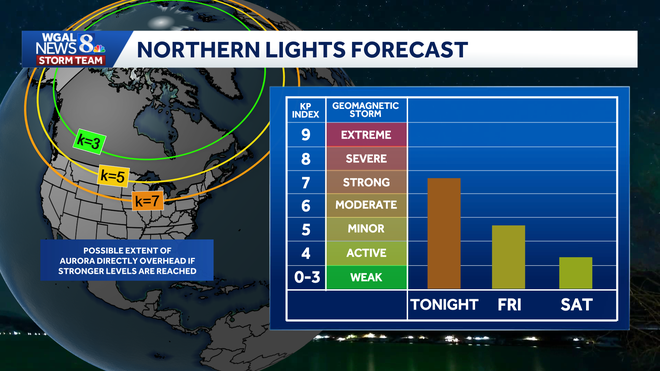
Kp index forecast for Thursday, June 4 – Saturday, June 6, 2026.
Forecasters at the Space Weather Prediction Center (SWPC) in Boulder, CO are forecasting a “potentially strong geomagnetic storm” to impact Earth late Thursday and Friday morning.
As of Thursday afternoon, the official SWPC forecast calls for Kp index values of 7 between 00z to 03z (8 p.m. – 11 p.m. EDT), which would be equivalent to a G3 Geomagnetic storm. However, the exact timing can change by a few hours due to changes in the speed of the solar wind.
Geomagnetic storms are rated on “G levels” ranging from G1 to G5, with G5 being the most extreme.
G1 | MINORG2 | MODERATEG3 | STRONGG4 | SEVEREG5 | EXTREME
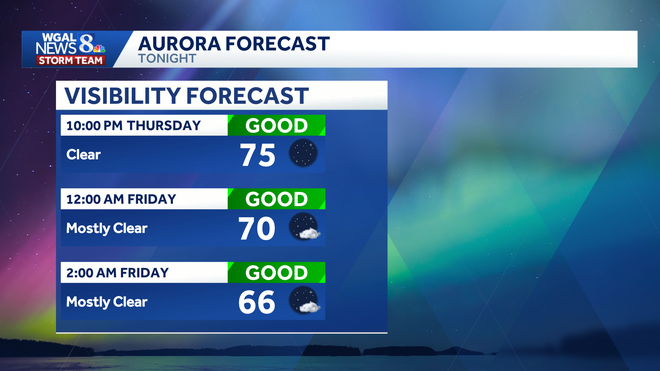
Viewing conditions in South Central Pennsylvania look excellent with very little cloud cover after sunset. High clouds currently over the area are expected to dissipate after sunset.
Hearst OwnedWGAL News 8 Storm Team
Viewing conditions for Thursday, June 4, night across the South Central PA.
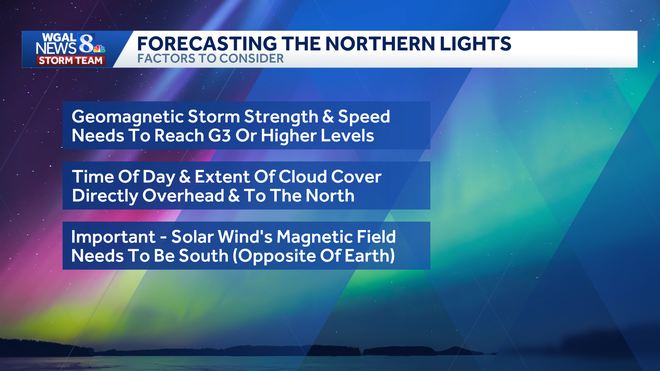
To see the aurora in Pennsylvania, you need at least a G3 geomagnetic storm to occur. The stronger the storm, the more likely Pennsylvania will see the northern lights. However, just because you have a strong geomagnetic storm does not mean you are guaranteed aurora. The direction of the solar wind is critical!
Hearst OwnedWGAL News 8 Storm Team
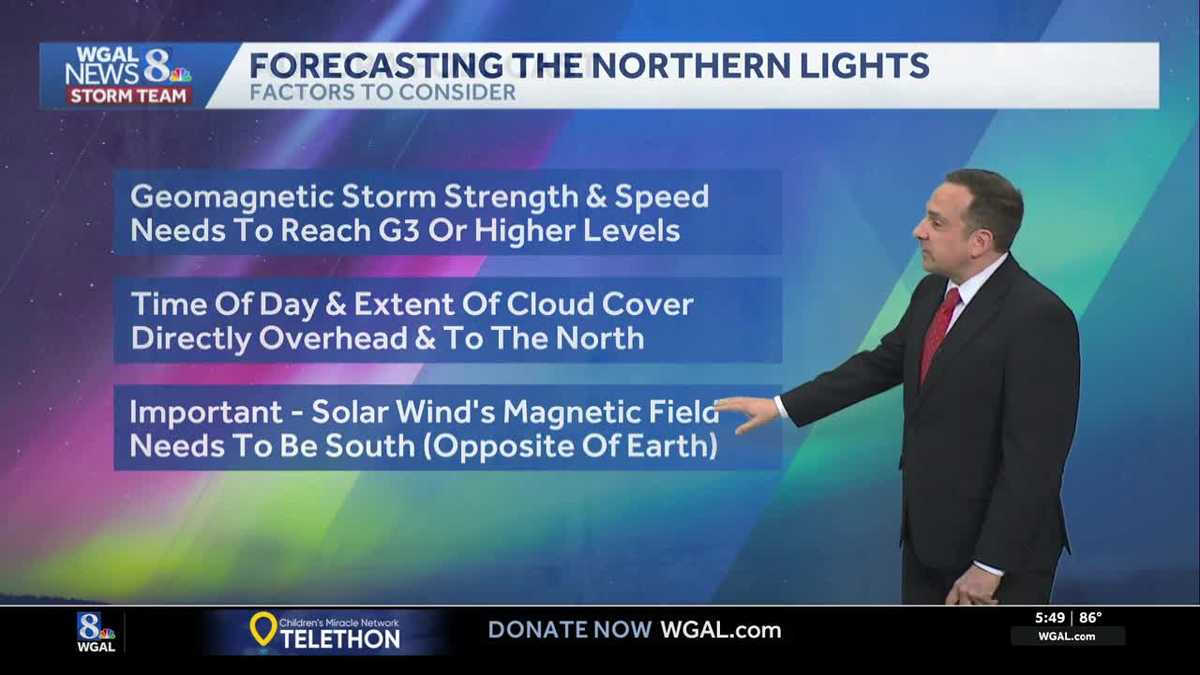
Multiple factors go into forecasting the Northern Lights.
Solar Wind’s Magnetic Field Needs To Be South
In addition to the strength of the storm, the orientation of the solar wind’s magnetic field is critical. For strong geomagnetic storming to occur, you need the polarity of the solar wind’s magnetic field to be south, or the opposite of Earth’s magnetic field.
Why? Opposites attract when it comes to magnets, and this attraction allows the maximum solar wind particles to reach and interact with the Earth’s atmosphere and produce aurora.
If the solar wind’s polarity is north, or the same as Earth, you get a bumper car effect and signifcantly less solar wind particles can reach Earth’s atmosphere.
In most solar storm events, the direction of the solar wind’s magnetic field is the determining factor on who sees the northern lights and who misses out. Unfortunately, there is no way to know for certain what the solar wind’s polarity is until it reaches our satellites about 1 million miles away. Due to the speed of the solar wind, this only provides a 30-60 minute warning to us down on Earth.
Share Your Photos!
If we are lucky enough to see the northern lights tonight, be sure to share your photos with us and the rest of the Susquehanna Valley!
Tips for capturing photos of the aurora borealis
Make sure you use the long-exposure setting (night-mode) on your camera to get the best color! Go outside and look to the north. You may have to look around a little bit to capture the color. Depending on the storm’s exact strength, you may only see color through the camera.
What are the northern lights?
The northern lights, or aurora borealis, are a captivating phenomenon characterized by colorful dancing waves of light in the sky. When there is a strong enough geomagnetic storm, the aurora can be seen in Pennsylvania.
During these storms, charged particles collide with gases in the Earth’s upper atmosphere, producing the spectacle.
The stronger the geomagnetic storm or the larger the amount of material ejected by the Sun, the farther south the northern lights can be seen during a storm.
How you can see the northern lightsCheck NOAA’s aurora forecast website. It’s a great resource for potential viewing times.If a northern lights viewing is in the forecast, check the WGAL News 8 Storm Team forecast to see if local conditions are favorable. Just because the Aurora is active, that doesn’t necessarily mean cloud cover and other local conditions won’t interfere with its visibility.If everything lines up for a viewing, you’ll want to maximize the darkness to really enjoy the show. Your best bet is to head to rural areas with very little light pollution. Find a spot, such as a hill or mountaintop, with a clear view of the northern sky and soak it all in.
Read more about the Space Weather Prediction Center here: www.spaceweather.gov.