
With the start of the holiday season approaching, food pantries and those who distribute food to them are bracing for more people amid the uncertainty around federal payments.
Officials said they were seeing unprecedented need for food and figuring out how to serve food to those who need it. The U.S. Department of Agriculture said Supplemental Nutrition Assistance Payments benefits would stop beginning Saturday because it could no longer pay for them, but on Friday two federal judges ruled nearly simultaneously that President Donald Trump’s administration must continue to fund SNAP, the nation’s biggest food aid program, using contingency funds during the government shutdown.
It wasn’t immediately clear how quickly the debit cards that beneficiaries use to buy groceries could be reloaded after the ruling. That process often takes one to two weeks. The rulings are likely to face appeals. The case was brought by 25 states, including Pennsylvania, who asked to use emergency funding for SNAP.
This comes as food pantries are already losing out on state funds due to the ongoing impasse over the passage of the state budget. The shutdown also forced the state to delay opening the 2025-26 Low-Income Home Energy Assistance Program season by one month.
Jennifer Warabak, executive director of CEO Weinberg Northeast Regional Food Bank, said the bank has been inundated with calls from people looking for food pantries and distribution sites in the four counties it serves — Lackawanna, Luzerne, Susquehanna and Wyoming.
“We’re getting a lot of calls from individuals that are just legitimately scared,” she said. “They’re nervous that they’re not going to get their benefits for November.”
Similarly, Helping Harvest, which distributes food to food pantries and other distribution sites in Berks and Schuylkill counties, has been receiving many phone calls and a lot of support has come in, President Jay Worrall said.
Jodina Hicks, president and CEO of Volunteers of America of Pennsylvania, is seeing the impact of SNAP potentially not being funded at its food pantries across the state. Locally, it operates two food pantries in Wilkes-Barre. She said the number of people coming to the pantries has tripled, and the pantries have run out within several hours of opening.
“When we’re open, we have lines circling through the parking lot on the sidewalks,” Hicks said.
For Jessica Wallo, director of community services for United Neighborhood Centers of Northeastern Pennsylvania, the most noticeable impact from the uncertainty around SNAP benefits at the food pantry on Olive Street in Scranton has been the number of new people, people who haven’t used the pantry for a number of years and people who are working but still need help. The pantry served 10 new families this week.
“We’re seeing new faces come in,” she said. “We’re seeing people who haven’t been here for years coming in for the first time.”
She expects the pantry will serve more than 800 families this month, while Worrall is expecting an influx of people at an upcoming distribution at the Fairlane Village Mall and its mobile markets in Shenandoah and Tamaqua.
Warabak said Weinberg has ordered additional food products, and the more than 300 food pantries it serves have increased their hours.
Worrall and Warabak acknowledged their food banks can’t completely fill the gaps left if SNAP isn’t fully funded.
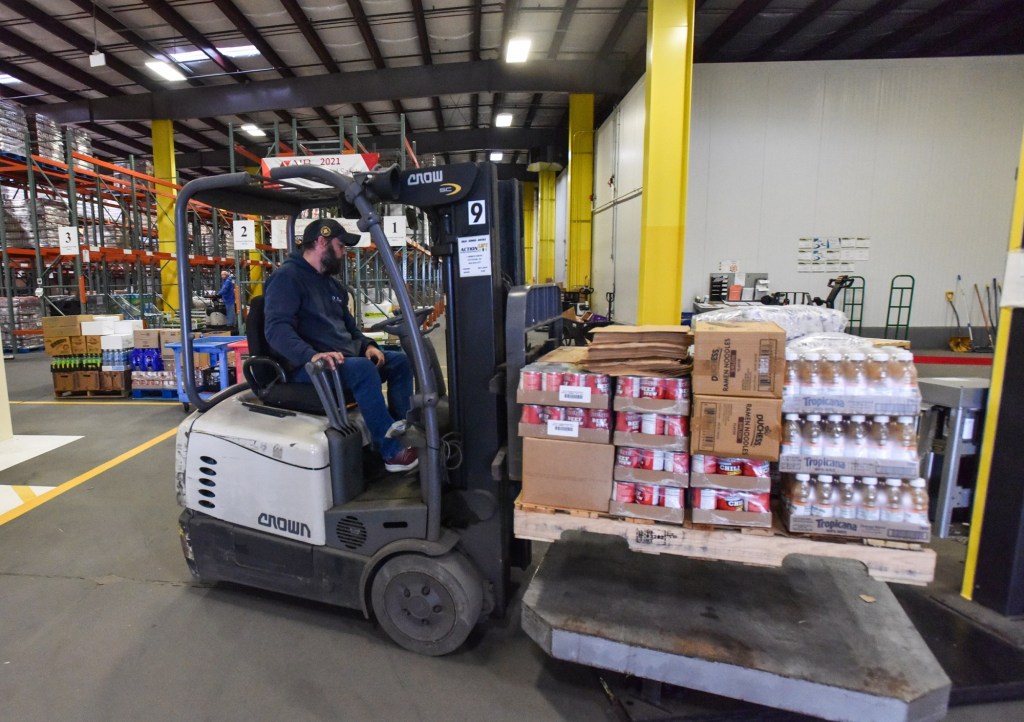
Employee Tim Golightly wraps up a pallet of pantry items at The Harry & Jeanette Weinberg Northeast Regional Food Bank in Pittston Twp. Friday, Oct. 31, 2025. (SEAN MCKEAG / STAFF PHOTOGRAPHER)
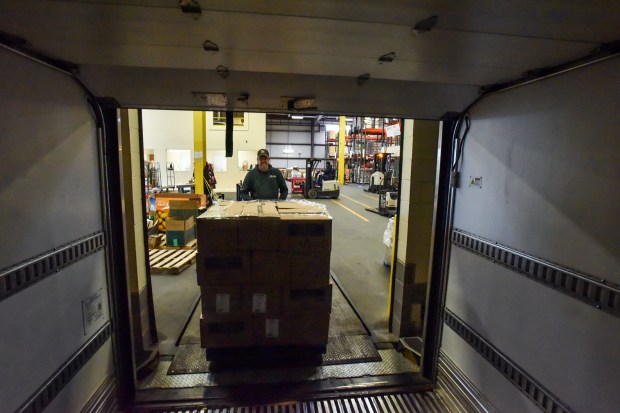
Employee Ryan O’Malley loads a pallet of pantry items into a truck at The Harry & Jeanette Weinberg Northeast Regional Food Bank in Pittston Twp. Friday, Oct. 31, 2025. (SEAN MCKEAG / STAFF PHOTOGRAPHER)
Show Caption
1 of 2
Employee Tim Golightly wraps up a pallet of pantry items at The Harry & Jeanette Weinberg Northeast Regional Food Bank in Pittston Twp. Friday, Oct. 31, 2025. (SEAN MCKEAG / STAFF PHOTOGRAPHER)
“I don’t want to pretend that we have potential actions that we could take that would really address a food insecurity catastrophe of this size,” he said. “We will not have the resources available to us to replace the SNAP funding that these people have lost, but we will do the best that we can.”
To meet the need, Hicks said VAP increased hours and the number of days they are open from two to three days a week, and increased the food supply from Weinberg. The pantries also received a grant from Geisinger and are reaching out to community partners to assure them they have the capacity for food.
Some sites are tapping into other parts of their budget to cover the costs. Warabak said her organization is spending funds that would normally be spent in the first part of the new year on purchasing more food — between $35,000 and $50,000 per truck.
Dave Young, chief executive officer of Schuylkill Community Action, said the agency has relied on reserves and donated funds to supply the 21 food pantries it runs throughout the county.
“We have started dipping into our reserves to make sure that people have their most basic needs met with this food assistance,” he said.
The agency also purchased a mobile food truck to deliver more food to pantries, which are projected to serve around 2,500 people.
With the anticipated increase in need, food banks and food pantries are appealing to communities. Worrall said his organization has been talking to supporters to understand the challenging time they are facing.
SNAP helps provide food for 156,000 people in Luzerne, Lackawanna, Schuylkill, Carbon, Susquehanna and Wayne counties.
Gov. Josh Shapiro on Friday signed a declaration of disaster emergency making $5 million in funding immediately available to Pennsylvania food banks. He is also leading a private-sector donation campaign, securing over $1 million in private donations for food banks through the SNAP Emergency Relief Fund.
U.S. Rep. Rob Bresnahan, R-8, Dallas Twp., co-sponsored a bill to keep SNAP, which serves about 1 in 8 Americans, funded during the shutdown and sponsored a bill to continue providing food aid through the program known as Women, Infants and Children for the rest of the year. To continue WIC earlier in the shutdown, the White House reallocated funds, which are nearly exhausted.
Angela Bassani, president and CEO of United Way of Lackawanna, Wayne and Pike counties, said many entities are relying on their reserve funds and the generosity of the community to step up and support the food bank, adding there has been an uptick in the number of people calling 211 for food and utility assistance.
“You’re looking at a situation where our nonprofits are stepping up so much, even though we’re all struggling with the federal and state budget impasse double whammy, but we realize that people are hurting very badly right now,” she said. “We’re all trying to do the best that we can to help as many people as we can get through this.”
Resources for food
Those looking for food assistance or to help those needing assistance can find it at the following:
ceopeoplehelpingpeople.org
helpingharvest.org
Call 211
schuylkillcommunityaction.com/services/pantry
Donating a nonperishable item in the lobby of United Way of Lackawanna, Wayne and Pike counties’ 10,000 Cans collection.
Heart of Scranton at safdn.org/heart
Act Out Theatre Group of Taylor has created free grocery grab bags on a first-come, first-serve basis, Monday through Wednesday, 5 to 8 p.m.
Northern Light Espresso Bar and Cafe in Scranton is offering complimentary breakfasts for those in need while supplies last Tuesdays in November while supplies last.