
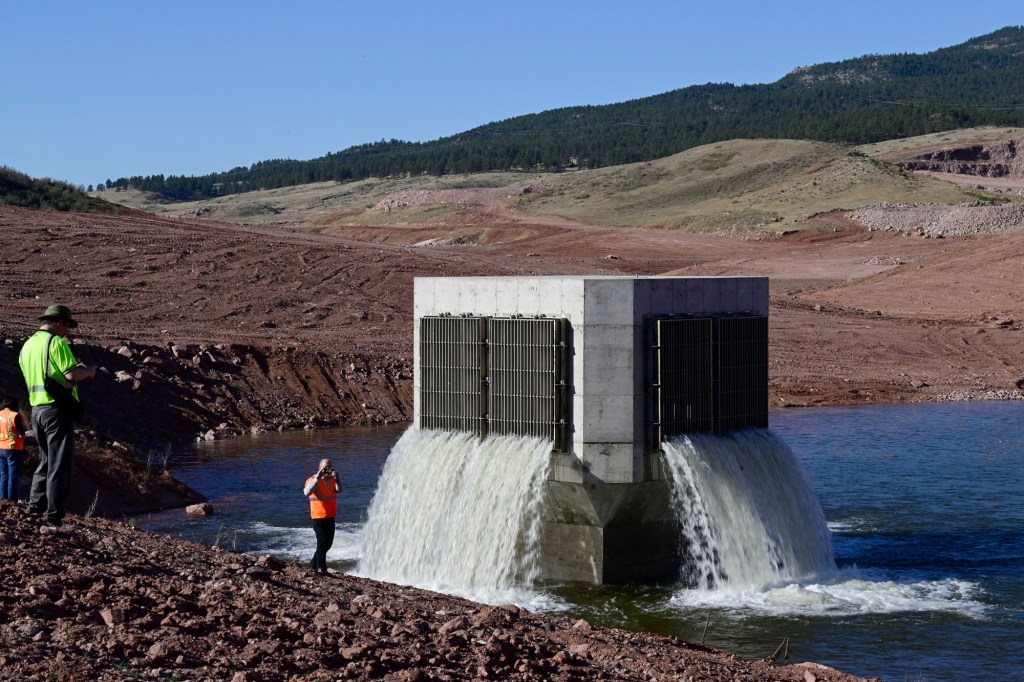
Erie leaders voted to contribute another $2.9 million to the Northern Integrated Supply Project, a decades-long water storage initiative that saw an exodus of other participating communities over the past year.
Town officials say NISP could help meet water demands tied to Erie’s continued growth, though questions remain about the project’s ultimate cost and whether it could affect existing residents’ water bills.
Town Council members last month voted 4-2 to approve a $2.9 million interim agreement, adding to the $29.1 million Erie has already decided to invest in the Northern Colorado Water Conservancy District’s project — an effort more than 20 years in the making that could create a major new water source for communities along the northern Front Range.
Had the council declined to authorize the additional payment, Erie would have forfeited its interest in the project, according to Erie’s special water counsel, Pete Johnson.
Johnson said “some amount, if not the full amount” of the town’s planned share of NISP water will likely be necessary to support the long-term anticipated growth in Erie’s population.
“Some of that growth and development certainly will not be possible without NISP,” Johnson told the Town Council during its May 26 meeting, adding: “There’s no other silver-bullet alternative project out there that’s a plug-and-play source of water of the same scope.”
A smaller water project
Northern Water‘s project is in the design phase and could break ground on major infrastructure next year. But the project has faced setbacks on its path to construction.
The project has faced both legal action filed in 2024 by the Save the Poudre environmental group — later settled for $100 million — and rising construction cost estimates.
In its early stages, 15 participants, including water districts and municipalities, had agreed to fund NISP: the Fort Collins-Loveland Water District, Erie, Fort Morgan, Left Hand Water District, Central Weld County Water District, Windsor, Frederick, Lafayette, Morgan County Quality Water District, Firestone, Dacono, Evans, Fort Lupton, Severance and Eaton.
Only nine participants, including Erie, signed on for the project’s next phase after Fort Collins-Loveland, the Morgan district, Firestone, Evans, Severance and Eaton withdrew. More than one cited rising costs as a factor in their decision, though Northern Water spokesperson Jeff Stahla said cost was not the only reason.
“There were some communities expressing concern just about how their conditions had changed since when they first signed on with the project,” Stahla told the Daily Camera. “So I don’t think it’s accurate to say that everybody had concern solely about the cost.”
“Those who are following construction costs, especially for water infrastructure, have been noting it has been going up faster than inflation for a while now. The estimates for NISP were also affected, but it was as much an industrywide issue as it was for this single project,” he later added.
Restructured for less participants, the project has shrunk and would encompass less water.
NISP was originally envisioned with two new reservoirs as water sources. The planned Glade Reservoir, northwest of Fort Collins, would receive water from the Cache la Poudre River, while Galeton Reservoir, northeast of Greeley, would receive water from the South Platte River.
Whether Galeton Reservoir is ultimately built will depend on future interest in the project, according to Stahla.
“We have actually been in conversation with other potential participants,” he said. “It’s nothing that we can talk about publicly, but I’m hopeful that by the time we get to the latter part of this year, that we’ll certainly be talking about this as a project that other northern Colorado communities will be wanting to invest in.”
For now, the project will move forward with only Glade Reservoir.
That reduces NISP from what was originally planned as “roughly a 40,000 acre-foot project” down to “a little shy of 20,000 acre-feet per year of firm annual yield,” Brad Wind, Northern Water’s general manager, told the Erie Town Council in May.
An acre-foot is enough to cover a football field in nearly one foot of water. One acre-foot roughly equals the annual water use of three households.
Looking at costs
Over the past year, the cost per acre-foot of NISP’s potential water storage has climbed roughly 38% as other participants have dropped out, Erie town spokesperson Gabi Rae told the Camera.
Todd Fessenden, director of Erie’s utilities department, estimated the total cost of the project for the town at “about $85,000 to $95,000 per acre-foot,” or roughly $400 million.
“And once you add the financing to that, you roughly double that number,” Fessenden added.
When the project still included both planned reservoirs and 15 participants, Erie was slated to receive 6,500 acre-feet of annual yield — about 16% of the total NISP supply. Under the revised plan, the town’s allocation has fallen to 4,500 acre-feet annually, but Erie’s share of the project’s overall yield has actually increased — to about 23% — making the town the largest shareholder of NISP.
“We reduced participation from 6,500 acre-feet to 4,500 acre-feet in the last month or so, and Firestone stepped out of the project at that same time,” Fessenden told the council in May. “So what happened was we reduced our participation, Firestone left and our cost went up, because our percentage of the project went up.”
Total costs for Glade Reservoir are estimated at about $2 billion, Stahla said. The project would also include pipelines, pumping stations and the relocation of about seven miles of U.S. 287 north of Fort Collins, a road that currently runs through the future reservoir site.
To date, NISP participants have spent roughly $200 million on the project, much of it on land acquisition and on permitting costs, according to Stahla.
Interim agreements with Northern Water get Erie to certain NISP milestones. The town’s most recent $2.9 million agreement will cover “activities related to designing and permitting the project” from May 1 to Dec. 31, but another budget request will likely come to the town’s leadership early next year — and that round of payment could be even higher as the project heads into the construction phase.
Andrea Kehrl, another attorney advising Erie, said a draft 2027 NISP budget circulated by Northern Water totaled about $28 million. If that figure remains unchanged, Erie would be responsible for 23%, or about $6.44 million. Payments go toward debt service through Northern Water to fund the project.
Uncertainty for today’s Erie residents
According to Erie’s NISP information webpage, the town views the project as necessary to meet projected population growth and future development demands. What remains unclear is how the project could affect current residents’ water bills.
“There’s no way we could sit here and say it’s not going to go up or it’s absolutely going to go up or by how much. That’s the tough thing,” Fessenden told the council.
Mayor Andrew Moore said council members had discussed NISP in executive session — a closed-door meeting — before deciding to bring the issue into public discussion at the May meeting.
Moore and Councilmember John Mortarello ultimately voted against approving the latest interim agreement. Mayor Pro Tem Brandon Bell and Councilmembers Emily Baer, Dan Hoback and Anil Pesaramelli voted in favor. Councilmember Brian O’Connor was absent.
Potential impacts on current Erie residents’ water bills were a key concern for Mortarello, who said that after more than two decades of NISP planning, the town still doesn’t “know how it’s going to affect our rates.”
That uncertainty also contributed to Moore’s opposition.
“If this water is only for growth, why would we sign up for it if it’s going to put the burden on those already here to pay for the growth?” Moore said.
“Big participants have left,” he added. “You have to ask whether the project is still financially feasible and whether purchasing and storing that water is a good decision for Erie.”
Sarah Hancock, the town’s finance director, told the council that “incomplete” information is contributing to the uncertainty.
“I have been running scenarios with the (town’s) water fund, and we see it being quite sustainable with the payment structure that we’ve been provided from Northern Water,” Hancock said. “But those numbers are changing all the time.”
“That is where we really do need some of this concrete cost information to answer that question fully,” she added. “Because with that at play, depending on what that debt payment even is, that tells us whether or not it does raise rates or what the sustainability of it is for the town.”
Stahla said the project is nearing a point where cost estimates will be stabilized by contractor bids.
“We won’t be guessing about the cost anymore — we’ll have bids in hand,” he said, adding: “That’s one way we’ll get to a very much more firm number about what the cost will be.”
‘A lot of money to walk away from’
Fessenden, the Erie utilities director, said there are currently no alternative water sources capable of meeting Erie’s projected long-term growth needs.
The town’s current water supply primarily comes from Colorado-Big Thompson units, and Erie has continued purchasing additional shares to increase its available supply. (The Colorado-Big Thompson Project “is delivered via pipeline from Carter Lake” in the Berthoud area to an Erie water treatment facility, according to the town’s website.)
“We’ve purchased 123 shares of C-BT water, so we’ve spent about $7.2 million so far this year,” Fessenden said.
But that strategy alone will not satisfy future demand.
“C-BT is less than the cost of NISP, but there’s only so much C-BT,” he added. “And if NISP goes away, then there’s going to be even more competition for C-BT. So you see what that will do to that price.”
Erie is also expected to receive water from the planned Chimney Hollow Reservoir west of Loveland, part of the Windy Gap Firming Project. But Fessenden said the project has been delayed after uranium was discovered in rock at the dam site, creating what he estimated could be a five- to six-year delay to resolve the problem.
Voting in favor of remaining in NISP, Pesaramelli likened water to gold in an area of the country that has already faced widespread drought.
“It’s just not for future housing. It’s resiliency. We could go into droughts or climate changes,” he said. “People elect us to make hard decisions. Sometimes we don’t have all the information looking into the future.”
Bell, before also voting in favor of continuing with NISP, noted the town has “several” letters of intent from developers.
“I have a feeling that if we pull out of this, that might jeopardize some of those,” Bell said.
If Erie decided to leave the project — which it could still do when presented with the next interim agreement — the town would need to divest its NISP shares, but selling could prove difficult.
“And there’s so many shares because all of the folks that have divested out of the project … that you can’t really sell shares right now,” Fessenden said.
“It’s a lot of money to walk away from, $30 million, and just have nothing,” Baer said.
“It’s water we’ve been counting on for at least two decades (for) the future,” Baer said. “It makes me nervous to think about walking away from a big water project without an alternative.”