
The most famous moment in American soccer history features a mysterious figure whose life had become the subject of post-playing intrigue. Just behind him were two players from Philadelphia.
As soccer comes center stage again this summer during the FIFA World Cup, Philadelphians could play a central role for the U.S. in a way they haven’t since that 1950 World Cup win over England.
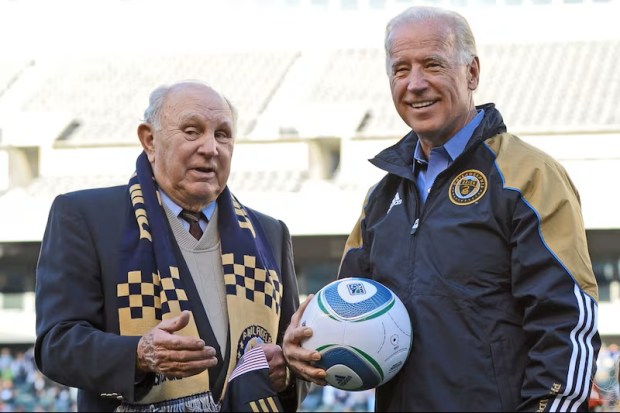 Soccer legend Walter Bahr speaks with then-Vice President Joe Biden before an April 10, 2010, game between the Philadelphia Union and D.C. United in Philadelphia. (AP Photo/Drew Hallowell)
It may be the strongest group of local representation ever for a U.S. national team. And that’s for a region that has been at the center of significant moments in American soccer history. None was bigger than in 1950 when the U.S. upset England at the World Cup in Brazil. The winning goal in that game was scored by Joe Gaetjens, an American soccer icon who was presumed dead a decade later in Haiti amidst civil strife in that country.
But the assist on Gaetjens’ goal went to Philadelphia native Walter Bahr, whose shot Gaetjens redirected home. And it was for a team captained by left half Ed McIlvenney, who called Philadelphia home.
By the U.S.’s third World Cup, it was only the latest instance of Philadelphia natives taking a starring role.
From the origins
So much of American soccer history has taken place in or around Philadelphia, even decades before the first World Cup in 1930.
The United States Soccer Federation formed in 1913 as the United States of America Football Association (USFA) and was recognized by FIFA a year later. It was borne out of the influential Allied American Association of Philadelphia helping settle a factional squabble between rival groups in American soccer governance.
A number of administrators from Philadelphia — among them long-time Penn soccer coach Douglas Stewart, John B. Farrell and Oliver Hemingway — helped create the organization.
When in 1916 there was demand for an American soccer team to test itself against European squads — it came from Sweden, a neutral party in the ongoing First World War — the first request was for championship side Bethlehem Steel. Eventually, they settled on an American all-star team that included five players from the Philadelphia area.
The Philadelphia influence on the first American World Cup team in 1930 started from the top. Robert Millar was the manager of that squad. A native of Scotland, his many stops in the U.S. included with the Bethlehem Steel powerhouse of the 1910s. He also played with Disston AA in Tacony in 1912-13, his first stateside posting, and Philadelphia Hibernian in 1916.
James Gentle was the most homegrown of the 16-man squad that went to Uruguay for the 1930 tournament and the only amateur.
He was born in 1904 in Massachusetts but attended the University of Pennsylvania. He played for Philadelphia Field Club, went on to coach the soccer team at Haverford College from 1935-40 and was a longtime supporter of Penn Athletics, including as president of the Penn Varsity Club from 1949-53.
None of the 16 players on that roster played in Philadelphia at the time of the tournament, but many made their way to the city at some point in their careers.
Bart McGhee immigrated from Scotland and settled in Philadelphia. His career began in Camden, and he played for Philadelphia Hibernian, Fleisher Yarn and Philadelphia Field Club, though most of his career was spent with the New York Nationals. McGhee, who scored against Belgium, died in Philadelphia in 1979.
Jimmy Douglas, a goalie who was part of the 1924 Olympic team, hailed from Newark, N.J., but played in 1928 with Philadelphia Field Club. Bert Patenaude, one of American soccer’s early icons and the scorer of the first World Cup hat trick, was born in Fall River, Mass., and spent most of his career with his storied hometown club. But he played for Philadelphia Field Club in 1928, then returned for stints with the German-Americans in 1933-34 and Philadelphia Passon in 1936 to conclude his career. Jimmy Gallagher did a stint with Fleisher. Like McGhee, he was a native of Scotland.
The 1934 team was likewise led by a coach with Philly roots in David Gould. A native of Scotland, his early stops in the 1890s including Philadelphia Athletic. He settled in the city and had served as an assistant coach at Penn from 1911 through the 1934 World Cup posting.
The team manager was Elmer Schroeder, then the president of the United States Football Association. A native of Philadelphia, he attended Penn, managed the U.S. at the 1928 Olympics, coached the elite German American clubs of the 1930s and was a former director of Lighthouse Boys Club. Schroeder was murdered in Philadelphia in 1953, a crime that was never solved.
On the roster in 1934 was Philadelphia native Al Harker, a Girard College graduate. His stops included Upper Darby soccer club, the Kensington Blue Bells and Philadelphia German-Americans, for which he played for nearly two decades from 1932 through the late 1940s.
Also from Philadelphia were Bill Fieldler, part of the 1936 Olympic squad, and Francis “Hun” Ryan, a Lighthouse product also on the 1928 and 1936 Olympic teams.
Peter Pietras was a Trenton native who played for the German-Americans when he was selected to the 1934 World Cup and 1936 Olympic team. Herman Rapp was one of his PGA teammates in 1934, while Joe Martinelli would play for the German-Americans after taking part in the World Cup.
To the 50s
The 1950 team’s ties ran through the generations. That was due to Bahr, who played for the national team from 1948-57, a lengthy career given the professional soccer conditions at the time. He played for every prominent Philadelphia club, with time at the Nationals, Uhrik Truckers and United German-Hungarians.
His managerial career showed his influence, coaching at Temple in the 1970s and then Penn State from 1974-88. The national team coach in 1950 was Bill Jeffrey, who coached at Penn State from 1926-50, meaning Bahr bridged almost a century in his links to Pennsylvania soccer figures past and present, ones that extend past his death at age 91 in 2018.
Bahr collected 19 caps with the national team, regularly serving as captain. He gave way in the England game, though, to McIlvenny, a Scotsman who played at Morton and Wrexham in the UK before coming to the U.S. in the late 1940s. His first stops in the country were Philly’s Fairhill Club in 1948 and the Philadelphia Nationals through 1950.
Bahr was a contemporary of Benny McLaughlin, a Philly native who came up at Lighthouse and Temple, then played for the Nationals and Uhrik Truckers. McLaughlin was part of the national team from 1948-57, though he didn’t play at the World Cup in 1950 because he couldn’t secure time off from work.
Out of the dark ages
The 1950 World Cup would be the last for the U.S. until 1990, the game professionalizing across the world but not here.
The Americans failed on nine straight occasions to qualify for the World Cup. Their qualification in 1990 came with FIFA having in 1988 awarded the 1994 World Cup to the U.S., and it was aided by Mexico’s disqualification for fielding over-age players at a youth tournament.
The closest local tie to that team was Peter Vermes, a Delran, N.J., native who played for the United German Hungarians for a season in the late 1980s. It would take until the 2006 World Cup squad for Philly to regain a true presence.
Ben Olsen grew up in Middletown, Dauphine County, but was part of FC Delco’s powerhouse teams of the 1990s. He attended Virginia before a decade-long pro career, mostly with D.C. United.
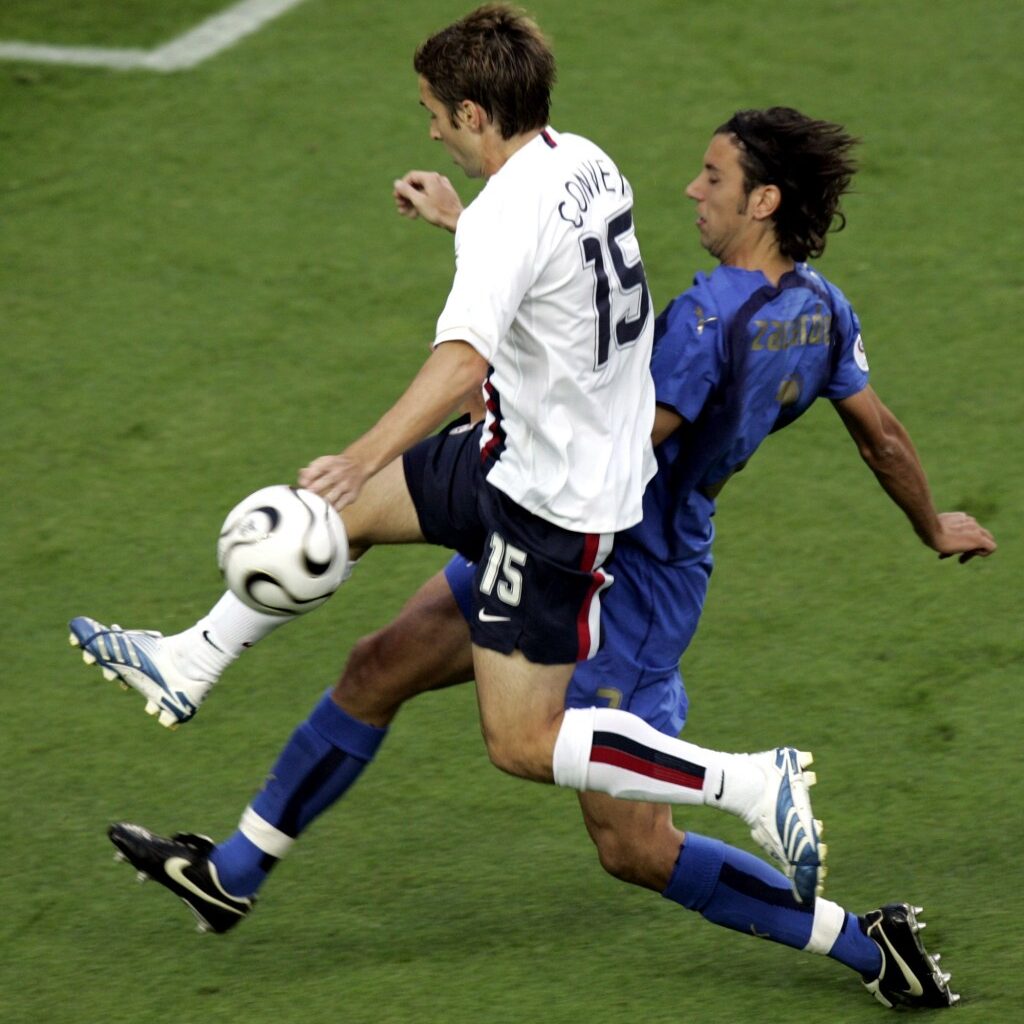
He was joined on the team in Germany by a pair of Inter-Ac products. Bobby Convey grew up in Philadelphia and played at Penn Charter before relocating to IMG Soccer Academy. A longtime MLS veteran, he was in the midst of a five-year stint with English club Reading when he was selected to the World Cup roster, the pacey left winger earning 46 caps starting in 2000, then the third-youngest player to debut, through 2008.
Chris Albright followed aspects of both pathways, a Penn Charter grad who spent two years at Virginia before joining MLS’s Project-40. The right back earned 22 caps from 1999-2007.
Convey started on the left wing against the Czech Republic and Italy in the 2006 tournament, then subbed on against Ghana. Olsen, who tallied 37 caps from 1998-2007, replaced captain Claudio Reyna in the 40th minute against Ghana, the U.S. going winless and bowing out in the group stage.
It would take until Qatar in 2022 for that kind of impact to be felt again.
In his role as era-bridger, Bahr was present at the inauguration of the Philadelphia Union’s existence in 2010. That club’s youth development began in earnest around 2015, when three-time American World Cup participant Earnie Stewart took over as sporting director.
Aaronson was the beachhead for that group, getting on the squad in 2022, his first season with Leeds United in the Premier League. Aaronson had 24 caps and six goals at the start of the tournament. He appeared as a sub in all three group games, then again in the Round of 16 loss to the Netherlands.