
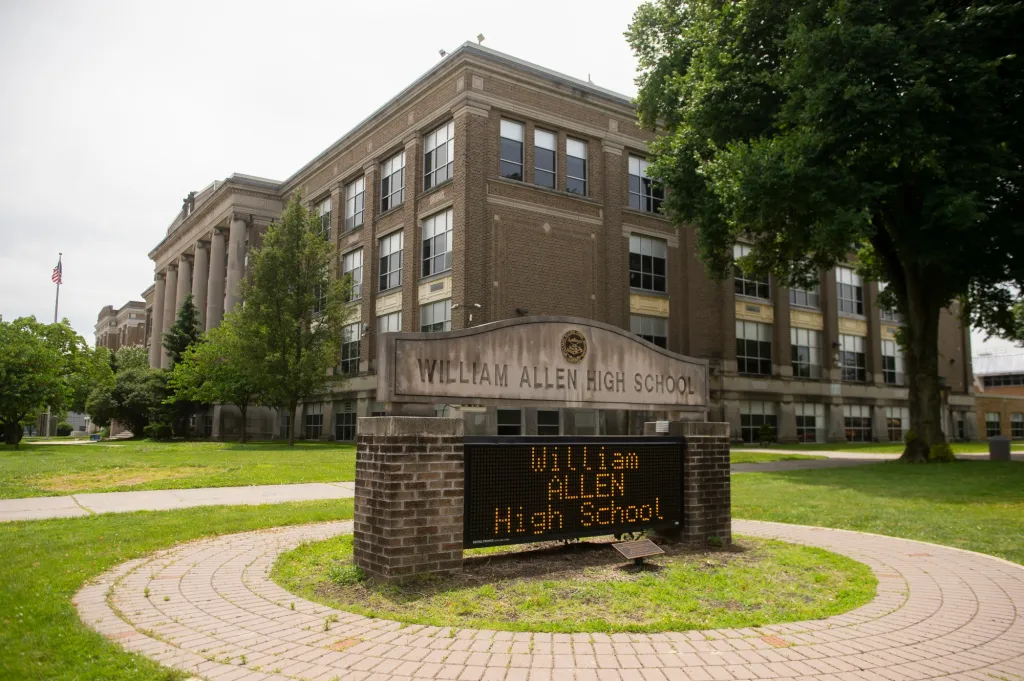
In the last budget cycle, 14 of the 17 Lehigh Valley school districts approved tax increases, and preliminary budgets for the upcoming school year, which must be finalized this month and begin in July, show those numbers could be even higher as district confront rising costs, aging infrastructure and other financial needs.
Here’s a look at where some of the largest Lehigh Valley districts stand as preliminary budgets are in their public review period before final school board approvals:
Aging infrastructure leads Allentown to consider tax increase
Allentown’s $514.7 million budget will likely include a 2.9% increase in property taxes. Interim Chief Financial Officer Jeffrey Cuff and Chief Operations Officer Robert Whartenby have repeatedly warned school board directors that they feel a tax increase is needed to fund construction and infrastructure upgrades.
Allentown School District officials call for tax increase to fund infrastructure upgrades
The district did not raise taxes in the 2025-26 school year.
Cuff’s May 28 budget presentation included instructions for how eligible seniors and disabled residents could claim a tax rebate. The $71 rebate is designed to cover the average increase that would result from the proposed tax increase.
The rebate program is narrow, however. Only seniors (65 years of age or older), widows or widowers (50 years of age or older), or permanently disabled adults (18 years of age or older) would qualify, if their income is under $46,520.
Rebate applicants must also have owned and occupied a residence in the district for the entire claim period. Required paperwork includes proof of payment for 2026-27 property taxes, which must be paid by Dec. 31 to qualify for the rebate, and either a copy of a 2025-26 state rebate check or a bank deposit statement.
At the May 28 meeting, board members Dianne Michels and Denzel Morris supported a motion to pass a preliminary budget that would have eliminated the tax increase. Michels backed off after district solicitor Jeffrey Sultanik emphasized the need to pass a preliminary budget that night (to allow for enough time for the legally mandated public review that comes before final budget approval in June) and asked Cuff to inform the board how much work it would take to redo the budget presentations to include a potential zero percent increase in property taxes.
The preliminary budget with the 2.9% tax increase passed by a vote of 9-0, although Morris later told The Morning Call his vote to approve it was a mistake, and he plans to vote against the final budget approval.
Bethlehem Area facing budget gap
Bethlehem Area School District spent this budget cycle trying to close a projected deficit. Its preliminary $390.5 million budget is up for discussion Monday and shows a projected $6 million gap between expenses and revenue, leaving the board with a final decision to make about how to best close that gap, as school districts are legally required to pass balanced budgets.
A proposal discussed May 11 would transfer $6 million from the district’s fund balance to close the gap.
The preliminary budget, which includes a 4% tax increase, passed 5-2 out of a May 11 special board meeting, with school board Directors Michael Faccinetto, Shannon Patrick, Karen Beck Pooley, Michael Recchiuti and Kim Shively voting in support and Winston Alozie and Silagh White voting no.
Chief Financial Officer Harry Aristakesian, who led last year’s charge to withhold charter school tuition payments as the district waited months for state lawmakers to pass a budget that would release state funds for schools, has continued to warn that rising charter school tuition payments are a primary factor in the district’s increasing costs.
Salaries and benefits make up more than 60% of the district’s budget, and those costs are rising, Aristakesian said. District communications said enough attrition occurred this school year to avoid the need for layoffs.
Aristakesian has also repeatedly emphasized that the district is losing enrollment to charter schools, which means its legally mandated charter school tuition payments are increasing.
There was movement in the state Legislature last budget cycle to reduce payments owed to cybercharters, but school district finance officers across the Lehigh Valley have continued to warn that traditional district schools continue to face rising costs from the payments they must submit when a student who is a resident of their district chooses to enroll in a charter school.
During Aristakesian’s March 30 budget presentation, he said salaries have increased $5.5 million (3.9%), medical and prescription benefit costs have increased $5.2 million (15%) and charter school tuition payments have increased $4.9 million (7.5%).
The district has more than 12,500 students spread across five municipalities, and its charter school enrollment has steadily increased from just over 2,000 students to nearly 2,500 students, Aristakesian told the board, arguing that there is a need for the district to retain more of its resident families in its own schools.
Parkland considers cuts to late bus, conferences
Parkland’s preliminary budget of nearly $261.7 million was approved May 12 and requires a $9.83 million transfer from the district’s fund balance. The proposal also includes a 3.5% increase in the district’s property tax rate, which district officials calculated would amount to an average increase of $145.43 for residential taxpayers.
The district was confronting a deficit, and its proposed budget cuts $105,000 in “supplemental educational technology apps,” eliminates the late activity bus and reduces the money available for out-of-district conferences.
To avoid layoffs or furloughs, the district is looking to evaluate all positions where a staff member is retiring to see which of those positions will potentially not be filled.
Parkland broke ground this spring on a $68 million renovation of its high school.
Parkland High School breaks ground on $68 million expansion
The district also created a five-year plan designed to reduce a structural deficit caused by annual debt service payments on its construction borrowing, plus rising costs for salaries, benefits, special education and transportation.
“To maintain stability in the District, the Board and Administration have developed a comprehensive 5-year, $20 million reduction plan to engineer a path to long-term financial stability,” a district news release states.
School board directors have been vocal in pushing for additional state-level reforms to address rising expenses for school districts.
The district faces a $40.1 million gap between its mandated special education expenditures and provided state and federal funding, the district’s news release states, adding, “The District strongly supports legislation like HB 2307, which would increase the state’s reimbursement share for the extraordinary expenses of high-need students.”
Like Bethlehem Area, Parkland officials have also been vocal in discussing the rising costs of charter school tuition payments.
“To combat rising outside charter costs, the District supports the Governor’s cyber charter tuition reform proposal, which aims to generate $250 million in statewide savings for school districts. Parkland also advocates for a moratorium on new cyber charters (SB 27), stricter oversight and residency verification (SB 927 & SB 934), and charter enrollment caps (HB 2293).”
None of the bills referenced in the district’s news release have yet passed, with some seeing their last action in 2025 and others seeing action this spring.
Easton Area director raises concerns about administrator salaries
Easton Area’s nearly $223.3 million preliminary budget was prepared by outgoing Chief Financial Officer Jack Trent, who is moving to Allentown School District at the end of the summer.
It includes a 3.5% increase in the district’s property tax rate. Budget documents note that 1.5% of that total tax increase has been designed for the $300 million capital project program.
Plans for a new $298 million high school have been a central factor in the district’s recent budget discussions. School board meetings have seen tense discussions about taxes.
The preliminary budget passed 6-3 last week, and school board director Brian Snyder said he was among the no votes in part due to concerns about how proposed tax increases have been discussed.
“One of the roles of a school board director is to represent the taxpayer, not function as a rubber stamp to everything and anything the district’s administration asks for. While the taxpayer often supports good schools and understands that education costs money, Easton’s board of directors (past and present) and administrators (past and present) have been quite cavalier over the years when it comes to taxpayers’ money,” Snyder said in an email.
“It’s as if some board directors and administrators feel that every taxpayer nickel is spent wisely and efficiently and there can’t possibly be any bloat, waste, or unnecessities. I find that difficult to believe within a $223M budget,” Snyder said, noting the number of district administrators that make six-figure salaries. Those salaries are in line with what other Lehigh Valley districts pay their administrators.
East Penn says ‘structural pressure remains’
East Penn will vote on its final budget Monday. The April presentation proposed a 4.1% tax increase, but also included an option to reduce that rate increase to 3.9%.
“The budget is balanced, but structural pressure remains,” the presentation notes, highlighting that expenses are growing faster than revenues. The total proposed budget is nearly $213.6 million.
The April proposal also includes a $1.5 million reduction in the district’s capital reserve contribution, and notes that reduction was made as the district worked to close its deficit. The presentation leaves open the exact amount of capital reserve transfer needed as it lays out the district’s options.
The proposal also identifies cuts to positions: two support staff facilities positions and two professional staff contract positions, as well as cuts to department budgets.