
WILKES-BARRE, Pa. — In the aftermath of a gut-wrenching 2-1 overtime loss to the Toronto Marlies that ended their season in the Eastern Conference Final Sunday, the Wilkes-Barre Scranton Penguins will say a disappointing, if not sad, goodbye Monday afternoon.
Breakup days are sometimes a cleansing of a bad season. You’ll see players who wore frowns like permanent ink begin to smile. Guys who wanted more are turning their attention to next season, and most of the guys dress like it’s the last day of school. You know, bust out the good watch, the stylin’ civies, maybe the fresh kicks, and breathe easy.
However, that probably won’t be the case in Wilkes-Barre. The loss visibly hit hard for a team of players who badly want to prove they are worthy of the next level, but also genuinely wanted to win for their friends.
Meeting with a couple of local reporters and PHN before the start of the interviews Monday, coach Kirk MacDonald admitted he didn’t get much, if any, sleep last night.
“I closed my eyes, at least,” said MacDonald with some gallows humor.
In addition to the WBS Penguins playoff run exposing the players to next-level pressure and forcing them to elevate their games, it also showed Penguins general manager Kyle Dubas a few things, too.
First, the Penguins have gone from a dreadful prospect pool to a solid minor league system with at least one top-six potential prospect and at least one future top-four defenseman.
Harrison Brunicke was impressive after he arrived from Kamloops in April. The depth of his game was unwavering. Unfortunately, he got his bell rung in the first period Sunday (essentially tossed into the boards after playing a puck forward) and was a bit disheveled for the rest of the game, but his future looks much brighter than we anticipated just a couple of months ago.
Suddenly, Brunicke is looking like a stud prospect, not just a potential second-pairing guy who can chip in on the power play.
**The other potential top of the lineup player is Bill Zonnon.
After a bolt of adrenaline when he first arrived, Zonnon settled. He slowed from his unsustainable pace of scoring a goal per game, and MacDonald generally kept him in a down-lineup role, but the physical tools are obvious. He just stands out. His jersey flaps in the wind generated when he skates.
Zonnon, 19, will need to learn to find open ice–he seemed to always have the puck in contested space–and fill into soft spots often enough to really let his skills shine where he could pressure the defense (instead of being pressured). But that’s not an uncommon issue.
As Dubas said on his team-hosted GM radio show earlier this season, even if Zonnon doesn’t develop, he already has the skills to be a productive fourth-line player in the NHL. That’s a nice place to start.
**Wilkes-Barre ranks 18th of the 32 AHL markets in terms of population. The arena is a little smaller, and it’s getting old, but there are no issues with it. Despite their limitations, the WBS Penguins crew does a great job with in-game presentation, too.
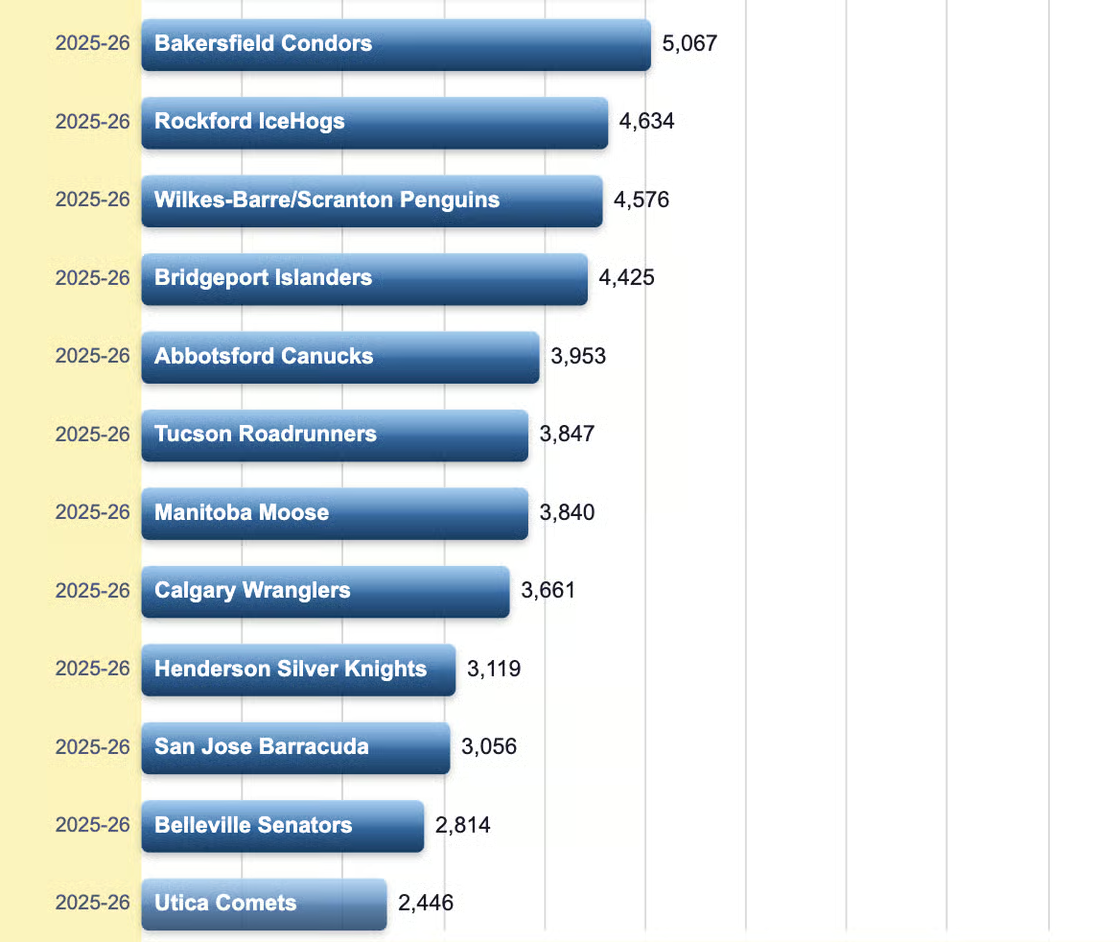
Maybe it’s changing society. Maybe changing demographics in the metro market. WBS struggled with attendance in the playoffs. They usually ended up with nice crowds, but there were a lot of late ticket sales, and some games with attendance under 4000.
No, the Penguins don’t need to dump Wilkes-Barre, but attendance is a problem that bears addressing at an organizational level before it worsens. The team finished 23rd in the league with a 4576 average attendance, just ahead of Bridgeport, which the New York Islanders dumped. Here’s the attendance graph from HockeyDB, from the bottom up.
Municipal enthusiasm was a bit dreary for a team that could have been a civic darling. If some efforts to create more enthusiasm fail, there are other east coast towns that could handle it.
Cmon, why aren’t Rutger McGroarty and Sergei Murashov doing some car commercials? I think I’d pay the talent fee for that bit of immortal goodness.
**One market to circle for the future would be Youngstown. It’s an easy drive from Pittsburgh, and has a metro market population only 20% smaller than Wilkes-Barre. There would be USHL concerns and complications, but those are issues for another day, long in the future. After all, Wilkes-Barre is guaranteed a team for the rest of the decade.
Actually, a few players have mentioned the lack of entertainment options in Wilkes-Barre, but that’s also how they became so close–they had to entertain themselves. So, it’s a double-edged sword, kind of like the Steelers’ training camp in Latrobe.
And the last note about the WBS Penguins. I feel compelled to defend some good people. In an effort to hype himself, an obscure writer who hasn’t been in the game long enough to have much of a resume took a few potshots at both the WBS organization and the crew covering WBS. I heard it got some traction, so I will tell you that Nick Hart and the WBS Penguins organization could not be better. Tony Androckitis of InsidAHLHockey.com and Sam Wismer cover Wilkes as faithfully as anyone covers any AHL team. I hope to use Sam a lot more next season.
**Owen Pickering played for a couple of weeks on a broken foot. He had to miss a few games, but MacDonald noted how the challenges showed Pickering’s maturity.
“He’s going in the right direction. I think he’s going to get (to the NHL). What he went through to get himself in the lineup to play in this series was impressive, and it speaks to his commitment level and how he cares,” MacDonald said. “I think that was a great sign of maturity on his part, just the way he handled it. He wasn’t ‘woe is me.’ He just stuck to the process of what he needed to do to get better throughout this. And if you watched his game throughout this series, when he was in the lineup, he played really well.
“He kind of figured out how to manage his game in situations where he couldn’t pivot in certain areas, he didn’t have the right steps, so he had to adjust what he normally would do, and he got into people and defended hard.”
Pickering was still in a walking boot for his exit interviews Monday, though he shaved his untamed playoff beard.
**For all the trade talk, and the exposition and analysis, is anyone else ready to skip ahead to the end of the offseason and to the final results? Let’s go, eh?
One thing that has been impressive about Dubas’s tenure is his creativity. Even the Erik Karlsson trade, which looked like a bad idea for two years, was quite affordable for a Norris Trophy winning D-man.
Yet for all of the Penguins trade talk, there is a path that requires very few of them. Instead of being creative, the Penguins and Dubas could also choose to take a few lumps in the immediate. Instead of the road less traveled, take the well-worn path of rebuilding.
Maybe win, maybe lose, but instead of doing so with big-name trade acquisitions, do so with homegrown talent.
It would be a short leap to include all of McGroarty, Pickering, Brunicke, Ville Koivunen, Tristan Broz, and Murashov on the 2026-27 NHL roster. Others, such as Avery Hayes and Bill Zonnon, could be included in roster battles, while also continuing to pursue young players struggling or out-of-favor.
Of course, such a path would be diametrically opposed to Dubas’s stated intention to pursue a later 20s “difference maker” in order to take a sustainable step forward next season.
Presumably, Dubas has additional plans in place to further support the later 20s acquisitions, if indeed one or more is possible … but the path well traveled is done so for a reason. If things don’t work out with the master Dubas plan, the summer of ’26 could be a fulcrum for a lot of second-guessing, in much the same way as keeping the core together in the summer of 2018.
Tags: kyle dubas Penguins Prospects Penguins Trade Pittsburgh Penguins
Categorized:Penguins Offseason Analysis