
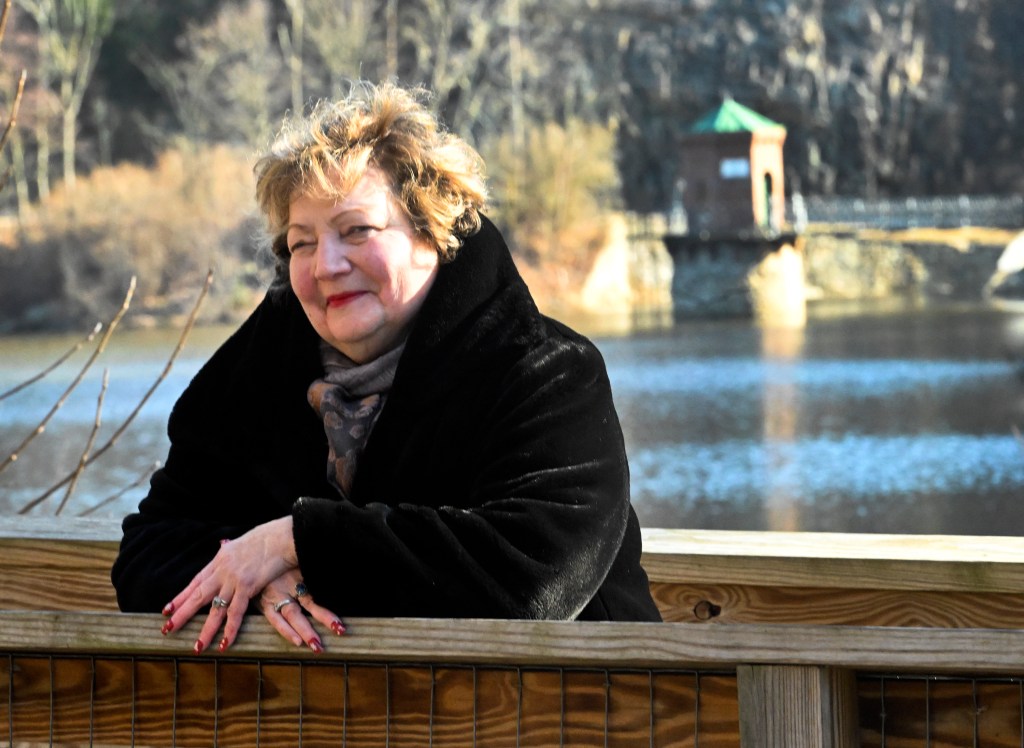
Marcia Goodman-Hinnershitz’s long tenure on Reading’s City Council has ended, but the former councilwoman says her commitment to public service has not.
As a five-term, 20-year representative of District 2, Goodman-Hinnershitz championed the city’s parks, landmarks and green spaces, many of which are in that district.
She has been an outspoken supporter of conserving the city’s natural and other resources and serves on the Foundation for the Reading Pagoda.
Now that she is free of council duties, Goodman-Hinnershitz expects to become even more involved.
“The Pagoda foundation is moving into the phase of major fundraising campaign,” she said, “and I will have a lot more time to focus on how to do that correctly.”
 The stairs and walls at the Pagoda are slated for repair during upcoming renovations to the site. (BILL UHRICH – READING EAGLE)
Her goal is to raise the approximately $10 million needed to have the Pagoda and its grounds restored and open for safe use by the public.
She plans to use the grant-writing and fundraising expertise she continues to hone as director of planning and resource development for the Council on Chemical Abuse, where she has worked since 1987.
Early years
Goodman-Hinnershitz did not envision a future as an elected official in 1983 when she earned a Master of Social Work degree from Temple University, Philadelphia.
“Somehow or another,” she said, “my work in social work brought me to the importance of a social worker as a public servant.”
She first ran for the Reading School Board out of a concern for local education and served one term. After failing in a bid for re-election, she set her sights on City Council and won the District 2 seat.
By then, she had gained some knowledge of city governance through her service on the city Charter Commission.
“Getting involved at that level was really a learning experience for me,” she said.
Her advice to those wishing to become more involved in local government is to seek appointment to one of the city’s many boards, commissions or authorities.
‘Lesson learned’
Asked about her proudest accomplishment in office, Goodman-Hinnershitz said it was successfully preserving Antietam Lake and the surrounding parkland from development.
Controversy over the future ownership and use of the 560-acre Antietam Lake property arose in 1998, during the term of Mayor Paul J. Angstadt and before the start of Goodman-Hinnershitz’s first term in 2003.
The lake property had been identified as one of 14 prospective city properties that might be sold to raise revenue.
An offer to sell the acreage surrounding the lake for private development placed the lake and surrounding woodland preserve in peril.
The dispute continued for nearly a decade as successive Mayors Joseph D. Eppiheimer and Thomas M. McMahon and members of council disagreed with one another and negotiated with private developers and Berks County officials over the sale of the lake property.
In 2008, after years of controversy, council approved the sale to the county.
Goodman-Hinnershitz and now-Council President Donna Reed, both on council at the time, were among those who voted in favor of that sale.
“The lesson learned,” Goodman-Hinnershitz said, “is to be careful when people come to you with red herrings that sound like good decisions.”
Council members should expect inevitable political motives and controversies to arise, she noted, and prepare by investigating the facts and seeking trustworthy counsel.
Her advice for the freshman council members: “Ask questions and listen before you talk and learn who you can trust.”
Though councilors are individually elected to represent each of the city’s six districts, Goodman-Hinnershitz said, their decisions most often impact the city at large. And there can be a lot resting on the council member’s ability to make informed and good decisions.
Open communication with the constituency is essential for keeping the public informed and inviting input, she said. Social media discussions, podcasts, virtual and in-person community conversations are examples of how council representatives might engage district residents.
Helping officials
Those who chose to run for council are typically highly committed to the city even before being elected, she noted. But there are no training requirements outside a brief overview of the city’s charter and code of ethics.
“I actually think there should be a City Council Academy,” Goodman-Hinnershitz said. “I think there should be something that helps you through each of the sections you’re going to need to make decisions on.”
The city’s operations are very complex, especially the financial aspects, she said, and it can be difficult to grasp everything in depth.
“Council members should be able to say, ‘If I don’t know this, maybe I need to sit with my fellow council members and have a little tutorial,’” she said.
The senior members of council were there for her when she first took office in 2003, Goodman-Hinnershitz said. Now, it is her turn to share what she learned over 20 years on council with the newly inaugurated.
Despite her ongoing passion for public service, she has no plans to run again.
“I would rather be a mentor,” she said, “and help other people grow into the position.”