
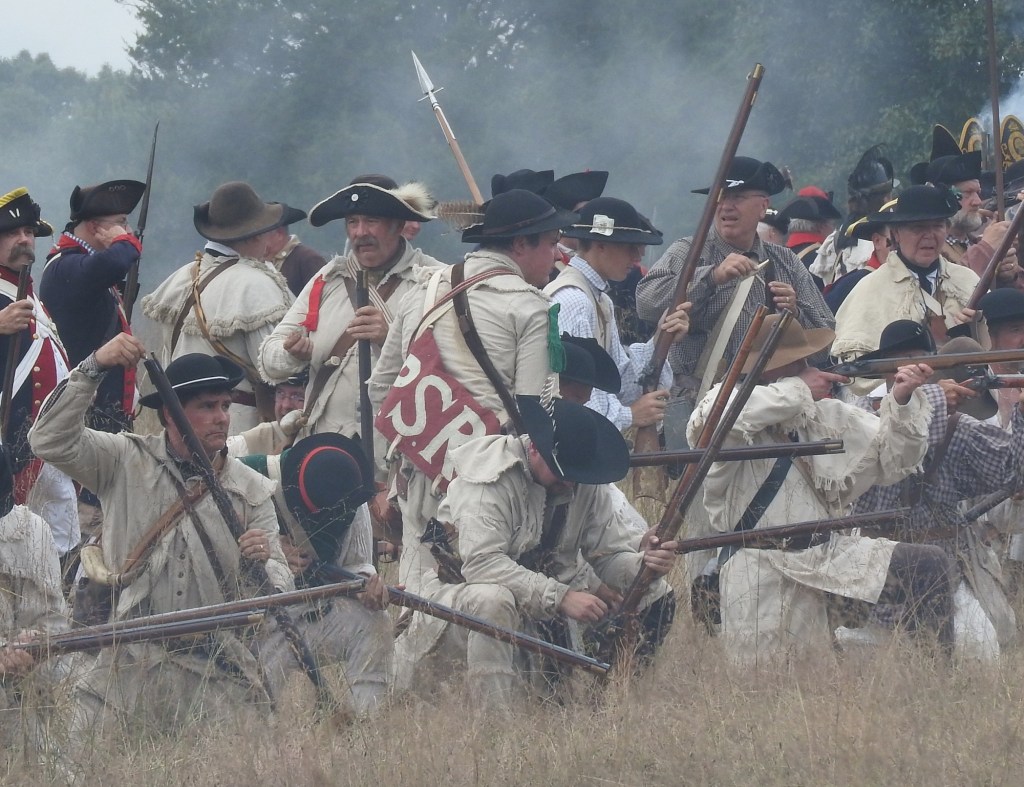
Editor’s note: Pennsylvania and New Jersey have played a key role in the nation’s 250-year history. While most are familiar with the events that happened in Philadelphia, our region also played a pivotal role in the development of the fledgling nation. In honor of the country’s 250th anniversary celebration, we will feature some of the places, people and events in the region that helped shape America’s history.
Col. George Nagle was someone who got things done.
That’s how his descendant, Bill Nagle, describes the man who led Berks County’s first American soldiers into the Revolutionary War.
In an interview with the Reading Eagle, Nagle of Laureldale recounted how his ancestor helped shape Berks County and America during the revolution.
Even as a child, George Nagle’s ability to execute was evident — at age 15, Nagle’s father, Joaquim, sent him from his homeland of Germany to scout the colonies.
“Through his report, they decided to pull up stakes and move here,” Nagle said. “That was in 1746.”
 USA 250 Anniversary Logo
Nagle’s family settled in Douglass Township, where his father and brother ran a grist mill. He later moved to Reading, where he became one of the area’s earliest sheriffs.
In that role, Nagle’s large stature — built via his trade as a blacksmith — and decisive nature suited him well.
“The Nagle family really were critical in settling and growing Berks County,” Nagle said. “From its frontier origin to being recognized as (an agricultural hub).”
When the call to join the revolution went out, the men of Berks were sought for their experience as seasoned frontiersmen.
Nagle said George Washington’s history fighting alongside his ancestor and others from Berks and Pennsylvania in the French and Indian War contributed to him adopting the guerilla strategies of frontier warfare.
“The Berks County rifleman wore frock shirts and fringe leggings,” Nagle said. “They carried tomahawks and learned from the Indians, really the way of life, to an extent.”
A powerful weapon
What most distinguished the soldiers from Berks and Pennsylvania was their weapon of choice.
That weapon, the Pennsylvania long rifle, played a decisive role in the regions included in Congress’ call to form an army, said Gregory Kreitz, a former Reading Eagle reporter and local history buff.
Kreitz reenacts battles involving Thompson’s Rifle Battalion — Pennsylvania’s first official unit in the Continental Army.
Thompson’s Rifles drew recruits from counties including Bedford, Cumberland, York, Northumberland, Northampton, Lancaster and Berks. Nagle led the Berks company.
“It (Thompson’s Battalion) changed the war,” Kreitz said. “It changed warfare of the Revolution.”
After Lexington and Concord and finding themselves at war, Kreitz said it’s likely that America’s founders were wishing for some kind of silver bullet.
That silver bullet was a lead ball, shot from a Pennsylvania long rifle with deadly accuracy up to 300 yards.
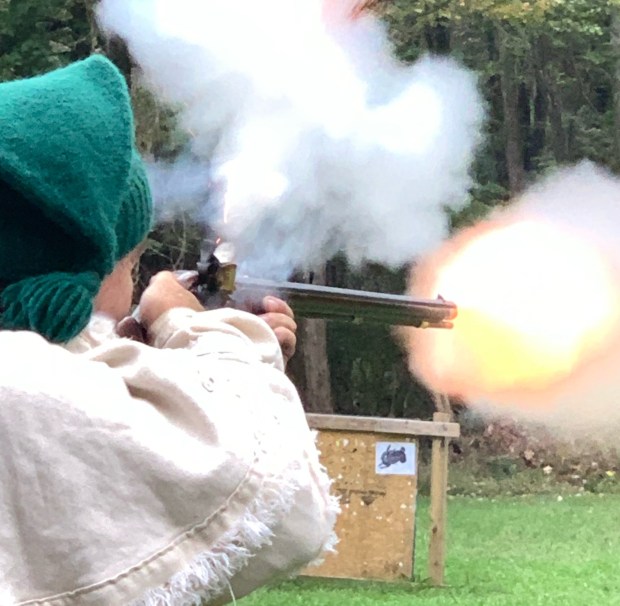 The Pennsylvania long rifle, pictured here, gave riflemen a critical edge over British forces during the American Revolution. (Courtesy of Gregory Kreitz)
“Until the riflemen arrived, everyone was living in a 50-yard world,” Kreitz said. “Muskets, the only weapon of the British, were fired in line but were only effective to kill around 50 yards forward.”
The rifle was first made in the early to mid-1700s by German immigrant gunsmiths in Lancaster and along the Wyomissing Creek in Berks.
Its greater range came from patched balls and spiral grooves inside a lengthy barrel, which spun the balls as they shot.
Kreitz said the rifle was built for one purpose — to expand the frontier.
“By the 1760s the frontier had settled near Chambersburg in the Conococheague Valley, a stone’s throw from Carlisle — the home of Col. William Thompson, who would command Thompson’s Rifle Battalion,” Kreitz said. “The long rifle enabled settlers to shoot game, feed their families and offered protection in Indian attacks. Having control of your target consistently at around 200 yards was a powerful advantage.”
Founding Fathers needed an edge
Before Congress’ official call to arms, Kreitz said John Adams, John Hancock and founding father Dr. Joseph Warren discussed frontiersmen in Pennsylvania that can hit targets accurately at great distances.
They needed an edge to augment the revolutionary force fighting the British garrison at the Siege of Boston.
At the time, that force was comprised mostly of militiamen from the New England colonies.
The congressional war resolution on June 14, 1775, was the first time an army was officially drafted — and it was solely riflemen, Kreitz noted.
The resolution called for riflemen from Pennsylvania, Maryland and Virginia, all areas along Great Wagon Road — running from Philadelphia to the Shenandoah Valley — where long rifle gunsmiths had settled and sold their wares.
“Continental Congress knew what kind of complement came out of the Berks County area,” Nagle said.
Under George Nagle, the Berks complement was the first among Pennsylvanians to reach the revolutionary headquarters in Boston.
“(Washington) sent messengers down and said, ‘Listen, I need the Berks County riflemen up here,’” Nagle said. “He (Nagle) and 95 of his buddies headed up to Cambridge (Massachusetts). They started sniping the Redcoats, shooting from behind a tree. The accuracy of the long rifle was something that they really hadn’t experienced.”
Kreitz said that before the long rifle, it was common for the British and colonists to talk across the lines at night.
“One night the riflemen showed up for the conversation,” Kreitz said. “They shot them dead…and changed the nightly routine forever.”
At the siege in Boston, Kreitz said Washington baited British spies into watching the riflemen’s shooting demonstrations on the Boston Common.
“The distances at which they hit targets was enthusiastically received by the Americans and fearfully noted by the spies,” Kreitz said. “Washington knew the enormous impact these soldiers were having.”
During the Siege of Boston, a detachment of Thompson’s Rifles, including Thompson himself, was sent to Quebec to participate in the failed capture of Quebec City.
In 1776, Thompson’s riflemen became the 1st Pa. Regiment of the Continental Line and remained that through the battle of Yorktown, where they fought, Kreitz noted.
After major victories at Trenton, Assunkpink Creek, and Princeton, Washington moved all his riflemen into one corps, commanded by Col. Daniel Morgan, who was originally in charge of the Virginia riflemen.
“That rifle corps was crucial in winning the Battle of Saratoga, the turning pointing of the Revolutionary War,” Kreitz said.
Thompson’s Rifles reputation
Nagle noted some members of Thompson’s Rifles earned Washington’s ire for being undisciplined, and in some cases, mutinous.
But Nagle’s Berks company was not among Washington’s disfavored and helped quell a mutiny among the ranks at Boston, Nagle said.
“There’s an idea that the riflemen were too unruly and Washington sent them to Quebec to keep them out of trouble,” Nagle said. “Part of that story is true, but it wasn’t the Berks County riflemen.”
He said Washington praised the Berks riflemen’s skill, citing letters kept by the Nagle family that document him urging Congress to extend their conscription.
George Nagle’s other family members, including his brothers, Peter and Frederick, and his son, Jacob served in the Continental force as well. Jacob was a privateer and Peter and Frederick achieved the ranks of captain and corporal, respectively.
After the war, Nagle and his family returned to Berks and carried on their mercantile businesses.
Why they fought
As to why his ancestors felt compelled to join the revolution, Nagle said there were several reasons.
“I think some of it came from the courage of their father’s military background,” Nagle said. “The other part of it was, the taxation without representation hitting Berks Countians, specifically Germans, who were really looked down upon by some of the Welsh and English settlers as being the stupid immigrants who couldn’t speak English.”
He noted that the Continental Congress under British rule only granted Berks County a single representative, while Bucks County representatives numbered in the teens, despite covering a similar area and population.
He said England was also heavily taxing foundries and forges, which were major industries in Berks at the time.
“They (the British) wanted iron out of the foundries to be shipped back to England,” Nagle said. “They wanted that middleman income. So they were really taxing us to eliminate the forges.”
As a blacksmith, his ancestor would have been acutely subject to the unfair treatment, Nagel said.
Nagle suggested the British never breaching Berks was likely due to Washington placing a high strategic value on the area’s resources.
“His breadbasket was here,” Nagle said. “The wagons were built here. The horses were coming from here. All the hay, food, provisions. We supplied a lot of the Northern army’s provisions out of Berks.”
The core motivator was Washington’s call for help, Nagle said.
“George Washington was the real key,” Nagle said. “I think that started in the French and Indian War, when they crossed paths and George saw what a long rifle can do. Whenever he needed them, they (the Nagles) were there 100%.”
Nagle, a retired patternmaker, said he takes pride in his ancestry.
“I was an orphan, I lost my dad when I was 7,” Nagle said. “Now I have a hell of a family.”
George and other Nagle family members have their graves at Charles Evans Cemetery in Reading.
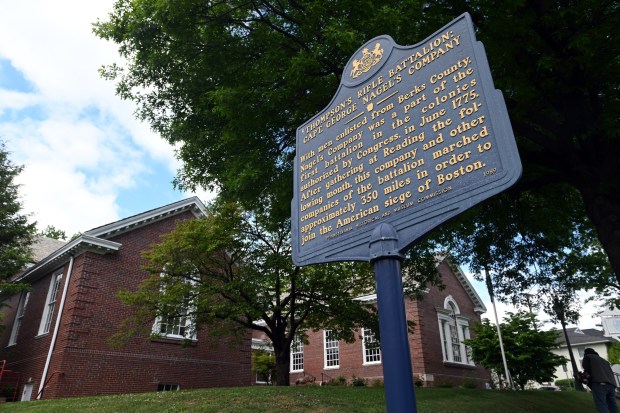 A Pennsylvania historical marker highlighting the Thompson’s Rifle Battalion during the Revolutionary War is displayed outside the Berks History Center, 940 Centre Ave. (BILL UHRICH/READING EAGLE)