
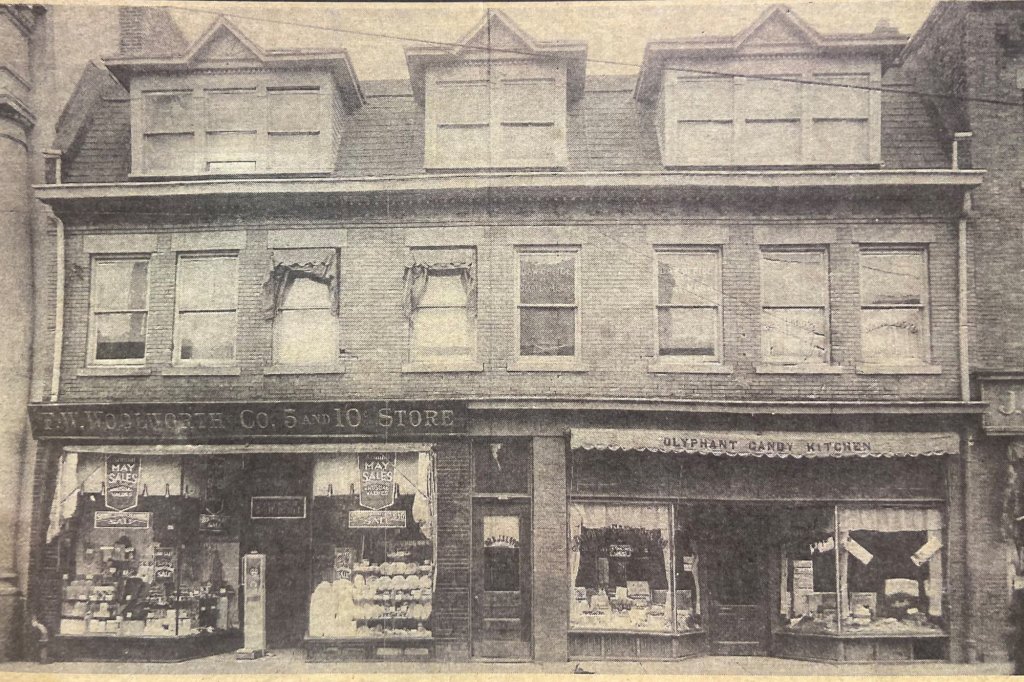
From a modest start to a booming enterprise, Woolworth’s transformed the retail sales landscape in Northeast Pennsylvania and far beyond. Charles Sumner Woolworth opened Woolworth’s Great 5-Cent Store and added 10-cent products soon after, making it one of the first five-and-dimes.
Opened on Nov. 6, 1880, his original “five-and-dime” store at 125 Penn Ave. was among the first in the city to use electric light and display windows to showcase goods.
The national ripple
Over 65 years, the chain that began with two stores in Pennsylvania grew to over 3,000 stores worldwide. C.S. Woolworth served on the boards of banks and businesses and contributed to causes like the Women’s Domestic Institute, now home to Scranton Prep.
After Frank Winfield Woolworth died in 1919, C.S. served as chairman for 25 years, stepping down at 87. He died in 1947, at 90.
The Woolworth Building’s heyday in downtown Wilkes-Barre ended years before the five-and-dime store closed its doors in 1994.
In Scranton, after a few years on Penn Avenue, Woolworth’s moved to around the corner on the 300 block of Lackawanna Avenue. It wasn’t until the late 1940s, that the store moved to the 400 block of Lackawanna.
Even with the brothers gone, Woolworth’s continued to expand the boundaries of retailing. In 1962, the company opened a large suburban store format it called Woolco, credited as the first “big-box” store. Walmart, Kmart and Target, followed Woolworth’s lead.
Although it had become global, peaking in 1979, the chain contracted through the 1980s and 1990s. The company changed its name to the Venator Group in 1997, and later to Foot Locker.
Living legacy
Woolworth’s pioneered innovations people take for granted today: using front windows to display merchandise and “self-service” stores where people browsed and could handle products.
The same year Woolworth’s opened on Penn Avenue, the electric light was introduced in Scranton, first at the Dickson Locomotive Works, then other factories and eventually through an electric utility. Woolworth quickly realized how abundant artificial light would be used in stores, and in future years made brightly lit Woolworth’s stores a company-wide standard.
Charles Woolworth presented Geisinger Memorial Hospital in Danville with a gift of $100,000. He also donated $50,000 each to Johnson School in Scranton and Keystone College in La Plume Twp.
Sidelight
On July 17, 1997, Woolworth closed its remaining stores in the U.S. However, The Innovation Center at Wilkes-Barre opened in 2004 at the former Woolworth’s location in the city, keeping innovation flowing in that space.
About the series
No. 21: As the nation approaches America250, we are counting down ways NEPA has powered American history.