
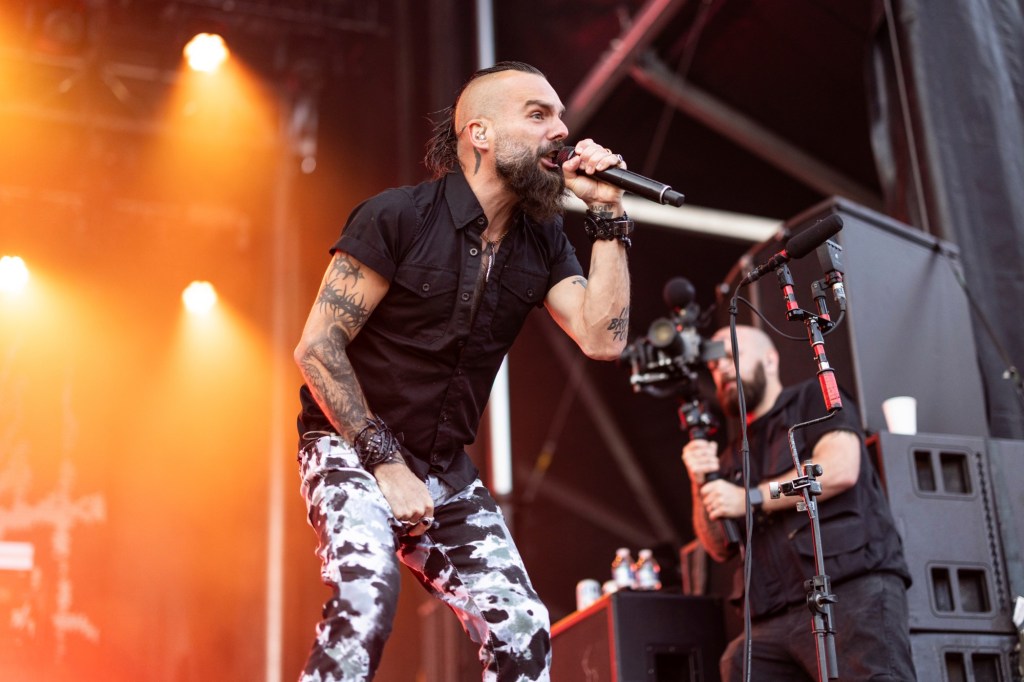
After their 2019 release “Atonement” earned a spot on Loudwire’s “50 Best Metal Albums of the Year” and secured Killswitch Engage its third Grammy nomination, the band took a step back to figure out what comes next.
Most bands would have rushed to release their next album, but Killswitch Engage, which takes the stage Saturday at Wind Creek Event Center, did the opposite.
Instead, they took six years off. During that time, frontman Jesse Leach moved to the Catskills, spent time in the woods, and reexamined his words so as not to rely on fire and brimstone, a vocabulary that stayed with him through much of their earlier work.
Now Killswitch Engage has returned with “This Consequence,” whose “I Believe” single marks the first-ever Top 10 hit on the Mainstream Rock chart in the band’s 25-year history.
We caught up with Leach recently to talk about pandemic isolation, vocal recovery and the audiences that keep the band going.
Q: You spent the pandemic years in the woods finding some kind of peace. Then you sat down to write and the anger was still there. How did you deal with that transition?
A: I had to really hone in on society. I watched the news, saw the divisiveness, and revisited my feelings from the pandemic — watching the world just kind of shut down and fall apart. Initially, I went back to those feelings of frustration and fear. It reawakened that younger, angrier part of me that knew something wasn’t right with how we were treating each other.
Looking at the divisiveness and the misinformation fed to people is what tapped me back into that primal rage. From there, the inevitable positive thinking that I just can’t help started to come up in songs like “Aftermath.” I found my groove after a couple of really pissed-off songs.
Q: “Forever Aligned” is the most personal song you’ve ever put on record. How do you sing something so private every night in front of thousands of people?
A: Because it rings true for a lot of people. Obviously, it’s written about my wife, but I do my best to write so you can apply it to your own life. I don’t like to use specifics. I believe there’s a higher power, and through that lens, I’m equally talking about that relationship. It’s a constant balance.
If she’s in the audience, it’s all about her. But if I’m out on tour, I’m looking at the audience and projecting it out to them. It’s you guys that are keeping me going. The song essentially has three meanings. As these songs sit with you, the meanings tend to expand.
Q: Your father was a minister who moved the family constantly. How much of that religious upbringing still shapes who you are today, and how much doesn’t?
A: It’s a constant muse. I sit comfortably with the good stuff that was taught to me about love, taking care of the poor and being mindful of your neighbor. Those concepts continue to remind me of my purpose. On the flip side, organized religion can be very ugly behind the facade. I’ve seen the abuse of power, the manipulation, and preachers standing in the pulpit claiming God is love while condemning a Muslim or a gay person. That stays interwoven into my DNA as a form of protest — wanting to correct the wrongs that have been instilled. I was raised in a very evangelical home, but we’ve all changed quite a bit. I stopped calling myself a Christian. I believe I am a spiritual being. I’ve humbled myself because I think there’s a bit of arrogance in telling somebody you know the absolute truth. The more I’ve traveled, the more my worldview has changed. It’s an acceptance that I don’t have the answers, but I’m going to continue to search until the day I die.
Q: You had vocal surgery in 2018 and spent years rebuilding your voice. Where are you with it now?
A: I’m not going to say “comfortable,” because I still train, but I’m in a much better place than I was back then. Coming out of the pandemic, I was nervous, wondering if I could do this again. Thankfully, I can. I’ve continued to study under my vocal teacher, Melissa Cross. She’s famous for her “Zen of Screaming.” She’s the first person to ever teach it.
Q: I’m guessing that a specialist in the Zen of Screaming has worked with vocalists from other metal bands.
A: She was the only one teaching it for many years, so she’s definitely worked with a lot of them. Randy (Blythe) from Lamb of God and I, we always talk about how much we admire her. And Corey (Taylor) from Slipknot. She’s done all the big ones.
Q: If you had to name the one thing Killswitch Engage has given you that nothing else in your life could have, what would that be?
A: I’m living a life now that I never would have imagined as a kid. I started in trailer parks on government assistance until my parents worked really hard to get into the middle class. I consider myself very fortunate. Right now, I’m standing by a river next to a mountain in the western Catskills with a nesting bald eagle flying above me, and I’m not worried about my bills. It’s almost as if the universe is constantly reminding me how good I have it, just to keep me in check.
Bill Forman is a freelance writer.